
Prime Minister Mark Carney speaks at the Alstom Plant in Thunder Bay, Ont., on Thursday.David Jackson/The Canadian Press
Getting caught up on a week that got away? Here’s your weekly digest of The Globe’s most essential business and investing stories, with insights and analysis on the biggest headlines, stock tips, personal finance strategies and more.
Carney announces Via Rail cars’ shift to domestic production amid trade war tensions
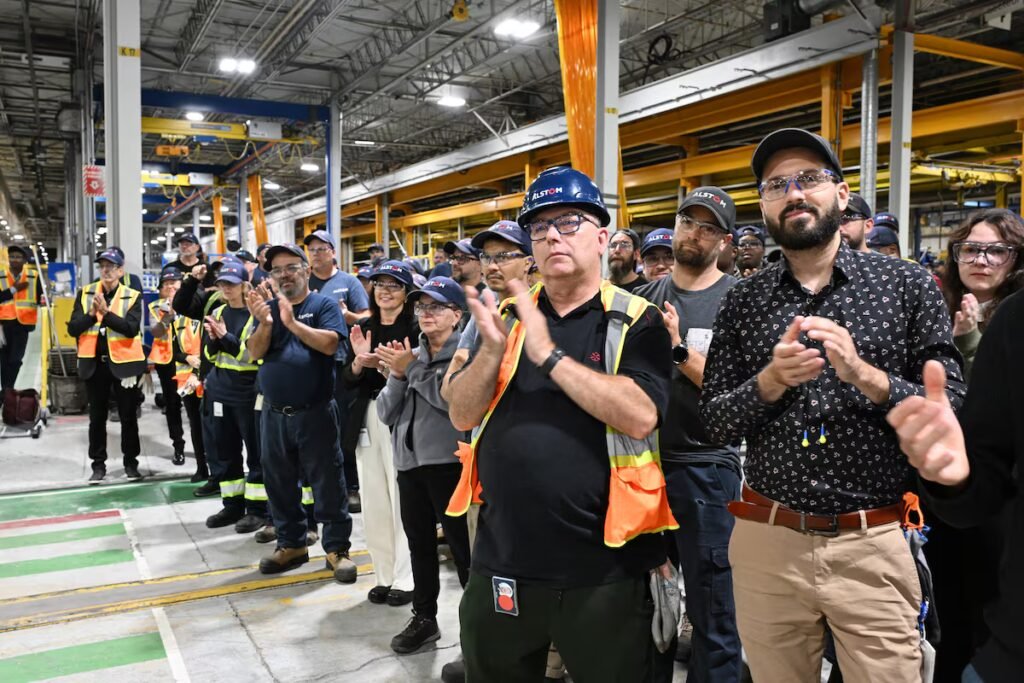
Alstom employees applaud as Prime Minister Mark Carney announces a plan to build wagons for Via Rail in La Pocatiere, Que., on Thursday.Jacques Boissinot/The Canadian Press
While the trade war continues to simmer, Prime Minister Mark Carney announced that the federal government will spend $4.7-billion to build and maintain more than 300 Via Rail passenger rail cars in Canada, using facilities in Thunder Bay, Ont., and Quebec. Carney said the move represents a shift away from importing trains from south of the border.
Carney said earlier this week that Canada is willing to return to the negotiating table once the American side changes its tone. “When the Americans stop doing memes, stop throwing shade, stop trying to be tough and start being serious about having those discussions, we can have those discussions,” he said.
Trade tensions between Canada and the United States could escalate next week as Ottawa plans to impose new countertariffs on Tuesday. Senior U.S. officials have said Canada should expect an additional response if the Sept. 8 countertariffs go ahead.
Major AI firms agree to Ottawa’s new data-centre framework as public opposition grows
An artist’s rendering of Meta’s planned AI data centre in Sturgeon County, Alta.Meta/Reuters
More than 20 artificial intelligence and digital infrastructure companies – including OpenAI, Anthropic PBC, Amazon Web Services and Meta – have signed on to a new federal framework for building data centres as local opposition to these facilities grows.
AI Minister Evan Solomon announced five broad principles for the development, which are not legally binding:
- Developers must minimize water use and other environmental effects;
- developers must be transparent about the impact on the local area;
- developers must not shift electricity costs on to Canadians;
- developers must create lasting local benefits;
- developers must bring “strategic value” to the country.
According to a Leger poll published in July, 42 per cent of the 1,505 Canadians surveyed oppose data centre development in their own province, while 44 per cent support it. Albertans were the most likely to strongly oppose development.
Bank of Canada keeps key interest rate at 2.25% as trade war risks slowing economic growth
The Bank of Canada held its benchmark interest rate steady at 2.25 per cent for the seventh consecutive time. But Governor Tiff Macklem struck a hawkish tone in the press conference after the rate announcement, suggesting multiple rate hikes are possible.
Mr. Macklem said the central bank is navigating two major risks: the global energy price shock caused by the war in the Middle East, and the escalation in the Canada-U.S. trade war. Of the two, he appeared more concerned that high oil prices could feed through into other consumer prices and become generalized inflation in Canada.
Financial markets are now placing the odds of a quarter-point interest rate hike in December at almost 90 per cent, according to Bloomberg data, with traders now pricing in three to four quarter-point hikes by the end of next year.
Carney’s summit to push Canadian resources, defence and tech to global investors
The Canada Investment Summit gives Ottawa and Canada’s companies a high-stakes chance to pitch the country as an attractive destination for investment capital.Darren Calabrese/The Canadian Press
Prime Minister Carney and top Canadian CEOs plan to showcase energy, critical minerals, defence and advanced technologies as sectors where Canada has untapped potential at a global investment summit in Toronto later this month.
The Canada Investment Summit, on Sept. 14 and 15, is drawing a group of about 250 heavyweight financial-sector executives who lead global companies that collectively oversee nearly $120-trillion in assets. The event gives Ottawa and Canada’s companies a brief, high-stakes chance to pitch the country as an increasingly attractive destination for investment capital.
The high-profile nature of the event has many on Bay Street keeping close tabs. Here’s everything we know so far about the summit, including the guest list, agenda and more.
In downtown Toronto, the office is back
Pedestrians walk in Toronto’s Financial District.Fred Lum/The Globe and Mail
Returning to the office? Downtown Toronto doesn’t look remotely the same. Many Bay Street towers have gone from a glut of empty space to near capacity. Now downtown Toronto’s towers are rapidly filling up, some to the brim. Restaurants in the financial district buzz with activity, and the underground network of tunnels connecting buildings bustles with commuters once again.
Return-to-office mandates from Canada’s largest financial institutions have contributed to much of the abrupt reversal, combined with a surprising burst of investment by companies in several sectors, including tech.
Jason Kirby, Rachelle Younglai and Vanmala Subramaniam crunched the numbers on the office revival, and what it means for Toronto’s workplace culture.
Prepare for the week ahead with The Globe’s investing calendar.


More Stories
Worried about index concentration? Don’t be
U.S. importer files lawsuit challenging Trump’s new tariffs on Canadian goods
Alberta migrant groups express alarm over referendum results on immigration reform