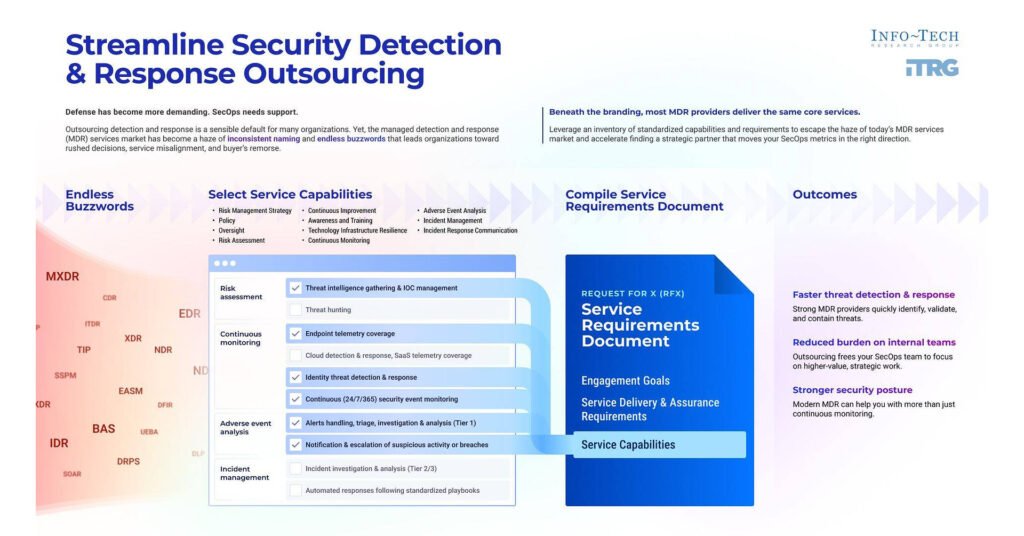
Growing threat volume, expanding attack surfaces, and limited security operations capacity are pushing more organizations toward managed detection and response (MDR) services. However, inconsistent terminology and vendor branding can make provider evaluation difficult, increasing the risk of service misalignment and buyer’s remorse. Info-Tech Research Group’s Streamline Security Detection & Response Outsourcing blueprint provides a four-phase approach to help security leaders define requirements, evaluate providers, and establish measurable outcomes before entering an MDR agreement.
ARLINGTON, Va., Aug. 27, 2026 /CNW/ — Security operations teams are under increasing pressure to keep pace with the volume and velocity of modern threats across growing attack surfaces. Continuous detection and response has become critical, yet many organizations lack the talent, operational maturity, or capacity required to provide effective coverage around the clock. New insights from Info-Tech Research Group indicate that outsourcing detection and response is therefore a sensible default for many organizations, but selecting the right provider introduces challenges of its own.
To help security leaders navigate the increasingly crowded market, the global research and advisory firm has published its Streamline Security Detection & Response Outsourcing blueprint. The resource provides a structured methodology to help organizations clarify service scope, establish measurable outcomes, define fit-for-purpose requirements, evaluate providers, and govern the relationship after implementation.
Info-Tech’s blueprint explains that providers often use different terminology for similar capabilities or package common services under branded offerings, making it difficult for security teams to determine which differences actually matter. The firm advises leaders to focus less on acronyms and marketing terminology and more on specific capabilities, organizational requirements, and the outcomes providers are expected to deliver.
“Don’t get lost in the noise and rush into a contract you’ll regret,” says
Seva Ioussoufovitch, senior research analyst at Info-Tech Research Group. “Take time to clarify the key outcomes and metrics you care about, inventory the capabilities you need, and craft fit-for-purpose requirements that will actually help you make an informed decision. Investing in disciplined procurement upfront will help avoid months of frustration down the road.”
Key Challenges Security Leaders Face When Procuring MDR Services
Despite the growing role of outsourced detection and response, the firm’s blueprint identifies several obstacles that can make provider selection unnecessarily difficult and increase the likelihood of poor service alignment:
- Inconsistent terminology and service definitions: Different providers use overlapping terms, acronyms, and branded descriptions for similar detection and response capabilities, complicating market research and comparison.
- Limited security team bandwidth: Security leaders and their teams often have little time available for detailed requirements gathering, market research, and thorough vendor evaluation.
- Growing vendor portfolios: Organizations already managing large numbers of technology and security providers may be reluctant to add another vendor, increasing the importance of evaluating opportunities for consolidation.
- Rushed procurement decisions: Insufficient requirements and evaluation can lead to service misalignment, operational gaps, and buyer’s remorse after an agreement has been signed.
Info-Tech’s Four-Phase Framework for Streamlining Security Detection & Response Outsourcing
To help security leaders move from market research through ongoing provider management, the Streamline Security Detection & Response Outsourcing blueprint outlines a four-phase methodology:
Phase 1: Prepare
Security leaders define the desired scope of the MDR engagement, document their internal environment, determine how detection and response responsibilities should be divided between the organization and provider, and identify the capabilities and provider characteristics required. Organizations can then use these inputs to begin developing an aligned vendor longlist.
Phase 2: Set Outcomes
Organizations identify their highest-priority engagement goals and select metrics that can be used to evaluate progress. Leaders then establish measurable KPIs and service level requirements (SLRs) that support provider evaluation, contracting, and ongoing accountability.
Phase 3: Procure
Security and procurement teams translate their priorities into detailed service requirements that allow vendors to be evaluated against consistent criteria. Organizations can then compare provider responses, conduct deeper discussions with shortlisted vendors, and maintain competitive leverage through the negotiation process.
Phase 4: Implement & Govern
Following vendor selection, organizations establish implementation plans, validate coverage and integrations, clarify roles and escalation procedures, and prepare internal teams to work effectively with the provider. Info-Tech also advises leaders to actively govern provider performance against agreed outcomes rather than treating recurring service reviews as passive status updates.
The Streamline Security Detection & Response Outsourcing blueprint emphasizes that MDR procurement can also provide an opportunity to rationalize existing security investments. Because modern providers may offer capabilities that overlap with tools and services already in an organization’s environment, security leaders can use the procurement process to identify unnecessary duplication and determine where vendor consolidation may improve both operational clarity and value.
By focusing procurement on standardized capabilities, clearly defined requirements, and measurable outcomes, Info-Tech’s approach helps security leaders move beyond vendor branding and evaluate providers based on their ability to meet organizational needs and remain accountable throughout the engagement.
For exclusive and timely commentary from Info-Tech’s experts, including Seva Ioussoufovitch, and access to the complete Streamline Security Detection & Response Outsourcing blueprint, please contact [email protected].
About Info-Tech Research Group
Info-Tech Research Group is the “get things done” partner for over 30,000 IT, HR, and marketing leaders worldwide. The fastest growing research and advisory firm, Info-Tech enables leaders to make well-informed decisions and transform their organizations through AI, strategic foresight, step-by-step methodologies, practical tools, industry-leading advisory, and training programs. For nearly 30 years, tens of thousands of private and public organizations have trusted Info-Tech to lead their most important initiatives through periods of change and deliver outcomes that truly matter.
To learn more about Info-Tech’s HR research and advisory services, visit McLean & Company, and for data-driven software buying insights and vendor evaluations, visit the firm’s SoftwareReviews platform.
Media professionals can register for unrestricted access to research across IT, HR, and software, and hundreds of industry analysts through the firm’s Media Insiders program. To gain access, contact [email protected].
For information about Info-Tech Research Group or to access the latest research, visit infotech.com and connect via LinkedIn and X.
SOURCE Info-Tech Research Group


More Stories
Xinhua Silk Road: Beijing financial forum to unveil outcomes on standards, platforms and open cooperation
Behind a water wall on NE First Avenue, Boca Raton gets its own private club
CCTV+: в китайской столице открылся Форум по оперативному реагированию на жалобы населения