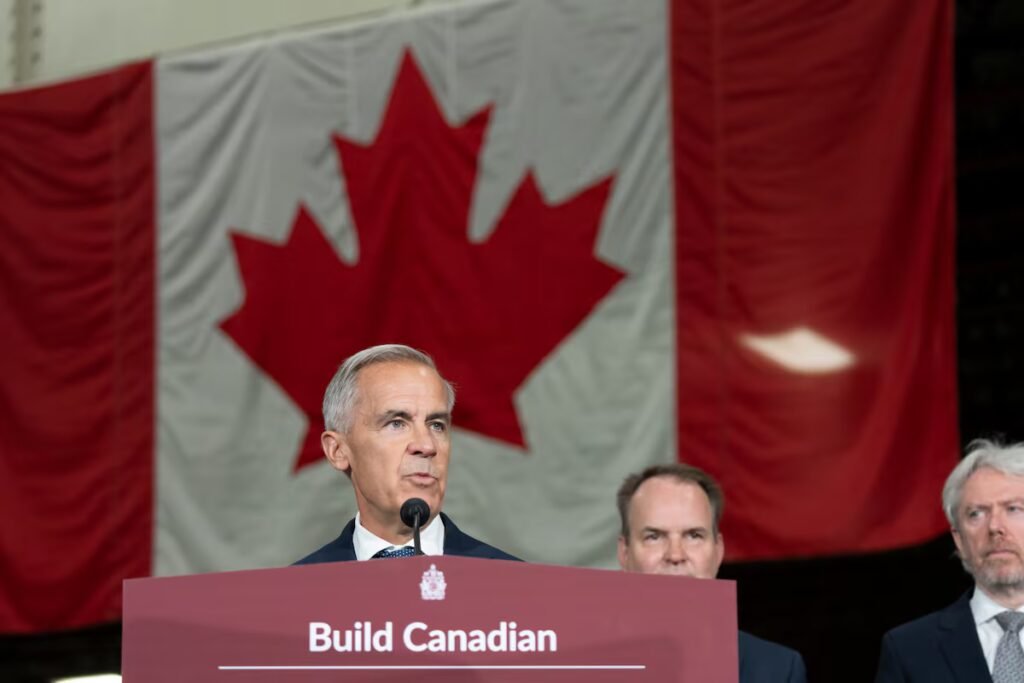

Prime Minister Mark Carney speaks at the Alstom Plant in Thunder Bay, Ont. on Thursday.David Jackson/The Canadian Press
In February, 2025, when he was the shoo-in candidate for the Liberal leadership, Mark Carney put forward his fiscal plan to “spend less and invest more.”
The future Prime Minister argued that Ottawa was spending too much while investing too little, and he was right. He analogized the situation to that of a company consumed by day-to-day expenses, but which needed to give itself room to grow the business by investing more in machinery and equipment.
Government had to stop paying for current spending by borrowing from the future, so that it would be able to borrow more to invest in the future.
Ottawa extends gas tax break ahead of countertariffs on U.S. goods
Team Carney’s first budget, released last fall, described itself as “our roadmap to spend less so we can invest more.”
But this week, the government announced a multi-billion-dollar spending initiative that does the opposite. Again.
It’s the wrong move. I say that knowing this conclusion will not be widely shared. Again.
Even Conservative Leader Pierre Poilievre, who would disagree with the government if it said the sky was blue, responded to the announcement by criticizing the Liberals for having stolen his idea, and for not having stolen even more of it.
“Conservatives,” he told Canadians, “have again won you savings.”
The policy in question involves a cut to the federal fuel excise tax on gasoline, aviation fuel and diesel. The Carney government brought in the tax reduction in April, lowering the levy by 10 cents on gasoline, up to 11 cents on aviation fuel and 4 cents on diesel. The temporary measure was supposed to expire on Sept. 7.
To no one’s surprise, this week the government extended it to Jan. 31, 2027. The cuts are thereafter supposed to be halved until the end of March, and then phased out.
Ottawa estimates that the full cost of the measure, from last April to next March, will be $5.3-billion. Every cent is borrowed money. Every cent goes straight to the deficit and debt.
Is this borrowing to invest? No, it’s borrowing to spend. It’s lowering the cost of filling your tank by topping up the national debt.
Nor is this a type of tax reform, with a tax cut here financed by tax increases or spending cuts elsewhere. Ottawa is simply backfilling by borrowing.
It’s also like a carbon tax in reverse: the more you drive, the more you save. Don’t own a car? Riding public transit? You’ll get nothing other than your share of future federal debt servicing costs. But if you’ve got two gas guzzlers in the driveway, savings await.
New Democratic Party Leader Avi Lewis criticized the measure, but only by fibbing about what it is and who benefits. He called the tax cut “another costly handout of public money to oil and gas companies.”
Gas prices drove inflation up to 3% in July as food cost pressures eased
No, it’s a handout to drivers. Drivers who vote. What politician would dare criticize that?
In 2022, Ontario Premier Doug Ford introduced a similar “temporary” gas tax cut. It was repeatedly extended, in multi-month increments, before being made permanent last year. It will cost the province $1.25-billion in lost revenue this year, and slightly more next year and each subsequent year. It’s all paid for with borrowed money and a larger deficit, and voters are apparently just fine with that.
Canada’s fiscal house won’t be broken by Ottawa borrowing $5.3-billion this year to lower the cost of gas. But to put things in perspective, that figure is more than last year’s entire budget for the Correctional Service of Canada, the Department of Agriculture or the Department of Natural Resources.
It’s only slightly less than the $7.7-billion the spring fiscal update said the government would invest – in total, over five years – in its defence industrial strategy, which aims “to build Canada’s defence manufacturing and technology base.”
It’s on par with the $5.7-billion budgeted over five years for investment in “trade diversification and infrastructure strategies.” It’s more than the $5-billion Ottawa plans to invest in a critical minerals strategy.
As the late U.S. Senator Everett Dirksen is reputed to have put it, “a billion here and a billion there, and pretty soon you’re talking real money.”
And if you spend a billion here and a billion there, no matter how popular it may be, you won’t have that billion to invest here or there.
This is particularly relevant at a moment when government bond yields – borrowing costs – have been shooting up around the world, in part on worries about large public debts.
I’m not telling the Carney government anything it doesn’t know. Just something it, along with the opposition and voters, sometimes finds inconvenient to remember.


More Stories
Worried about index concentration? Don’t be
U.S. importer files lawsuit challenging Trump’s new tariffs on Canadian goods
Alberta migrant groups express alarm over referendum results on immigration reform