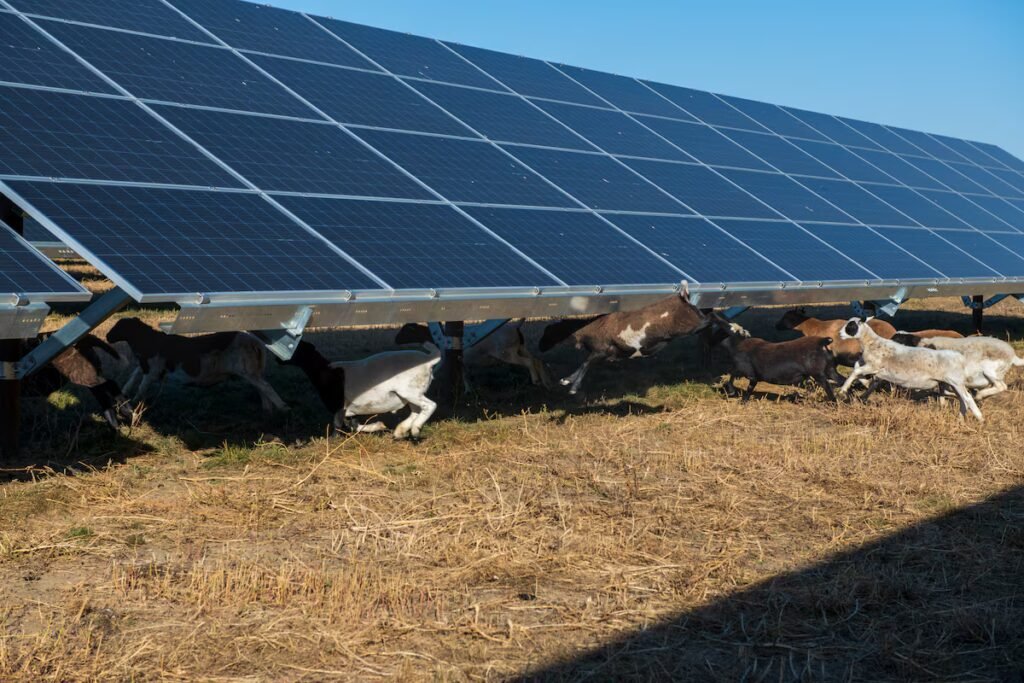

Sheep run under solar panels at the Enbridge Alberta Solar One project near Burdett, Alberta.Guillaume Nolet/The Globe and Mail
Alberta will begin charging a recycling fee on all new solar panels next month, in a move that industry players say adds another burden on top of a swath of onerous new rules and regulations recently introduced by the government.
RJ Sigurdson, Minister of Affordability and Utilities, said Thursday that the $14-a-panel charge would help keep solar panels out of landfills when they reach the end of their lives decades from now. “Responsible growth means planning ahead and making sure we get it right at every stage,” he told media.
The money won’t go to government coffers, he said. Instead, it will be used to fund the development of North America’s first solar-panel recycling program.
Alberta-Ottawa MOU talks should address renewables roadblocks, think tank says
Alberta has the second-largest installed solar capacity in Canada, after Ontario. Renewable energy was once a thriving billion-dollar sector in Alberta, but project deals have almost completely collapsed since the province overhauled rules governing the industry, plummeting 99 per cent between 2023 and 2025.
The new rules include a 35-kilometre buffer zone for wind projects to preserve so-called “pristine” viewscapes, limits on the ability of the industry to build projects on irrigatable lands, and a new system requiring secure funds for the eventual cleanup of turbines and solar panels.
Tyler Marriott, the co-founder of Calgary-based solar panel installation company Level Up Solar, said the recycling charge beginning Oct. 1 will increase project costs and add another layer of administrative burden to his operations.
While he acknowledged that $14 “isn’t the end of the world” and is unlikely to make or break a deal for someone interested in installing solar panels, he observed that the charge seems to reflect the government’s lack of support for any part of the energy sector that isn’t oil and gas.
“It just seems like they’ve got an axe to grind with the industry,” he said.
“This is energy as well. We could work together instead of feeling like we’re enemies.”
Environment Minister Grant Hunter said that if the recycling program ends up being cheaper than anticipated, the government would pass the savings to consumers by lowering the per-panel fee.
But as it stands, the $14 charge will add roughly $1-million in costs to the average renewable project, according to analysis from Business Renewables Centre-Canada, which helps businesses and institutions access renewable energy.
The Indigenous-led solar farm redefining Alberta’s energy landscape
Although other governments around the world are beginning to establish end-of-life recycling programs for clean-energy infrastructure, Alberta’s proposed fee is between 139 per cent and 3,500 per cent higher that what other jurisdictions are charging, the organization said.
Jorden Dye, director of BRC-Canada, said in a statement that the recycling fee does little but “saddle the industry with another disproportionate burden,” adding costs and red tape to a sector that has helped diversify Alberta’s economy and lower electricity prices.
“While BRC supports the introduction of a recycling fee, we cannot support a punitive tax far exceeding any other jurisdiction,” Mr. Dye said.
The new fee is being instituted decades before the vast majority of Alberta’s solar panels would come close to landfills, with the bulk of utility-scale and rooftop solar capacity expected to last into the 2040s.
That has Mr. Dye questioning the urgency of implementing a fee. Nor has the Alberta Recycling Management Authority, which will oversee the program, published a breakdown to explain how the $14 figure was calculated, he added.
Independent research commissioned by the Canadian Renewable Energy Association pegged the cost of recycling a solar module at roughly $5, once cost escalation over 20 years and the potential for panel reuse are factored in.
That makes Alberta’s fee nearly three times higher than what the economics support, “and it ignores the reuse pathways that would shrink the recycling burden even further,” Radha Rajagopalan, the association’s director of policy for Alberta, wrote in a recent analysis.
Mr. Hunter, speaking at the news conference, countered that implementing the fee is “the right thing to do” to ensure solar panels don’t end up in landfills.
“Albertans who are looking for a green solution when it comes to electricity – that’s why they put the solar panels on, because they believe that is the right approach – they’re also looking for a green solution when it comes to end of life for solar panels,” he said.


More Stories
Green investment guidebook authors hold off on adding carbon capture for oil, gas after pushback
Six charts that show how B.C.’s fiscal outlook has gotten worse
Strategic maple syrup reserve close to empty, producers say