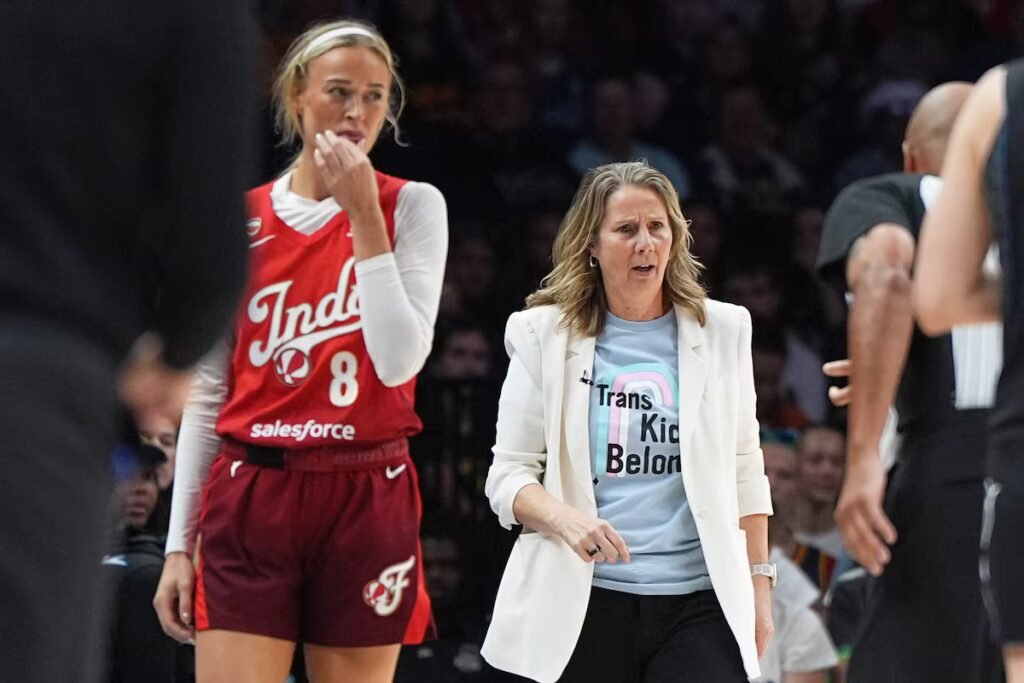

Indiana Fever guard Sophie Cunningham (left) and Minnesota Lynx head coach Cheryl Reeve shared a court and words earlier this month after Cunningham shared her opinion on transgender participation in women’s sport.Abbie Parr/The Associated Press
By all measures, the 30th season of the WNBA has been an unprecedented success. In March, the players’ association won a hard-fought battle for a historic collective agreement, which boosted the average player’s salary north of a half-million U.S. dollars, and improved provisions for housing, parental leave, training and facilities.
Two months later, two expansion teams – the Toronto Tempo and the Portland Fire – each launched their inaugural season to sell-out crowds.
Revenue for the league surpassed an estimated US$200-million last year. Viewership for the league is skyrocketing and venues are packed: The Tempo made WNBA history in July, setting a regular season attendance record when 20,996 fans sold out the Bell Centre in Montreal to watch them play the Dallas Wings.
This year’s WNBA All-Star Game drew 19,783 fans, beating the 15,973 attendance of the NBA All-Star Game. Earlier this month, more than 2.5 million American viewers tuned in to ABC for a game between the Indiana Fever and the Minnesota Lynx. The T-shirt slogan “everyone watches women’s sports” is no longer a rallying cry. It’s simply reality.
As a Tempo season ticket holder, I’ve been at almost every home game and the vibe is magical – it’s the most diverse, happy and enthusiastic crowd I’ve witnessed at a professional sports event. When star guard Brittney Sykes returned to the court earlier this week after an eight-week hiatus owing to a foot injury, the cheers were so loud, she said she got “chills,” adding, “I said from the beginning, like yes, the W fans, in the States, they give love, but … like Toronto and Canada itself, the love that they give is just ridiculous.”
And the games this season have been electric. In June, Toronto’s Marina Mabrey tied the WNBA single-game scoring record with a scorching 53 points. This month, Minnesota’s Kayla McBride set a WNBA single-game record with 10 three-pointers. Her effortlessly cool young teammate Olivia Miles made her professional debut this season breaking several rookie records, becoming the fastest to reach 400 points, 100 rebounds and 100 assists in just 22 games. Ten games later she surpassed Caitlin Clark as the fastest to 650 points and 200 assists.
Yet, if you listen to some noisy, angry, conservative activists and commentators, you might think this thriving, thrilling, joyful league – and, really, women’s sports in general – is in grave danger. The supposed threat? Trans women.
The latest tempest began with comments made by Sophie Cunningham, a bench player for the Fever, who has come into prominence for styling herself as the protector of Clark, her more talented teammate, and, most recently, for a statement she made in an ESPN feature in July, speaking out against trans women in sports.
“I want to protect young girls in a locker room, or young girls in a sport who shouldn’t have to go against biological men,” she said.
In the wake of the ESPN story where Cunningham shared her thoughts on transgender participation in sports, rallies for and against Cunningham, like this one in Minneapolis, have followed the Indiana Fever everywhere they’ve played.Abbie Parr/The Associated Press
Despite the absurd suggestion that young girls would ever, in any situation, compete against grown men, Cunningham’s comments have set off a panic, with people demanding that the WNBA address the issue.
It’s set off a campaign of misinformation about transgender people, trolling by sad-sack former NBA players who have announced they want to be eligible for the WNBA draft, and anti-trans protestors showing up at games.
Cunningham made the comments at a time when trans people in the U.S. are under intensive attack, with hundreds of bills being introduced and passed to prevent them from receiving basic civil rights such as health care, housing, education, legal recognition and protection from discrimination.
Sports in particular have been a target, with anti-trans advocates saying that they are sticking up for girls and women, and suggesting that trans girls and women would either pose a physical threat or else have an unfair advantage.
According to the site Trans Legislation Tracker, in 2026 alone, there have been 103 bills in the U.S. aiming to restrict transgender participation in elementary, high school and postsecondary sports. The site says that more than “one third of U.S. states have already passed laws banning transgender students from participating in sports consistent with their gender identity.”
This is a landslide of legislation for what amounts to a non-issue. Trans people make up about 1 per cent of the population in the U.S. and just a tiny number of them play sports. As of 2023, in K to 12, only 12 per cent of transgender girls participate in sports, and in several states trying to ban their participation, less than five trans girls in total want to play sports at any level.
U.S. Supreme Court allows states to ban transgender girls and women from school athletic teams
In 2024, during a U.S. Senate committee appearance, NCAA president Charlie Baker said that of the 510,000 total college student athletes, fewer than 10 were known to be transgender. Yet, the following year, the NCAA announced that student athletes assigned male at birth may not compete for an NCAA women’s team. (Student athletes of any sex or gender may participate on NCAA men’s teams.)
As for the WNBA, there has not been a single trans woman player in its 30-year history. The league’s only trans player was Layshia Clarendon, who retired after the 2024 season. Clarendon came out as non-cisgender in a 2015 essay in The Player’s Tribune. In a 2025 interview with Jemele Hill, Clarendon recalled that other players in the league were overwhelmingly supportive.
Individual players such as Golden State’s Gabby Williams have voiced support for trans players in light of Cunningham’s comments – “I would welcome a trans athlete on my team or against my team,” she said. Her coach, Natalie Nakase, has also chimed in. “For me, sports is about belonging, It’s about inclusivity. It’s about allowing everyone to be their authentic self,” she said when asked about Cunningham’s comments. Minnesota coach Cheryl Reeve has been equally outspoken, pointedly wearing a T-shirt that read “Trans kids belong” at a game against Indiana.
Layshia Clarendon (left) of the Los Angeles Sparks, seen here playing in 2023, is the WNBA’s first openly transgender, nonbinary player. They retired in 2024. In its 30-year existence there has never been a transgender woman in the WNBA.Steph Chambers/Getty Images
The WNBA players association released a statement earlier this month that read, “The WNBPA represents 200+ individual people with different lived experiences, cultures, lifestyles, and opinions. We embrace justice, equity, diversity, and inclusion. Hate, abuse, and demonization of any person or group of people, including transgender people, only fuel fear, division, and harm. We will continue to have hard conversations. But we will not be used as political pawns.”
The players are right in their understanding that they and their league are being used to further an outside agenda – and it’s not just because the minuscule numbers of trans athletes don’t bear out the alleged threat. It’s also the science, which has not found that trans women have a physical advantage that is meaningfully different than any other physical variabilities between individuals – such as height, age and ability to recover from injury, as well as material differences such as access to training and development opportunities.
Cathal Kelly: Everyone but the WNBA has an opinion on what the league should say about transgender participation
A recent meta-analysis report published in the British Journal of Sports Medicine looked at 52 previous studies comparing the physical performance of trans athletes with their cisgender peers. Researchers concluded that while transgender women exhibited higher lean mass than cisgender women, their physical fitness was otherwise comparable.
Some sports bodies had previously found other alternatives to banning trans women owing to any possible physical advantage by having them maintain a regime of hormone therapy for a set time and at a set level before competing. In 2015, for instance, the International Olympic Committee allowed transgender women to compete in female events if their testosterone levels remained below 10 nanomoles per litre for at least 12 months prior to competition.
The IOC has since announced, however, that transgender women will be banned from competing in female events at the Los Angeles Olympics in 2028. As well, all women who want to compete must undergo a genetic test to confirm their biological sex in order to be eligible. The Women’s Tennis Association has likewise mandated that all professional players have a genetic sex test to be eligible to tour and compete. In both cases, it’s only women who must undergo testing – not men.
What’s become clear in all this is that the attacks on trans women athletes are not about protecting cisgender women, at all. They actually take attention away from the real threats to women’s sports: pay inequity, unequal media attention, lack of equal representation of women in management roles in pro sports, predatory and abusive male coaches, social-media hate threats directed at women athletes, or limited access to training and development opportunities.
Instead, the panic over the possibility that a handful of trans girls and women may play sports is meant to undermine all women athletes and all women’s sports. The underlying assumption in “protecting women” is the belief that if someone excels at athletics, they can’t possibly be a woman. And this notion is both demeaning, as well as putting all girls and women in sports at risk for scrutiny about their sex and gender.
Consider an upcoming ballot initiative in Washington State seeking to bar transgender kids from participating on girls’ sports teams specifically. The measure would mandate that all girls playing in elementary and high school sports have a health care provider certify their sex assigned at birth either through genetic screening, testosterone level tests or a physical exam of their reproductive anatomy.
Is this protecting women? Imposing sex testing on them, but not their male peers? Subjecting little girls to genital exams if they want to play soccer?
Not only is this kind of invasive scrutiny of girls’ bodies creepy and discriminatory, it will discourage many of them from playing sports. In fact, rather than making sports less welcoming, research in the U.S. has found that states that include transgender participation in youth sports have more overall participation by all girls than in states with bans.
It’s not surprising that the WNBA has been the site of this latest round of faux concern about trans issues. The league has always been scrappy, grassroots and political. It’s one of the most proudly diverse sports leagues, with about 70 per cent of players identifying as Black and about 30 per cent identifying as gay or queer. And the WNBPA was the first labour union for professional women athletes. From the beginning, the players were vocal about equal pay and social justice.
WNBA says fans should have been free to wear shirts with messaging about transgender issue
Even now, with much more spotlight and attention – and much more expensive designer tunnel fits – the league has stayed close to its roots. And its ever-growing popularity – the packed venues, the hot selling merch, the wild media attention, the continuing expansion of the size of the league and the number of regular season games – is not in spite of its diversity, inclusivity and authenticity but because of it.
Courtney Williams (left) of the Minnesota Lynx & Natisha Hiedeman (right) of the Seattle Storm have found tremendous success and corporate acceptance as the StudBudz, a livestreaming duo with 118,000 followers on Twitch, and 162,000 followers on Instagram.Geoff Stellfox/Getty Images
Take the recent all-star weekend in Chicago. It was a chaotic, joyful bacchanal with a live stream by the StudBudz – former Minnesota teammates Courtney Williams and Natisha Hiedeman – that generated 41.3 million minutes watched. And the charisma of the StudBudz as out, queer, masculine Black women has been a major draw for fans and advertisers, and has become a model of player-created content. As Forbes recently reported: “Their partnerships with brands such as AT&T, Starbucks, Airbnb, Coach, Cash App and Sprite demonstrate the breadth of their appeal.”
What the WNBA represents is that every kind of woman is welcome, that all expressions of gender are valid. These are competitive, confident women who remade the rules of the game and built a league of their own on their own terms. And for those who don’t want women to have agency over their bodies, their careers, their money and their destiny, that is very threatening.
And that’s what the furor over trans women athletes is really about. It’s not that women’s sports has anything to fear – it’s that a lot of people are afraid of women’s sports.


More Stories
Mercedes’ Antonelli earns surprise pole for the U.S. Grand Prix as he chases record-breaking F1 title
Golden State Valkyries beat the Atlanta Dream 67-62 to even the WNBA Finals at 2-2
CF Montreal eliminated from playoff contention with 2-0 loss to MLS-best Nashville SC