
Synchronizing your upper arm movements with your shoulder blades (scapulae) is essential for proper shoulder mechanics, whether you’re throwing a ball or dropping down for a push-up. To safely generate maximum force, you’ve got to build active control over the entire shoulder girdle. Combining isometric holds with dynamic mobility builds serious shoulder strength, restores high-quality range of motion and improves postural alignment throughout your upper back and neck.
Push-up challenge, week 3: Core and posture
Test it:
Low push-up isometric hold
The lowest point of the push-up is where technique tends to fall apart. This test isolates that exact breakdown point, revealing weak and unstable spots in the shoulders, upper back and core. If you can’t lower to this bottom position from a full push-up, use your knees or place your hands on a bench.
How to do it: From a high plank – hands slightly wider than your shoulders, feet hip-width apart – lower to the floor with pristine form: hands gripping, arms pulling inward, shoulder blades down, hips tucked and glutes squeezed. Gently touch your chest to the mat, then lift it an inch or two. Your body should hover in a long, rigid line, held up purely by upper-body and core tension. Hold for 10 seconds initially, building up to 30–45 seconds.
Key take-aways: Keep your upper arms aligned with your ribcage, parallel to the floor, with your elbows pointing back. “Screw” your hands into the floor as your arms pull toward your torso. If your shoulders shrug to your ears, your elbows flare past 45 degrees or your belly sags, you’ve lost your structural anchor and the test is over.
Train it:
The Hitchhiker
“Scapulohumeral rhythm” is a fancy term for the coordinated movement of your shoulder blades and upper arm. This mobility exercise restores proper shoulder mechanics and body awareness by guiding the shoulder blades down the rib cage through a full range of motion.
How to do it: Lie face down with one arm extended overhead, thumb up, and the other arm acting as a pillow for your forehead. Lock your body into a tight plank – toes down, knees up, hips tucked, ribs down. Pull your elbow toward your hip using your shoulder blade and upper arm. Next, pass your hand under your armpit so it is reaching straight back, then bend your elbow to place the back of your hand on your lower back. Drop your elbow to the floor using your shoulder blade, then lift it high, reverse the sequence, and return to the start. Do 5–10 reps per side.
Key take-aways: Use this as a warm-up or active rest. The closer your upper arm stays to your torso, the harder the movement becomes – give yourself some space at first, keep it slow and fluid.
Bent-arm A-frame
This isometric hold activates your lats – the push-up’s mechanical brakes. It teaches you to internally rotate through the shoulders, creating a rock-solid frame to push from while building strength in your arms, hands and wrists.
How to do it: Get into an A-frame/downward dog position, with your hands in front of your shoulders, your back flat and your hips as high in the air. If tight hamstrings are holding you back, lift your heels and/or unlock your knees. Slightly bend your arms and pull your elbows toward your midline, as if squeezing a beach ball under your chest. To increase the challenge, bend your elbows deeper or shift your weight forward to bring your shoulders closer to your hands. Hold for 20–45 seconds for two to three sets.
Key take-aways: Don’t let your elbows flare! Keep them aligned with your shoulders and wrists for maximum stability. And remember: high hips, flat back. The goal isn’t to lower your head all the way to the floor like a press; it’s to hold the position and resist gravity.
Crab setup
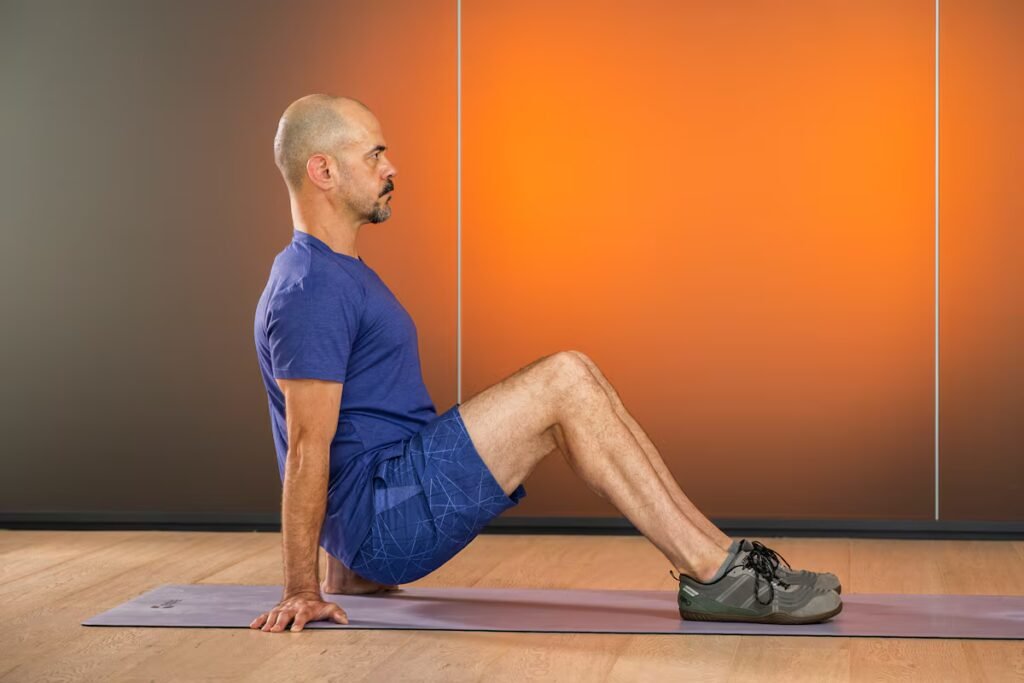
The crab walk is an old-school gym class exercise, but we’re focusing on one part of the movement – the initial setup. This position develops downward pushing strength and lights up the lower and mid-traps to reinforce an anti-shrug posture. It also strengthens the hands and wrists while building the compressive core strength required to keep your torso aligned while performing push-ups.
How to do it: Sit on the floor with your knees bent and feet flat. Place your hands on the floor behind your hips, fingers pointing away from your body. Press your palms and heels down to lift your hips a few inches off the floor. Pull your shoulders back, open your chest and aggressively drive your hands into the floor to keep your torso long and tall. Placing your hands on yoga blocks can make the lift-off much easier. To increase the challenge, pull your hips back between your hands. Perform two to three sets, holding for 20-45 seconds.
Key take-aways: Don’t let your ribcage lift or your shoulders collapse. Keep your crown and collarbones high as your shoulder blades draw down your back, pushing deep into the floor.


More Stories
Game on! Explore western Newfoundland through its moose tacos, caribou loin and pulled-bear sandwiches
These at-home treatments tighten, smooth and plump your skin
Why Champagne is fighting to protect its name around the world