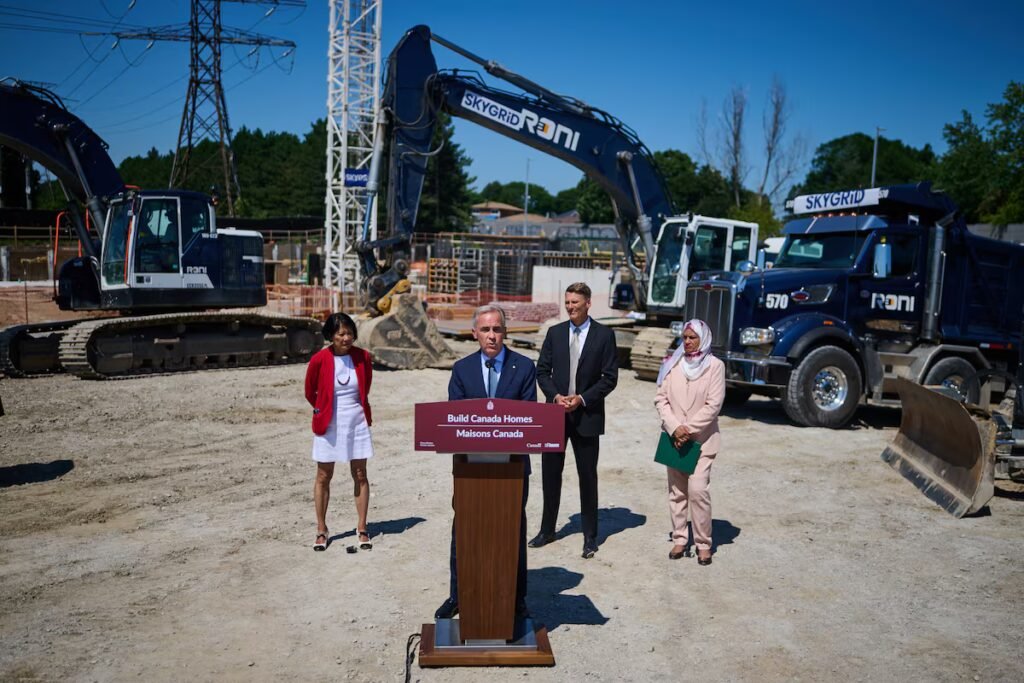

Mayor Olivia Chow, left, Prime Minister Mark Carney, centre, and housing minister Gregor Robertson speak at a housing announcement in Toronto, on Aug. 5.Sammy Kogan/The Canadian Press
When Prime Minister Mark Carney and Mayor Olivia Chow turned up at a construction site earlier this month, they came lugging a truckload of big numbers to unload on the city’s perennially fraught housing market.
The feds will provide $2.7-billion in low-interest loans and grants to build 5,600 new rental homes – both market and subsidized – across 18 projects, all on land owned by the city. Toronto will ante up a further $530-million in capital, plus a century’s worth of property tax abatements. And 80 per cent of the new units will be under construction by year end, according to Mr. Carney.
In a statement, the leaders described the deal as “a new partnership.” But it is really? The answer is both yes and no.
Unlike many previous announcements, this one will provide a substantial number of non-market apartments – 1,818, or 32 per cent – with affordable rents in rent-controlled units, as well as some deeply supportive housing projects with integrated services from community agencies. Three of the projects, to be funded by Build Canada Homes, a new agency hived off from Canada Mortgage and Housing Corp., will use mass timber and panelized or modular construction.
“This announcement absolutely moves in the right direction because it does exactly what anyone interested in housing has been asking for,” says Dani Saad, WoodGreen Community Services’ vice-president of policy and development, and a housing policy adviser to former prime minister Justin Trudeau. “It brings together land, finance and capital to get shovel-ready projects approved and delivered.”
Carney pledges $2.7-billion for Toronto rental homes
Yet all but one of the sites have been in the planning pipeline for years, just waiting for the funding. Five are already under construction, according to data provided by the city. Several of the other sites were leftovers from former mayor John Tory’s 2018 Housing Now program – vacant municipal land that had been rezoned but remained fallow. “Realistically, we need $5- to 6-billion a year to actually accelerate these kinds of projects,” says affordable housing advocate Mark Richardson, technical lead for the watchdog group HousingNowTO.
The one genuinely new project is called C1 Bayside, a Waterfront Toronto parcel. Hines, a large U.S. builder, had tentatively slated it for office space on Queen’s Quay East, but let its rights to the site lapse earlier this year. A spokesperson said in an e-mail that the city “anticipates undertaking a process to bring on a development partner in 2027.”
What’s more, the Ontario government was conspicuous by its absence. Provincial health, justice and social service ministries incur the high cost of homelessness. Social housing providers say that for such programs to deliver on its promise, Queen’s Park needs to tee up funding to underwrite supportive housing geared at homeless individuals as well as deeply affordable units suitable for low-income households living with the risk of eviction.
“Frankly, all orders of government need to be part of that solution, including the province,” says Keith Hambly, CEO of Fred Victor, which last year established a partnership with University Health Network to run an innovative 51-unit supportive housing complex in Parkdale for homeless people who are routine visitors to emergency rooms. “A housing solution absolutely needs the province to come to the table. If they’re not there, there’s not a lot of opportunity to actually make housing happen on the scale it needs to happen to address not just issues of affordable housing but issues of supportive housing here in Toronto.”
Hospitals getting into the housing business
Other insiders note that while the new subsidized units are welcome and needed, they’re still playing second fiddle to federal programs aimed at boosting private sector development, in this case market rentals. Private firms are developing eight sites, including the Kilmer Group and Tricon, Osmington Gerofsky and Dream Impact Trust. Osmington Gerofsky is co-owned by Osmington Inc., a private commercial real estate and investment company controlled by David Thomson. The Thomson family holding company, Woodbridge Co. Ltd., owns The Globe and Mail. Build Canada Homes CEO Ana Bailao, a former deputy mayor, previously ran Dream’s affordable housing team.
“There’s $1.8-billion [in federal funding] for the private sector and $310-million for the non-profit sector,” says Andrea Adams, executive director of St. Clare’s, a non-profit that runs nine buildings with 960 units, and has signed on to operate one of the projects in this latest announcement, People’s Place, a co-op being developed by the Parkdale Land Trust. “That kind of tells a story right there.”
She adds that the funding for non-profits tends to be razor thin, with nothing left over to reinvest in new projects. “The breakdown is $164,000 per unit for the non-profit sector and $500,000 per unit for the private sector. That also doesn’t make sense.”
University of Toronto housing scholar Carolyn Whitzman observes that this latest announcement, and previous deals unveiled by the Carney government, feel like expedient one-offs, and lack any kind of overarching policy framework, given that the $115-billion National Housing Strategy, the Trudeau government’s marquis program, will expire in 2028.
“I think this is akin to that level of ambition, but it will be a test of endurance,” says Mr. Saad. “We need 50 more of these announcements. Every indication is suggesting that we’ll get there. But we as a country, you know, the affordable housing crisis is a nation building project, and I think the prime minister sees it that way. I think it fits into his nation-building frame.
Mr. Hambly, for his part, is hoping for something more definitive. “A [new] national housing strategy in my opinion is needed. It provides some assurance of a framework which we in the non-profit housing world can [use to] guide our decision-making in the future.”


More Stories
Canada, UAE sign trade deal as Carney pushes to expand investment ties
The branch-plant economy is breaking in Canada. Now what?
Adviser ISS recommends vote against takeover of H&R Real Estate Investment Trust