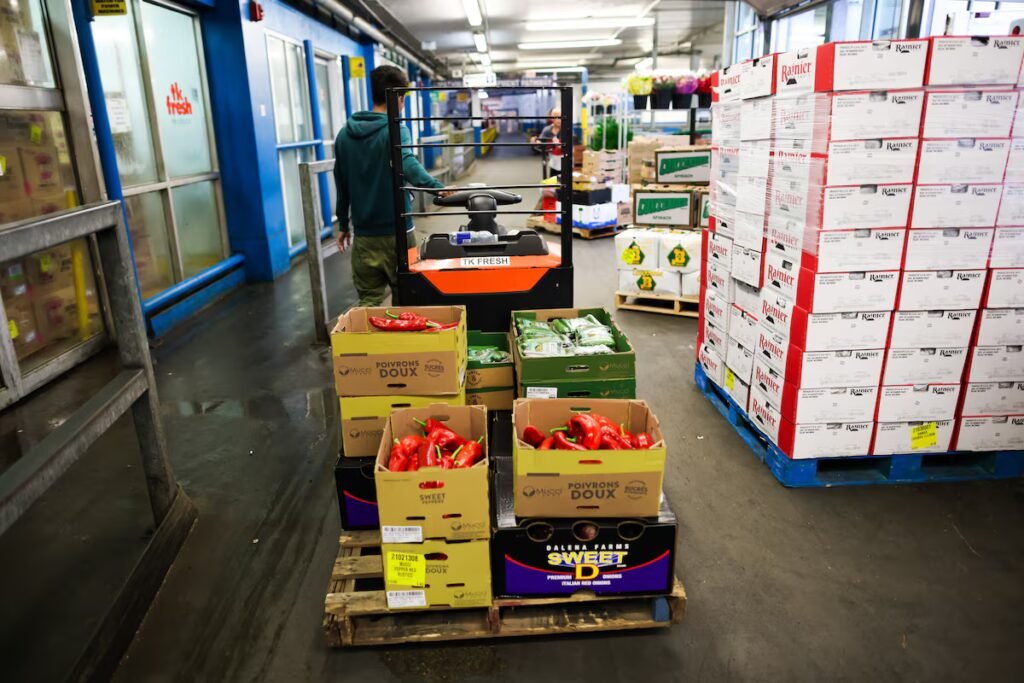

A worker loads a truck at the Ontario Food Terminal in Toronto, in June, 2025. BC Food & Beverage is readying a proposal for a massive food terminal with an estimated cost of $700-million. Meanwhile, Manitoba is looking to build its own terminal with a price tag between $150-million and $200-million.Cole Burston/The Globe and Mail
Food industry associations in British Columbia and Manitoba are seeking $1-billion from government and private business to build regional food terminals as trade tensions with the U.S. continue to expose the risks of relying on north-south trade.
BC Food & Beverage, which represents provincial food processors and manufacturers, is readying a proposal for a massive facility with an estimated cost of $700-million.
The proposed space would be the first in the province and loosely modelled on the Ontario Food Terminal, the only one of its kind to distribute two billion pounds of food each year across Canada. The western anchor would be part of a network of terminals that move food along interprovincial routes already running from the port to Alberta, the Prairies and Northern Canada.
Manitoba’s industry association is looking to build its own terminal with a price tag between $150-million and $200-million.
“What Donald Trump has done is, he’s made us realize, ‘Wow, we’re vulnerable – we have a lot of eggs in one basket,’” said Michael Mikulak, executive director of Food & Beverage Manitoba.
Here’s how Canada’s countertariffs could hit your wallet
Food terminals, which function as independent wholesale food marketplaces, offer a more efficient way for Canadian supply to meet Canadian demand, he said.
By concentrating multiple producers at one facility, these operations can cut the cost of shipping product orders to stores.
Both the B.C. and Manitoba proposals are largely in response to Ottawa’s National Food Security Strategy, launched in June. It pledged $3-billion over 10 years to expand domestic processing and production, make supply chains more efficient and improve grocery competition. The strategy was developed amid rising food costs and trade tensions with the U.S. that threaten decades-old supply routes.
“The food industry is more than just feeding Canadians – it’s an economic engine with still so much room to grow,” said James Donaldson, chief executive officer at BC Food & Beverage. “To see that level of commitment was really exciting.”
Opinion: Canada’s new Food Security Strategy won’t end food insecurity
The B.C. concept, which has been dubbed “the Pacific Gateway,” is even more ambitious than its Ontario counterpart. With the Port of Vancouver and Vancouver International Airport already moving mass quantities of food to and from Asian markets, the B.C. terminal has an opportunity to become a “regional trade hub,” according to Mr. Donaldson.
In an e-mail, Ron Lemaire, president of the Canadian Produce Marketing Association, said what’s particularly interesting about the B.C. proposal is that “it thinks about food distribution as national infrastructure.” It positions British Columbia as a “western anchor” that serves communities across Western Canada while also leveraging international trade, he said.
Though success will depend on industry buy-in, advocates of the projects say they’re not simply about creating more efficiencies for industry players, but about building out better food distribution to improve Canada’s food security.
Today, they argue, countless inefficiencies make it hard for retailers, producers and processors to build up domestic supply chains.
“We keep hearing about a truckload, container load, going out half full,” Mr. Donaldson said. “You’re bearing the whole cost of that truck on half the product.”
Competition bureau launches study to examine how food supply chain affects grocery prices
Currently, separate groups are responsible for securing produce, optimizing freight and repacking items that arrive damaged. “Having a centralized facility where all of those things can be consolidated is what we saw as an opportunity,” he said.
Mr. Donaldson’s team is looking for funding through the National Food Security Strategy’s Food Link Fund, which pledged $1-billion to expand food terminals and start construction on two new ones by the end of 2028, along with provincial and private sources. They’ve already rallied commitment from provincial leaders.
B.C. Agriculture and Food Minister Lana Popham said in a statement that her ministry is “excited” by the proposal’s potential to “unlock new, long-term food security and supply-chain resistance.”
“This means more potential for fresher and more affordable food for British Columbians, and more jobs and economic growth for the agriculture and food sectors,” she said.
Private investment, Mr. Donaldson said, could come from suppliers, distributors and companies that want to become anchor tenants. So far, he said, the response has been “green lights across the board.”
Food & Beverage Manitoba, for its part, wants to offer full-blown food-processing capacity – such as washing and bagging potatoes – on top of aggregating and distributing food from an estimated 120,000-square-foot Winnipeg facility.
“Canada is really good at shipping out commodities,” Mr. Mikulak said. “But why are we shipping out wheat when we could be shipping out pasta, bread, crackers?”
Beyond helping to shore up domestic supply chains, food terminals help boost competition in the grocery sector by improving access for more players, said Gary Sands, senior vice-president with the Canadian Federation of Independent Grocers.
Editorial: A missing link in the Liberals’ food chain plan
Some of the country’s largest grocers, including Loblaw Cos. Ltd. L-T and Empire Co. Ltd., EMP-A-T also own distributors that their smaller competitors rely on for many of their goods. “If you’re buying goods directly, and not through a wholesaler in Ontario for produce, you’re getting more choice, and you’re containing your costs more,” Mr. Sands said, calling that an advantage for independents.
Proponents also hope that food terminals can provide a buffer against rising grocery costs, as food-price spikes have outpaced general inflation for 18 straight months.
“When we talk about affordability, we often focus on the consumer side. But for perishables, infrastructure performance is price policy,” Mr. Lemaire wrote. “When food moves efficiently, waste is reduced, costs are lowered, and consumers benefit.”
Peter Chapman, founder of retail consulting firm SKUFood, said the success of food terminals will depend on real commitments from both the buying side – retailers, restaurants and others – and the producers who sell goods to commit to doing business there. They will also require sufficient volumes of products.
“It’s not just building it,” he said. “They really need to have the conversations with the suppliers and the buyers, and are people really going to come together to support it?”


More Stories
It’s human to care how much money others make. Can it be healthy?
Elon Musk enters his era amid the Tesla renaissance
No timeline to resume formal trade talks with U.S., chief negotiator says