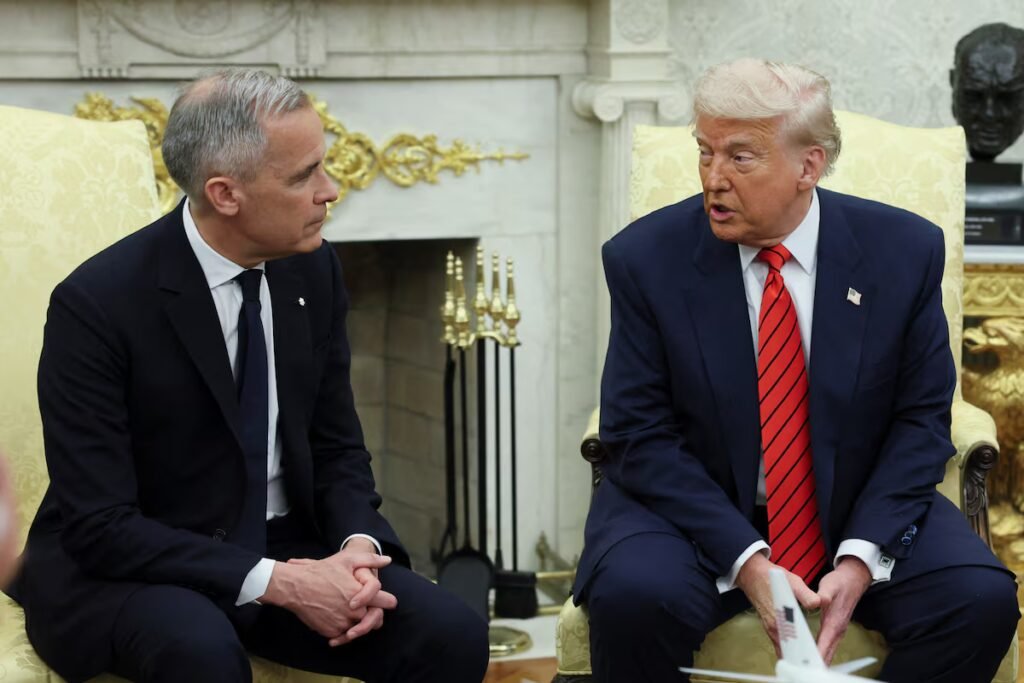

Prime Minister Mark Carney meets with U.S. President Donald Trump at the White House, in May, 2025.Leah Millis/Reuters
Carlo Dade is director for international policy and the New North America Initiative at the School of Public Policy at the University of Calgary.
Sean Willett is a co-founder of polling firm Goodbit.
Tuesday night, U.S. President Donald Trump suspended his latest tariffs on Canada for three days as the two countries work to finalize a deal.
But deal or no deal, the deeper threats to Canada from U.S. Section 338 tariffs have not ended.
As long as the president retains sole discretionary authority to impose tariffs, the threat remains. Remember that Canada had an agreement, incorporated into the current USMCA and ratified by Congress, to restrain the use of Section 232 tariffs. The failure of that agreement is a precedent to guide all future dealings with the U.S., including those conducted after Mr. Trump leaves office.
While the new tariffs don’t affect large trade volumes, the unique threat to which Canada must continue to be on guard is the potential by a president to single out provinces for individual tariff action. So far, Ontario and Quebec are most affected; Alberta and Saskatchewan are not. Mr. Trump knows what he’s doing.
Carney briefs premiers, cabinet as negotiators work to finalize trade deal
More so than Mexico and countries with weak subnational and strong federal government, this is a particular vulnerability. It is seen not just in the secessionist movements in several provinces but also in broader fights such as EVs vs. canola, where one regional economy is pitted against another.
But Mr. Trump is wrong, new research shows.
Recently, the New North America Initiative at the University of Calgary and Goodbit put scenarios of sown dissension via Section 338 tariffs to about 1,900 Canadians outside of Quebec. They did so in a game about provincial co-operation on tariff response in the days before the tariffs were to take effect.
The research asked participants to work through concrete scenarios involving provincial co-operation and explain who they would trust to manage a response.
The research revealed an important pattern. Participants came away seeing more clearly how Section 338 can pressure provinces one at a time. They were more willing to help another province, including at a cost to their own. Some of the strongest movement came among Albertans, conservatives, and people who trusted neither Ottawa nor their provincial government.
Campbell Clark: What’s on the table? Trump’s talk doesn’t sound quite like Canada’s
Importantly, the response went beyond “yes, elbows up.” Support for buying Canadian was already high and remained so. What changed was willingness to work constructively with other provinces, suggesting that national solidarity can deepen if Canadians see co-operation between provinces as part of the response. In Canada, where research shows that interprovincial co-operation is a rare achievement, this is significant.
That matters because it suggests an understanding that pressure applied to one province today can be redirected to another tomorrow. Helping a province in the crosshairs becomes an act of collective self-defence rather than charity.
The same pattern appeared when participants were asked to make a harder choice. In one scenario, the tariffs would end if their province put American products back on store shelves. In every province, the most common response was yes.
Such solidarity does not come without a cost, of course. Participants agreed to restock American products in their provinces only if the provinces giving something up received something in return.
The lesson for Canada now facing a U.S. armed with “divide and conquer tariffs” is that Canadian solidarity, while strong, is not something governments can simply assume; it must be built by informing Canadians of what is at stake.
Explainer: Trump made new trade deals with countries around the world. Here’s how they played out
Canadians seem willing to accept that one province may sometimes have to give something up for another, but they want to know the bargain is reciprocal: who is carrying the cost, who benefits, and what comes back to the province making the concession. Without that clarity, what is meant to look like a national strategy can quickly feel like one province being asked to take one for the team. That’s a guaranteed winning proposition for a U.S. administration hostile to Canada.
The same expectation runs through the findings on trust. Participants were more persuaded by visible results, a record of delivery, and honesty about the cost than by meetings and signed agreements, which were often dismissed as photo opportunities.
A declaration of unity is useful, but it is not the same thing as a durable bargain between provinces. If leaders want Canadians to support co-operation when the costs are uneven, they need to explain what each province is being asked to give, what it will receive, how those costs will be shared, and how the public will know whether the arrangement has worked.
Section 338 has the real potential to further press provinces one at a time, should the Americans decide to play that card. That they have not done so does not mean that they will not. With Section 338 tariffs, a lethal threat for Canada, federal and provincial governments must not choose a strategy of hope over preparation.


More Stories
Anthropic signs onto $10-billion Nova Scotia data centre project
An independent Alberta may find the cost of regret hard to swallow
Pitching in: Family helping raise $8-million for BC Children’s Hospital