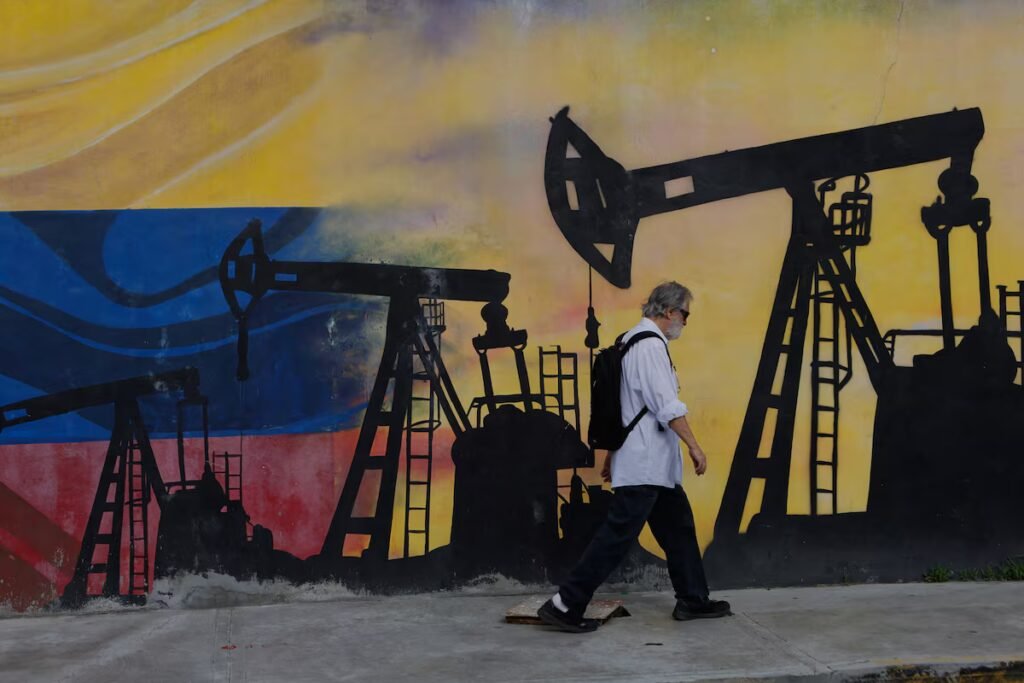

A pedestrian walks past a mural featuring oil wells in Caracas on Saturday, a day after U.S. President Donald Trump announced a deal giving the United States a stake in Venezuela’s oil reserves.Pedro Mattey/The Associated Press
U.S. President Donald Trump has struck a deal with Venezuela to take control of its oil reserves and signalled the arrangement should be viewed as a warning to Canada as the trade war intensifies.
On Sunday, Mr. Trump shared a link on social media that said the Venezuela deal, which will grant the United States majority control over the South American country’s vast oil reserves, puts “Canada on notice.”
Experts said the deal, announced days after U.S.-Canada trade talks fell apart, could force Canadian crude to compete barrel-for-barrel with Venezuela’s product over the years to come.
Explainer: What to know about Trump’s deal for access to Venezuela’s vast oil reserves
The President said in a Truth Social post that the reserves will be used to refill America’s Strategic Petroleum Reserve (SPR), located along the Gulf Coast, which has been drawn down sharply in recent years to respond to global supply disruptions and high fuel prices. The same day, Mr. Trump made a series of posts directed at Canada, attacking the country’s auto industry and urging Canadian companies to move their operations to the U.S. to avoid tariffs.
Venezuela’s acting President Delcy Rodríguez said the deal is a “25-year bilateral project” with the United States that will see her country develop new oil fields and significantly increase its production targets.
Rory Johnston, oil market analyst at Toronto-based Commodity Context, said Venezuela has historically faced challenges getting its product to market and called Mr. Trump’s claim that the deal will amount to 65 billion barrels coming under U.S. control a “red herring.”
“Despite Venezuela having these massive claimed reserves, they currently produce only about a million barrels a day,” he said. In comparison, Canada produces over 5.3 million barrels of crude oil per day.
Regardless, for the Canadian crude industry, the effect of the U.S.-Venezuela partnership could eventually be an “incremental” increase in competition with the oil flowing into the U.S.’s Gulf Coast, said Mr. Johnston.
This shift will likely result in “slightly worse oil prices for Canada, all else equal,” Mr. Johnston said, adding that declines will probably be “in the ballpark of $4 to $5 dollars a barrel.” Canadian crude is similar in quality to Venezuela’s.
Opinion: Using oil to retaliate against the U.S. would be exceedingly stupid
On Truth Social, Mr. Trump said the “topping up” of the SPR will begin “very shortly,” though more details about the deal’s timeline have not been provided. U.S. motorists have recently been feeling the squeeze at the pump amid the war in Iran.
Ms. Rodríguez said on social media that the deal “will facilitate a significant flow of investment aimed at the recovery and reconstruction of strategic infrastructure for the development of our hydrocarbons industry.” Venezuela’s oil infrastructure is in a state of disrepair after decades of damage and decay.
The announcement of the deal comes nearly nine months after the U.S. military at Mr. Trump’s direction carried out an operation to capture Venezuela’s former leader Nicolás Maduro and spirit him to the United States to face federal narcoterrorism and drug trafficking charges.
On Saturday, Ms. Rodríguez said on state broadcaster VTV that the deal will involve developing 17 strategic oilfields with a production target of more than 1.5 million barrels per day. The same day, The Wall Street Journal reported that the U.S. government plans to take a 35 per cent passive stake in Venezuelan businessman Alejandro Betancourt’s private oil company North American Blue Energy Partners.
Mr. Johnston said the deal signals that the U.S. is diversifying its imports away from the country it has been the most dependent on: Canada.
“In the same thread, we do need to continue to double down our diversification on our dependence on their energy demand,” he said, adding that the issue speaks to the long-standing push for the West Coast pipeline – a project that Prime Minister Mark Carney has prioritized.
Big oil companies report massive profits as Iran war drives up prices
Dmitriy Frolovskiy, a Toronto-based energy analyst, also said Mr. Trump’s deal is a signal for Canada to work to expand the list of countries it ships oil to.
“You need to be more mobile. You need to be more flexible, and you actually need to explore new markets. Because if you don’t explore new markets, then it’s a competition,” he said.
It’s a competition that Canada is at risk of losing and a threat to the country’s economic security, said Shawn Barber, a retired foreign service officer and ambassador.
“Trump has said America doesn’t need and doesn’t want our cars, our steel and our aluminum,” said Mr. Barber, who is also the former head of the task force on economic security at Public Safety Canada.
“With this deal, he’s fired a shot across our bow. He’s now saying that, in the years ahead, America won’t need our oil either.”
With reports from Reuters


More Stories
Netflix issues weak quarterly forecast days after laying off 6% of staff
BMO appoints new U.S. head as Darrel Hackett steps down
Telesat creditors put forward new proposal as debt repayment deadline draws closer, source says