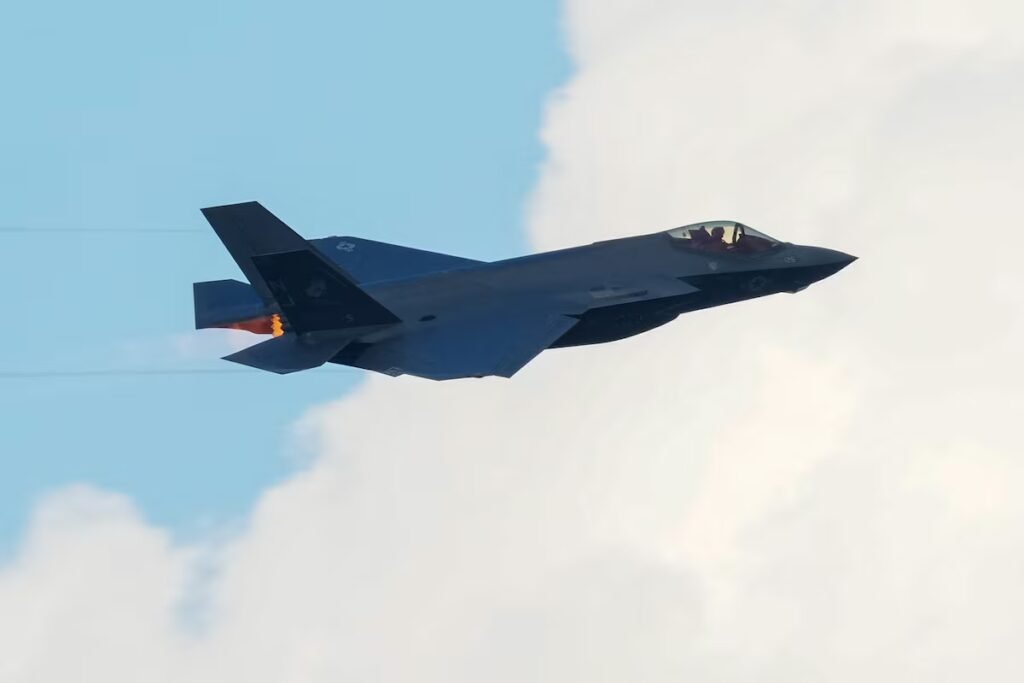

Carney ordered a review of Canada’s purchase of 88 F-35 jets from American company Lockheed Martin shortly after assuming office in March, 2025.KEN CEDENO/AFP/Getty Images
Canada has kept its defence relationship with the U.S. largely on the sidelines of recent trade talks. But with negotiations broken down, experts say the likelihood of major defence procurements factoring into punitive measures taken by either side is growing.
Talks between the two countries collapsed on Friday just before President Donald Trump’s latest round of tariffs of 50-per-cent on US$20-billion worth of Canadian exports came into effect. Days earlier, the U.S. and Canada had reached a tentative deal, but Prime Minister Mark Carney pulled back at the last minute, stating that the U.S. had changed its terms.
Now, Canada is preparing to implement “dollar-for-dollar” counter-tariffs starting Sept. 8, which the Trump administration will consider responding to with a further escalation of the trade war. On Sunday, U.S. Transportation Secretary Sean Duffy told Fox News it was “foolish” for Canada to think it could win a trade war with Mr. Trump. He also falsely claimed that Canada doesn’t have a military.
Canadians ready to go elbows up as they brace for trade war with U.S.
Throughout the talks, on the Canadian side, defence has come up mostly in broad terms, said Erin O’Toole, former leader of the Conservative Party of Canada and a member of Canada’s Advisory Committee on Canada–U.S. Economic Relations.
Canada’s lead negotiators made clear to the committee, he said, that the goal has been for the trade dispute not to affect other bilateral engagements, including military co-operation. After all, Canada and the U.S. remain deeply integrated at an operational level, through activities such as joint military exercises and the North American Aerospace Defence Command (NORAD).
But the procurement of the actual equipment Canada is using in these operations is another consideration, Mr. O’Toole said – one that is more likely to be affected by what’s going on at a political level.
“The level of aggression shown against us cannot just be sloughed off. It has to be responded to,” he told The Globe and Mail. Even if that means reconsidering Canada’s options when it comes to major procurements such as fighter jets, he added.
Mr. Carney ordered a review of Canada’s purchase of 88 F-35 jets from American company Lockheed Martin shortly after assuming office in March, 2025. That review is continuing and Canada’s order has stalled at a legal commitment to buy just 16 jets. Meanwhile, the Swedes are building their case for Canada to buy the American jet’s main competitor, the Swedish-made Gripen, from aerospace and defence company Saab.
An ocean away from the trade negotiation nucleus in Washington last week, thousands of visitors and delegations from 37 allied air forces gathered at the Malmen Airbase in Sweden for the centenary of the Swedish Air Force, where F-35 and Gripen fighter jets stood side by side.
On Saturday, Micael Johansson, Saab’s president and chief executive, told The Globe he had learned of the collapsed trade talks that morning in the news. But his answer to Canada’s dilemma was not to force a choice. “I don’t think Canada will give up F-35 completely. They will, of course, go forward with that to some extent. I have no clue how many.”
Analysis: America is really being a bad friend
It’s unfortunate that economic and diplomatic frictions are affecting Canada’s procurement approach at all, especially when it comes to looking out for the country’s best military interest, said Christopher Coates, former deputy commander of NORAD and director of foreign policy, national defence and national security at the Macdonald-Laurier Institute.
“Certainly, in the case of the F-35, there is no better option from a Canada or from a NORAD perspective than the F-35,” he said, adding that it’s in Canada’s best interest to not let a rupture in trade affect its ability to defend North America alongside the U.S.
While Canada’s relationship with the U.S. is based upon economics, the United States’ relationship with Canada is based upon defence and security issues, said Raquel Garbers, a former director-general within the Department of National Defence and principal architect of Canada’s defence policy.
If the U.S. judges Canada’s politically motivated procurement decisions as putting its own security at risk, the economic consequences for Canada may only worsen, said Ms. Garbers, who’s also a senior fellow at the Macdonald-Laurier Institute and Australian Strategic Policy Institute.
Therefore, Canada needs to figure out how to manage its relationship with the U.S. constructively, while simultaneously leveraging it to build up its own niche capabilities, she said.
Ottawa readies tariff-relief plan for businesses
“Canada’s strength will always lie in being inside the U.S. orbit,” she said. “It needs something to protect against overreach, and that means making itself indispensable.”
While other industries such as automotives are being punished by U.S. tariffs, the opportunity is there for Canada to pivot and build its strengths in areas such as defence, said Eliot Pence, CEO of Ottawa-based Dominion Dynamics, and a member of the Advisory Committee on Canada–U.S. Economic Relations.
“We can create leverage for ourselves if we decide to invest in ourselves.”


More Stories
OpenAI engineer arrested over listening device found in conference room, say FBI, company
Saudi Aramco headquarters reportedly hit by ballistic missile as Houthi conflict escalates
Montreal-based software firm Lightspeed cuts 250 roles