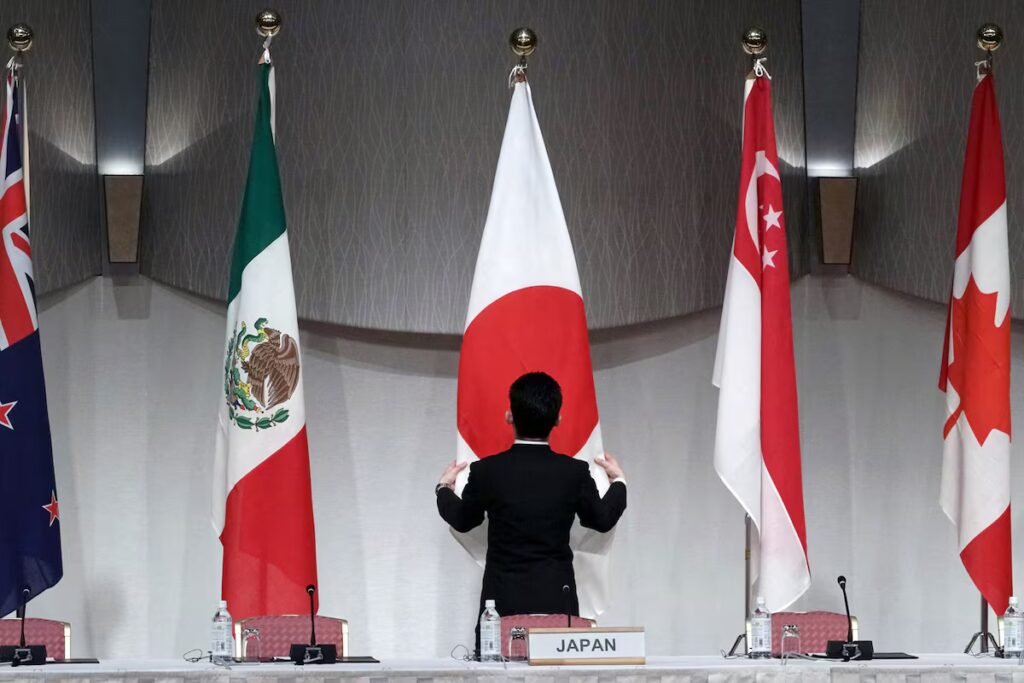

The Japanese flag is adjusted prior to a joint press conference of the Comprehensive and Progressive Trans-Pacific Partnership in Tokyo, January, 2019.Eugene Hoshiko/The Associated Press
In 2017, U.S. President Donald Trump foolishly withdrew the United States from a mega-trade pact involving numerous Pacific Rim countries, including Canada.
The U.S. exit from the Trans-Pacific Partnership – a signature initiative of former president Barack Obama that Mr. Trump vulgarly likened to “a rape of our country” – initially caused consternation for the deal’s remaining signatories.
But those jilted trading partners came together and hammered out a successive deal known as the Comprehensive and Progressive Agreement for Trans-Pacific Partnership, or CPTPP, salvaging much of the initial pact. It came into force in 2018.
Opinion: As middle powers forge a future without the U.S., Canada walks a tricky path
CPTPP is an alphabet soup of an initialism, to be sure, but the deal is crucial to Canada’s trade ambitions in the Indo-Pacific. The 12-country trade pact, which is attracting new interest from other middle powers, is also serving as an insurance policy against Mr. Trump’s global trade war.
Aside from Canada, CPTPP’s members include an array of countries, including Australia, Mexico, Chile, Japan and Britain – many of the middle powers stung by the collapse of rules-based trade and Mr. Trump’s escalating economic coercion.
Britain’s membership in the CPTPP officially took full effect this past Tuesday, and London is already encouraging businesses to utilize the deal to bolster trade with Canada. (Ottawa ratified Britain’s accession in July.)
“We want good growth felt in every postcode, not just measured on a graph,” Chancellor of the Exchequer John Healey said in a press release on Sept. 1.
Although the two countries had a pre-existing bilateral trade agreement, London says the CPTPP confers more advantages on British businesses, including enhanced business mobility and improved access to public procurement.
“We have also exported our products to Canada and are hopeful that the UK’s full accession to the CPTPP will create further opportunities in this market for growth in the future,” stated Ken Baker, managing director of agri-tech company EmTech Hatchery Systems, in the same British government release.
Other middle powers are either eyeing membership or stronger ties with the CPTPP trading bloc as a hedge against both the U.S. and China.
South Korea, which first signalled its interest in joining CPTPP in 2021, recently launched stakeholder consultations on possible membership.
China seeks Canada’s help in joining Indo-Pacific trade pact, Senator says
Both Taiwan and China have separately expressed interest in joining the trade pact. But the entry of either one would be politically fraught for its existing members, including Canada.
The United States-Mexico-Canada Agreement, or USMCA, expressly prohibits signatories from entering into a free trade deal with a so-called non-market country. (That’s code for China.)
American protectionism is also spurring Japan’s interest in promoting itself as the ideal host of a permanent secretariat of the CPTPP, according to published reports.
The European Union, meanwhile, is seeking enhanced co-operation with the CPTPP trading bloc, with Canada’s support.
“Within this group, Canada has self-selected as the bridge economy, and the EU-CPTPP bridge is explicitly referenced in what has come to be called the ‘Carney Doctrine’ or ‘Carney Credo,’” states a new report published by the Asia Pacific Foundation of Canada, giving a nod to Prime Minister Mark Carney’s speech in Davos, Switzerland, earlier this year.
During that address, Mr. Carney urged middle powers to build a new order based on shared values, characterizing Canada’s approach as “principled and pragmatic.”
The CPTPP is pivotal to Mr. Carney’s goal of doubling non-U.S. exports by 2035, as tensions flare with Washington.
Trade talks between Canada and the U.S. broke down on Aug. 21, triggering a new round of tit-for-tat tariffs.
Mr. Trump imposed 50-per cent-tariffs on $28-billion of Canadian exports, and subsequently threatened to double auto tariffs from 25 per cent to 50 per cent on Jan. 1, 2027, and apply them to auto parts for the first time.
For his part, Mr. Carney has vowed to implement dollar-for-dollar countertariffs on Sept. 8.
The future of the USMCA is far from guaranteed. Not only is the U.S. negotiating separately with Mexico, but Mr. Trump has repeatedly mused about pulling out of the deal altogether.
If the U.S. ultimately leaves the trilateral USMCA, the CPTPP provides Canada an alternate avenue to increase trade with Mexico.
Canada has historically underutilized the CPTPP for trade with Mexico because of the overlapping USMCA, according to a federal analysis. Exporters seeking certainty in an increasingly uncertain world should bear this in mind.
Mr. Trump’s fit of pique that prompted the U.S. withdrawal from the CPTPP’s predecessor agreement is proving to be a gift for middle powers nine years later. Let’s be sure to tell him that Canadians are much obliged for the safety net.


More Stories
Millions of hacking attempts as companies and governments rush to fix programming flaw
Business Brief: Proton’s negative reaction to Bill C-22
Power Sustainable acquires B.C.-based Fine Choice Foods