
As AI becomes more embedded in enterprise operations, workforce and vendor dependencies are shifting, and geopolitical pressures are reshaping procurement. Infotech’s annual report, Tech Trends 2027, examines 14 trends across four themes and identifies opportunities and risks that will shape IT strategy and technology investment in the coming year.
ARLINGTON, Va., Oct. 27, 2026 /PRNewswire/ — Technology leaders preparing for 2027 will need to account for shifts that can change the cost, security, and viability of their investments. Global research and API-driven advisory firm Infotech has released its annual flagship report, Tech Trends 2027: Bring Clarity Amid Chaos, which identifies 14 trends across four themes for the months ahead.
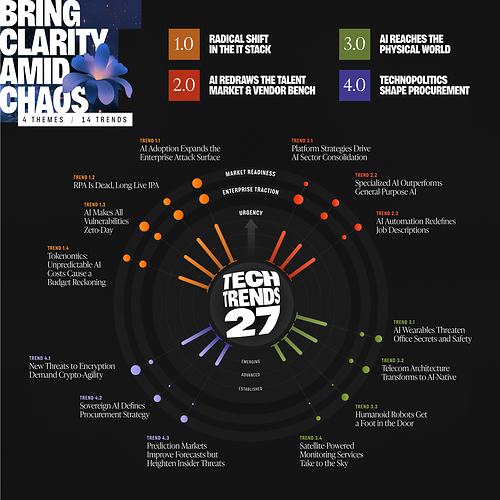
Infotech’s highly anticipated report finds that as AI model capabilities converge, supporting architecture, tooling, and governance will become ever more important to enterprise AI outcomes. Decisions about how AI is deployed will increasingly determine whether organizations can control costs, change providers, and maintain oversight as automation expands.
Drawing on expert interviews and primary and secondary research, the Tech Trends 2027 report examines how these trends apply to various sectors, including financial services, healthcare, legal services, manufacturing, and government, and tracks policy and procurement developments in the United States, Canada, the United Kingdom, Australia, and the European Union.
Each trend is assessed for market readiness and enterprise traction, reflecting how well the market can support adoption and how organizations are responding. These assessments are intended to help technology leaders determine which developments require action and which warrant further testing or monitoring.
“In 2027, technology leaders will be facing pressures from vendors that are obsessed with driving AI demand, executives that mandate AI use without defining desired outcomes, and employees that just want to get their hands on it,” says Brian Jackson, Principal Research Director and lead author of the report. “Those leaders will do well to remember it’s not their priority to unleash unbridled AI power onto their organizations, but instead to take the reins and steer its potential in the direction the organization wants to go.”
Four Themes and 14 Trends to Watch in 2027
Emerging technologies will require different responses in the coming year. Some, such as AI agents embedded in enterprise software, already demand operational oversight, while humanoid robots remain an opportunity for bounded pilots. Infotech’s Tech Trends 2027 report places these developments within a wider assessment of changing supplier markets, workforce requirements, and technology access.
Across four themes, the following 14 trends highlight the developments technology leaders need to consider when planning for 2027:
Theme 1: Radical Shift in the IT Stack
AI is changing how enterprise systems execute work, consume resources, and expose organizations to risk. Within this theme, the report examines four trends reshaping automation architecture and operational controls:
- Trend 1 – AI Adoption Expands the Enterprise Attack Surface
Personal AI accounts, unsanctioned connections, and agents embedded in approved software create new entry points. As their use grows, stronger identity controls and an accountable human owner for every agent will become essential. - Trend 2 – RPA Is Dead, Long Live IPA
AI agents in intelligent process automation (IPA) platforms can interpret information and plan actions, while established robotic process automation handles repeatable execution. Combining these capabilities will allow organizations to extend working automation investments as they pursue more complex workflows. - Trend 3 – AI Makes All Vulnerabilities Zero-Day
AI is increasing the pace at which software flaws can be identified and exploited, putting pressure on remediation capacity. Keeping up will require continuous security testing and greater vendor accountability. - Trend 4 – Tokenomics: Unpredictable AI Costs Cause a Budget Reckoning
Consumption-based pricing and multi-step agent workflows complicate spending forecasts. Connecting AI spending with business value will depend on clearer cost attribution, appropriate model selection, and controls over usage.
Theme 2: AI Redraws the Talent Market and Vendor Bench
As AI changes the work organizations automate and the capabilities they buy, technology leaders face new dependencies across their suppliers and workforce. This theme covers three trends:
- Trend 5 – Platform Strategies Drive AI Sector Consolidation
Competition to control enterprise orchestration and supporting tools points to consolidation through 2027. Deals that hire away a vendor’s core team may disrupt product development and support without triggering contract protections tied to an acquisition. Contracts should account for these continuity risks, with provisions for ongoing service, data portability, and transition periods negotiated while buyers still have leverage. - Trend 6 – Specialized AI Outperforms General-Purpose AI
The advantage is clearest in regulated industries such as healthcare, legal, and financial services. Specialized models and tooling may have few credible substitutes, making it harder to switch providers and giving vendors greater pricing power. Choosing them will mean weighing performance and industry fit against supplier dependence and the availability of workable alternatives. - Trend 7 – AI Automation Redefines Job Descriptions
AI agents are taking on tasks that once helped junior employees build experience. As those tasks become automated, organizations will need to redesign entry-level roles and preserve development paths that build future expertise and institutional knowledge.
Theme 3: AI Reaches the Physical World
Wearables, programmable networks, robotics, and satellite services are extending digital capabilities into physical environments. Across these four trends, Infotech’s report distinguishes near-term governance needs from opportunities best evaluated through targeted pilots:
- Trend 8 – AI Wearables Threaten Office Secrets and Safety
Recording-enabled devices offer uses in fieldwork and accessibility, while introducing privacy and confidentiality risks. Acceptable-use policies should govern when these devices can be worn and used to record, with room for employees who rely on them as assistive devices.. - Trend 9 – Telecom Architecture Transforms to AI-Native
Mobile networks are becoming an AI services layer, with new capabilities coming online as 5G Advanced rolls out through 2027 and 6G follows by 2030. Network APIs will open access to services such as fraud detection and low-latency processing, but organizations adopting them will need a clear API security strategy, tighter control of non-human identities, and safeguards against consumption-based cost spikes. - Trend 10 – Humanoid Robots Get a Foot in the Door
Falling unit costs and rising investment are creating more opportunities to pilot humanoid robots, though autonomy remains limited. Bounded testing should precede broader deployment, with vendor evaluations factoring in reliance on human teleoperators and integration requirements. - Trend 11 – Satellite-Powered Monitoring Services Take to the Sky
Improving imagery and new satellite services are broadening opportunities to monitor assets, infrastructure, and environmental conditions. Organizations evaluating these services should weigh their availability and the operational value of more frequent, detailed observations.
Theme 4: Technopolitics Shape Procurement
Geopolitical uncertainty and emerging security risks are influencing technology selection, supplier relationships, and information governance. This theme comes with three key trends for 2027:
- Trend 12 – New Threats to Encryption Demand Crypto-Agility
Quantum computing and AI-assisted attacks could weaken widely used encryption, while governments are issuing guidance and timelines for post-quantum migration. Preparation starts by identifying where cryptography is embedded, planning algorithm replacements with minimal disruption, and adding post-quantum readiness to vendor assessments. - Trend 13 – Sovereign AI Defines Procurement Strategy
Data and AI sovereignty will influence infrastructure choices as organizations assess where technology operates and who controls it. Provider selection will increasingly involve jurisdiction, operational control, and continuity of access. For critical applications, maintaining access to at least two competitive frontier AI providers and designing workloads to shift between them can reduce dependence on a single service. - Trend 14 – Prediction Markets Improve Forecasts but Heighten Insider Threats
Fast-growing platforms such as Kalshi and Polymarket are expanding prediction markets, and contracts on executive turnover, layoffs, and earnings give insiders new reasons to act on confidential information. IT, legal, corporate communications, and investor relations will have to coordinate on monitoring and policy updates, including naming prediction markets in insider-trading policies.
Infotech’s Tech Trends 2027 report also highlights how these developments intersect. For example, decisions about specialized AI can affect supplier flexibility and workforce requirements, while physical AI introduces new demands on connectivity, security, and workplace policies. Infotech recommends that technology leaders evaluate these dependencies together when planning investments for 2027 and beyond.
“The right response to an emerging technology may be a limited pilot, a change to procurement requirements, or a decision to keep watching,” says Jackson. “What matters is knowing where a decision is urgent and where the organization needs more evidence before it commits.”
On November 11 at Infotech LIVE 2026 in Toronto, Gord Harrison, Chief Research Emeritus at Infotech, will explore the report’s findings during his Tech Trends 2027 keynote. The session will examine how technology acceleration and shifting global dynamics are reshaping enterprise capabilities, risks, and operating models.
Download and read Infotech’s Tech Trends 2027: Bring Clarity Amid Chaos report for more insights on the year ahead.
For media inquiries or interview requests with Infotech’s experts, including Brian Jackson, please contact [email protected].
Media Passes for Infotech LIVE 2026 in Toronto
Media professionals, including journalists, podcasters, and industry influencers, are invited to attend Infotech LIVE 2026 in Toronto to gain exclusive access to research, content, and interviews with industry leaders.
Media professionals can apply for complimentary in-person passes by contacting [email protected].
About Infotech
Infotech (formerly Info-Tech Research Group) provides an API-driven advisory model to over 30,000 IT leaders globally to systematically improve their organizations. With 30 years of trusted expertise and proven impact, Infotech equips technology leaders with industry-leading expert guidance, proven methodologies, practical tools, training, coaching, and consulting to accelerate decisions and deliver measurable outcomes.
To learn more about Infotech’s HR research and advisory services, visit McLean & Company, and for data-driven software buying insights and vendor evaluations, visit the firm’s SoftwareReviews platform.
Media professionals can register for unrestricted access to research across IT, HR, and software, and hundreds of industry analysts through the firm’s Media Insiders program. To gain access, contact [email protected].
SOURCE Infotech


More Stories
FOX NATION PARTNERS WITH ACADEMY AWARD WINNER AND "LANDMAN" STAR BILLY BOB THORNTON FOR NEW ORIGINAL DOCUDRAMA "BILLY BOB THORNTON PRESENTS: THE MAYFLOWER"
S&P Cotality Case-Shiller Index Reports Annual Gain in August 2026
/C O R R E C T I O N – Cogniedge.ai/