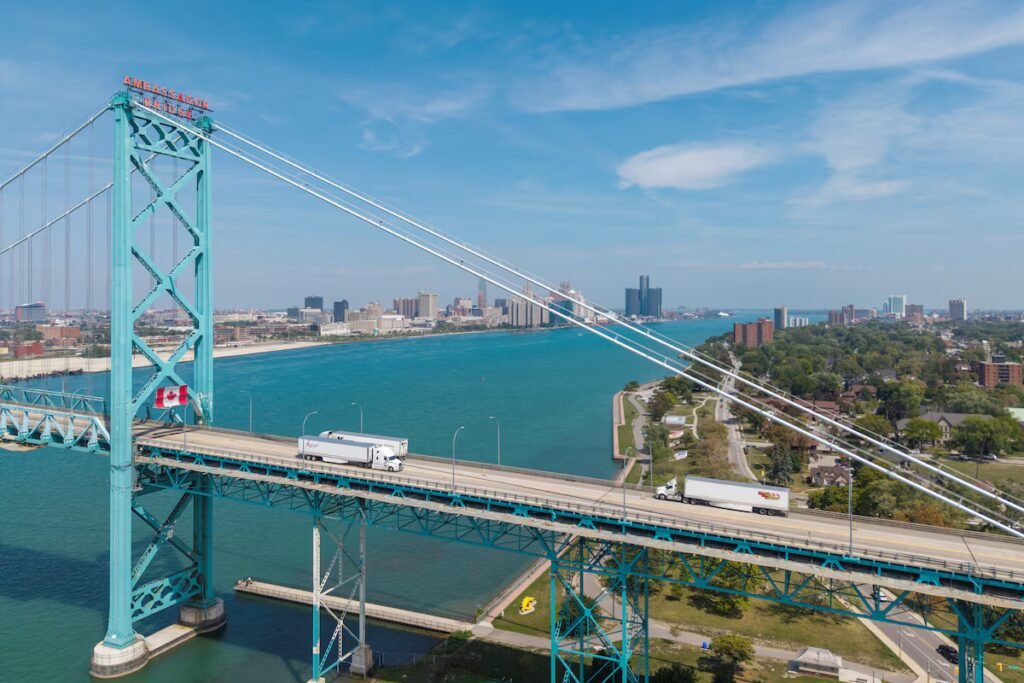

Vehicles crossing the Ambassador Bridge, connecting Windsor, Ont., and Detroit, on Tuesday.Carlos Osorio/Reuters
The latest escalation in the trade war between Canada and the U.S. will raise consumer prices only modestly for Canadians, but those increases will come on top of already high living costs and amid growing economic uncertainty, analysts say.
The price pressures north of the border will come from Canada’s retaliatory tariffs, which will raise the cost of a wide range of goods imported from the U.S. Ottawa’s countertariffs, which range from 15 per cent to 50 per cent, target $27.6 billion of U.S. imports and are scheduled to come into effect on Sept. 8. They are in response to U.S. tariffs on an equal amount of Canadian goods that came into force Aug. 22.
With 80 per cent of the tariffs targeting industrial inputs and just 20 per cent hitting consumer goods, the impact on inflation is likely to be muted, Ali Jaffery, chief economist at consultancy KPMG Canada, told The Globe and Mail in an interview.
But another round of tit-for-tat tariffs means “costs are adding up, and the economic risks are growing” for Canada, Mr. Jaffery wrote in a recent note to clients.
Mr. Jaffery said he expects Ottawa’s countertariffs to push up prices for Canadians by 0.2 per cent to 0.3 per cent overall within a year, with those increases gradually percolating through retail and supply chains in the next several months.
Opinion: Don’t worry, Canada. The trade war will end, and end quickly
But a range of consumer products that are directly targeted by Canada’s retaliatory measures will likely see bigger and faster price jumps of between 1 per cent and 1.5 per cent over the course of six months, he added. Those goods include household items such as appliances, furnishings, stationary, as well as personal hygiene and cosmetic products.
The good news is that the countertariffs mostly target U.S. imports that are easy for Canadians to swap with products made elsewhere, which should allow consumers to dodge the brunt of the increases, Mr. Jaffery said. Since Canada doesn’t produce a lot of the products targeted by the countertariffs, most substitutes will likely be imports from other countries, he added.
The retaliatory tariffs targeting U.S. manufacturing inputs, such as steel and aluminum, will also eventually push up prices for consumers, but those increases will be smaller and take longer to show up, he added.
One open question is to what extent businesses, which pay the tariffs, will pass on the extra costs to consumers. The Bank of Canada, for example, estimates that generally about three-quarters of the higher costs from tariffs are passed on to consumer prices within 18 months.
Mr. Jaffery said he used similar assumptions in his estimates of potential price increases. But he added that firms could decide to eat more of those extra costs if the economy weakens and consumers pull back on spending. That could be the case if there is a further escalation of trade tensions, he said.
From flower farmers to cheesemakers, meet the business owners and leaders affected by the trade war
In such a scenario, he said, “firms are going to want to prioritize sales over margins.”
Another factor that will affect the ultimate cost of countertariffs for Canadians is the U.S. exchange rate. A worsening trade war could weaken the loonie, driving up the price of U.S. imports in general and adding to the cost of goods targeted by the tariffs.
The Canadian dollar has weakened modestly since the breakdown of trade talks, dipping from around 73 US cents to around 72 US cents. However, it remains stronger than it was in late June, when it reached a low of around 70 US cents.
Overall, economists expect the tariffs to deal a blow to the Canadian economy, which just started to pick up speed. Canada’s inflation-adjusted GDP grew 3.3 per cent between March and June on an annualized basis, the fastest pace of growth since 2023.
Now analysts are downgrading their growth projections, with some expecting that the trade war flare-up will shave up to around 0.5 percentage points off Canada’s GDP growth over the next year.
That’s not enough to derail the economic recovery, but it is enough to “dent it,” according to Mr. Jaffery.


More Stories
Green investment guidebook authors hold off on adding carbon capture for oil, gas after pushback
Six charts that show how B.C.’s fiscal outlook has gotten worse
Strategic maple syrup reserve close to empty, producers say