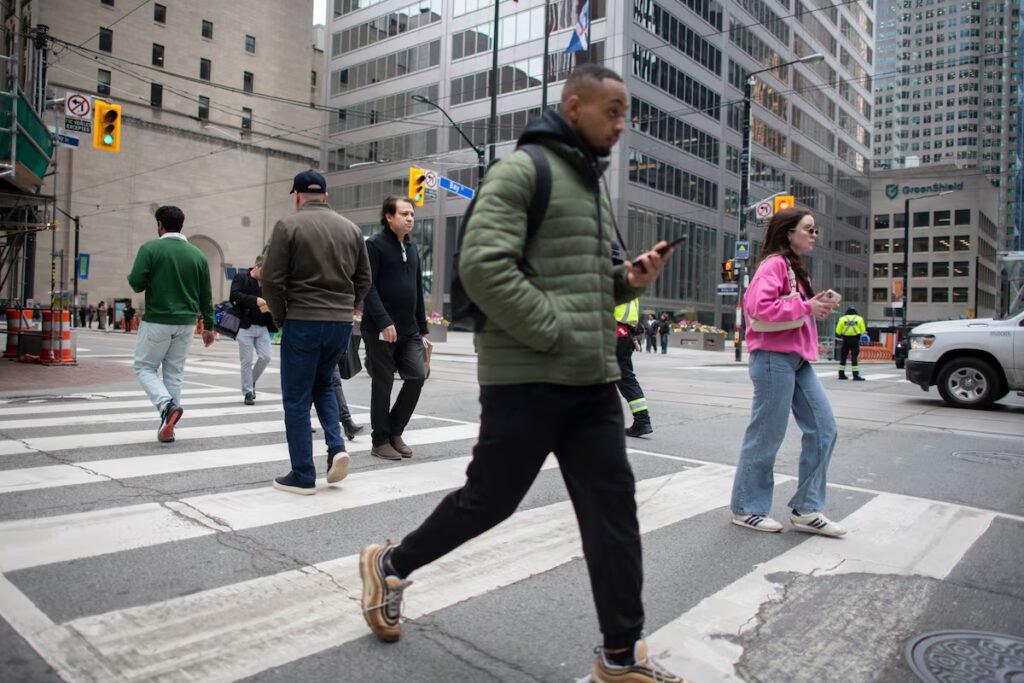

Pedestrians cross an intersection in Toronto’s financial district in May. Bank CEOs say clients are adjusting to economic uncertainty amid an escalating trade war with the U.S.Fred Lum/The Globe and Mail
The chief executive officers of Canada’s biggest banks are signalling caution over the escalating U.S. trade war, but say consumers and businesses have been resilient and loan defaults are manageable.
Ottawa’s retaliatory tariffs on $28-billion worth of U.S. imports took effect early Tuesday, as Prime Minister Mark Carney pushed back on President Donald Trump’s trade war. As the turmoil has intensified, concerns have mounted over potential loan defaults alongside higher pressure on people’s wallets.
Loan losses at the banks have remained within the lenders’ expectations since the U.S. embarked on its trade war more than a year ago, and bank CEOs told a conference on Wednesday that clients are continuing to adjust to ongoing economic uncertainty.
Live updates: Canada to blame for Washington’s escalation of trade war, Greer says
Royal Bank of Canada RY-T chief executive officer Dave McKay said that the bank has seen credit risk across clients improve as they adjust to the uncertain environment.
As more sectors are targeted by tariffs, companies are pulling back slightly and making more conservative decisions on their investments and borrowing.
“They’re going to manage their expenses not knowing the duration of this conflict and the magnitude of the loss of those clients’ bases, and whether they can pivot their sales to another market or not,” Mr. McKay said during an event Wednesday held by Bank of Nova Scotia BNS-T.
“I am worried about the expansion of this, but it’s important that we get to a good long-term deal for Canada. There’s enormous benefit on both sides of the border, and I think Americans are telling their congressmen the same thing – that this relationship’s important to America and it’s important to Canada.”
He said the bank is maintaining higher capital levels, with a CET1 ratio of 13.5 per cent as an extra buffer against possible effects of the trade war. That level is well above the minimum 11 per cent set by Canada’s banking regular, the Office of the Superintendent of Financial Institutions.
Scotiabank chief executive officer Scott Thomson told the conference the bank has seen some stress across mortgages, particularly in Toronto and Vancouver, but its loan portfolio in small business, commercial and auto have not had any significant issues.
RBC launches $1.4-billion fund to invest in Canadian technology companies
When the U.S. initiated its trade war last year, Scotiabank set aside additional provisions for credit losses – the funds banks set aside to cover loans that may default, based on models that use economic forecasting to predict future losses.
The economic environment would have to erode significantly to hit the lender’s most pessimistic scenario, which Mr. Thomson said gives him confidence the bank could manage an uptick in loan losses.
“What happened in the macro to date hasn’t been that significant. You saw the announcement yesterday. A relatively small amount of trade is tariffs, and I don’t think that’s going to have a huge impact on the credit performance,” Mr. Thomson said.
“But obviously, we’ll have to stay tuned for what transpires over the next year or so from a macro perspective, and the relationship with the U.S. will be important.”


More Stories
Binance replenishes 90% of assets stolen in record hack
Ottawa’s investment in Cohere, RBC blocks personal AI agents and Cleveland-Cliffs’ plan to recall Stelco workers: Must-read business and investing stories for the week of Oct. 31
Alberta’s data-centre boom faces fierce and growing opposition