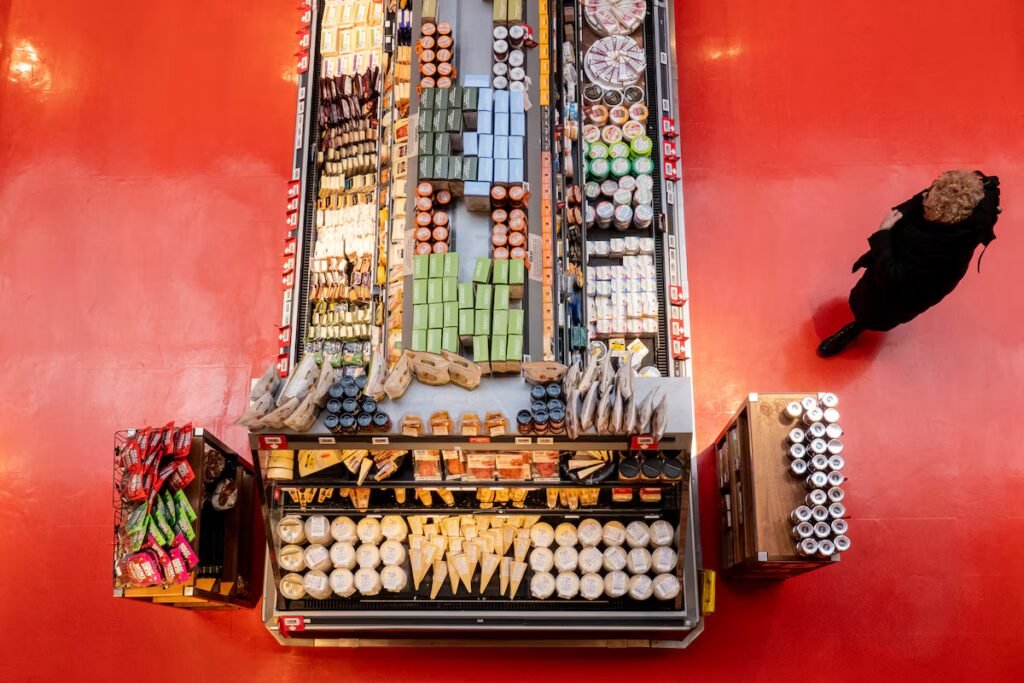

Good morning. The last time Canada hit back against U.S. tariffs, consumer goods and groceries were caught smack dab in the middle of former prime minister Justin Trudeau’s counterlevies on billions of dollars in American products. Mark Carney’s approach is different. But will it be enough to keep surging grocery prices at bay? We’ll unpack that below.
Up first
In the news
Pump: Finance Minister François-Philippe Champagne announced the federal gas tax break will be extended into the early months of 2027 to help consumers weather rising costs.
Plans: Carney and top CEOs intend to highlight Canada’s untapped potential in the critical-minerals, defence and energy sectors at an investment summit in Toronto this month.
Planes: The Swedish defence company Saab outlined a smorgasbord of benefits that Canada can expect should it proceed with a major order for Gripen fighter jets.
A customer shops at a grocery store in Toronto.Chris Young/The Canadian Press
In focus
Can Carney’s tariff strategy keep grocery prices in check?
Peanut butter, coffee, chocolate, spinach, celery and that signature export of the U.S. President’s home state – Florida orange juice. These were just a few of the food staples included in the first round of Canada’s countertariffs when Donald Trump unleashed his trade war last year.
While retailers absorbed some of the higher costs they faced, inevitably some of that was passed down to consumers. Prices for tariffed products went up by as much as 6 per cent compared with untariffed goods.
“Last time, it was more a tit-for-tat retaliation,” Gary Sands, a senior vice-president with the Canadian Federation of Independent Grocers, told me. This time, despite vowing a “dollar-for-dollar” response to U.S. tariffs, the government is trying to blunt the impact for Canadian consumers by targeting products with direct Canadian substitutes available. It’s about “shifting buying habits” as well, he said.
So what does that mean for your grocery bill?
About 80 per cent of Canada’s tariffs target industrial inputs, and just 20 per cent are aimed at consumer-facing goods. In the grocery aisles, those include dairy products, cheese, honey and flour, along with household must-haves such as toilet paper. All of these have easy-to-access Canadian alternatives – hence, the hope of shifting habits.
Canadians are already spending about 30 per cent more to feed themselves than they were in 2019, not to mention that grocery price increases have outpaced general inflation for 18 straight months.
The price of fresh tomatoes in Canada was up by 45.2 per cent year-over-year in May. Between 2017 and 2026, ground beef has gone from $9.12 a kilogram to $16.07.
Tariffs, of course, are far from the only culprit behind grocery bill inflation. Fuel costs have spiked by an average of 46 per cent since December, 2025, driving up food production and transportation costs, for example.
Does focusing away from consumer goods blunt the impact of countertariffs?
It depends whom you ask.
Some have argued that the focus on ingredients, packaging and agricultural equipment could cost consumers even more this time around. Grocers would need to invest further in changing suppliers and importing from more distant markets. Supply chains would be less efficient.
Sands, however, told me the calculus changes when viewing the latest countertariffs in tandem with Canada’s new National Food Security Strategy.
Ottawa announced the initiative in June, pledging more than $3-billion over 10 years to essentially make Canada less dependent on the U.S. supply chain. It promised to expand Canadian processing, help grow fresh food year-round, give more money to investigate anti-competitive behaviour in the grocery sector and, importantly, create more food terminals and hubs.
Instead of buying exclusively from wholesalers run by major retailers, “food terminals are an opportunity for local Canadian producers to get their product directly to mostly independent grocers,” Sands said.
None of this guarantees stable grocery prices. “Anyone who has any involvement in the food industry and makes a prediction that this or that is going to lower food prices is being disingenuous,” Sands told me.
But what it may do is equally valuable: make the Canadian supply chain – and Canadians’ grocery bills – less vulnerable to the ever-changing whims of the U.S. President.
Charted
Renewed attacks
The resumption of U.S. air strikes on Iran has driven yields to new highs and affected investor behaviour. They are betting that central banks, especially those in Europe, will raise interest rates to try to tame inflation at the expense of economic growth, European bureau chief Eric Reguly writes.
Quoted
The development of new technology is not an excuse for theft. We need to really be setting this up for the future. Because if we don’t, I’m really worried that this AI output is just going to start replacing human creation.
— Jennifer Brown, SOCAN chief executive officer
The Society of Composers, Authors and Music Publishers of Canada hopes its federal lawsuit against Suno, an AI music generation platform, will produce legal and regulatory guardrails that prevent the unauthorized sampling of tracks, Lana Hall reports.
Up next
More files we’re following
Court: A U.S. law firm representing survivors of the Tumbler Ridge mass shooting is filing 30 lawsuits against OpenAI.
Law: An Ontario judge is allowing a class-action lawsuit against Galaxy Digital Inc. after finding evidence that investors were misled about two now-collapsed cryptocurrencies that created multibillion-dollar losses.
Earnings: Companies reporting today include BRP Inc., Enghouse Systems Ltd., Lululemon Athletica Inc. and VersaBank.
Morning update
Markets were muted in choppy trading as a global bond selloff eased, with investors turning to upcoming U.S. economic data for clues on the Federal Reserve’s next policy moves.
Wall Street futures were mixed with the Dow pointing higher, while TSX futures were little changed.
Overseas, the pan-European STOXX 600 was up 0.04 per cent in morning trading. Britain’s FTSE 100 gained 0.07 per cent, Germany’s DAX gave back 0.04 per cent and France’s CAC 40 slid 0.33 per cent.
In Asia, Japan’s Nikkei closed 0.17 per cent lower, while Hong Kong’s Hang Seng slid 0.39 per cent.
The Canadian dollar traded at 72.41 U.S. cents.


More Stories
Worried about index concentration? Don’t be
U.S. importer files lawsuit challenging Trump’s new tariffs on Canadian goods
Alberta migrant groups express alarm over referendum results on immigration reform