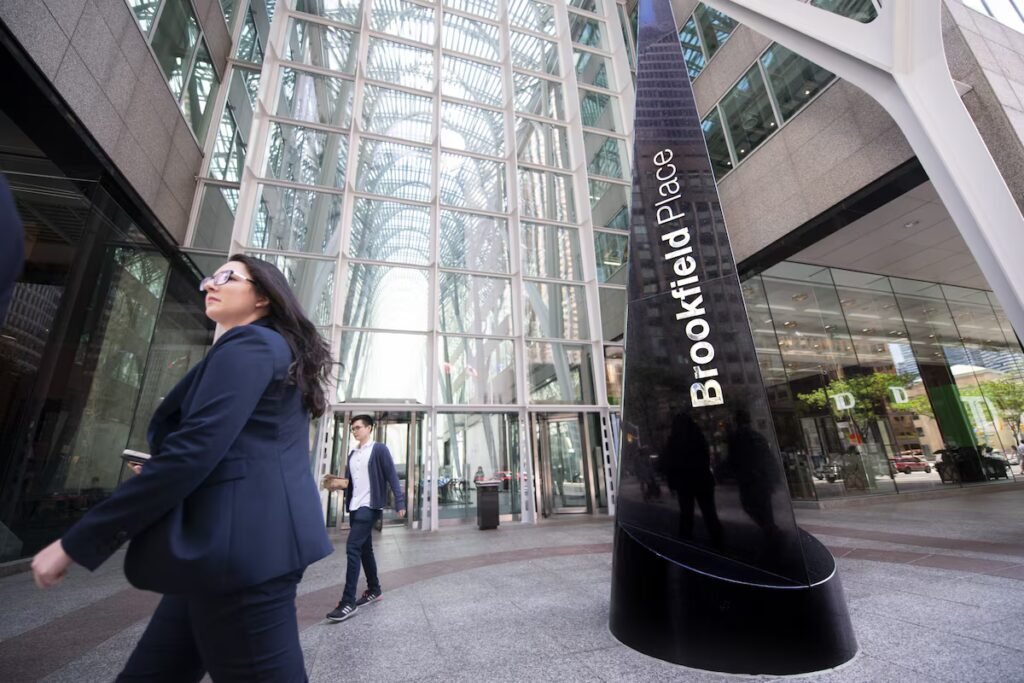

Brookfield Place in Toronto’s financial district.Fred Lum/the Globe and Mail
Brookfield Corp. says it can manage the risks in financing the expanding cost of computing power for artificial intelligence through a US$500-billion partnership with chip maker Nvidia Corp. and other financial-sector heavyweights.
Until recently, Brookfield had largely focused on backing the development of new AI infrastructure, such as data centres and the huge amounts of energy needed to run them.
Now, Brookfield is one of six major financial institutions, including Blackstone Inc. and Goldman Sachs Group Inc., that plan to jointly raise as much as US$500-billion to finance the purchase of chips needed to support the rapid expansion of the AI sector.
Nvidia, Wall Street giants partner to raise $500-billion for AI infrastructure
“We’re very excited about the opportunity,” Brookfield Corp. chief financial officer Nick Goodman said on a Thursday conference call discussing the company’s second-quarter financial results.
“Compute is the critical part of the infra stack supporting AI,” he said, referring to the different layers of infrastructure behind the technology.
Brookfield Corp. is the parent company of Brookfield Asset Management Ltd., which oversees more than US$1-trillion of assets across infrastructure, private equity, renewable energy, real estate, credit and insurance.
The breakneck pace of construction of new data centres and AI infrastructure, backed by vast pools of money, are fuelling fears that an investment bubble could be forming even as demand is increasing for AI tools and the compute to run them.
Some investors have also questioned the apparently circular nature of deals in which Nvidia invests in companies that are major buyers of its advanced chips.
The new partnership between Nvidia, Brookfield and other Wall Street financial giants – which is so far outlined in a memorandum of understanding – represents an attempt to create robust and affordable ways to borrow to support the sector’s continued expansion.
The graphics processing units (GPUs) needed to run large AI models “can represent half of the required capital to complete the build,” Mr. Goodman said. “So, finding efficient ways to finance the equipment is becoming increasingly important.”
He said Brookfield mitigates the risks inherent in investing in AI by signing contracts that promise cash flows, and by dealing with established companies such as major technology providers that Brookfield considers less likely to default on loans, Mr. Goodman said.
Opinion: Canadians are invested in the wrong segment of AI – without even knowing it
Those companies include the hyperscale AI labs, chip providers and customers that buy computing power, which form the main base of customers for Nvidia’s cutting-edge products.
“We believe we can invest around this with the right risk controls,” Mr. Goodman said.
He also said the revenue from those contracts is still comparatively small, relative to Brookfield’s overall business.
“We believe that we are not really stepping out from our historical focus on risk management and earning attractive returns while taking a moderate amount of risk, but we can do it at scale here.”
Brookfield Corp. reported a 15-per-cent increase in second-quarter distributable earnings – a measure it uses as a proxy for cash earnings that could be paid to shareholders – to US$1.4-billion, or 61 US cents a share, compared with the same quarter last year.
Profit was US$703-million, or 14 US cents a share, compared with US$1.1-billion, or 10 US cents a share, a year earlier.
Brookfield raised US$77-billion in the second quarter, much of it from the company’s acquisition of British-based insurer Just Group PLC, bringing its half-year fundraising total to US$98-billion.
Last week, Brookfield’s asset-management arm reported higher quarterly profits and a similar, 15-per-cent increase in distributable earnings.


More Stories
Carney’s first-ever project of national interest, Stelco cites tariffs for layoffs and finance executives bet on prediction markets: Must-read business and investing stories for the week of October 3
Behind the rise of Canada’s lengthy ‘Frankenstein’s monster’ tax code
Before AI can kill us the bubble will burst