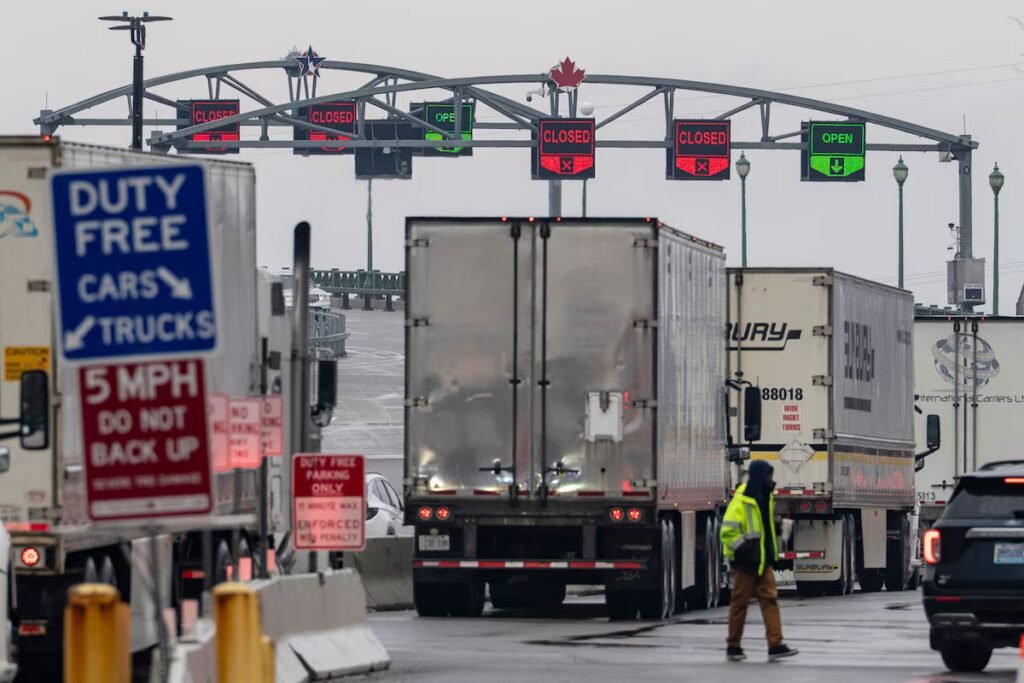

Trucks stop near the Peace Bridge U.S.-Canada border crossing in March. There are hints that the Trump administration will define illegal transshipment through a protectionist lens, writes Rita Trichur.Yuki Iwamura/The Associated Press
U.S. President Donald Trump’s administration is developing a new technological weapon to escalate his global trade war – and Canada could easily become caught in its crosshairs.
The White House is warning the world that it is creating an artificial-intelligence-enabled “detective border” to crack down on customs fraud by China and to impose “penalty tariffs” on other countries that enable Beijing’s evasion of U.S. duties.
Although the AI tool is ostensibly being designed to detect abuses of the United States-Mexico-Canada Agreement and other trade deals, its inevitable algorithmic biases (we are talking about Mr. Trump and his toadies, after all) also risk frustrating Canada’s efforts to diversify trade away from the U.S.
This looming, yet underreported threat is casting a pall over the future of USMCA because it is informing U.S. demands for tighter rules of origin, favouring more American content, aimed at the auto sector and beyond.
Washington’s concern centres on a common trade practice known as “transshipment.” As I explained in a previous column, it occurs when foreign goods make a temporary stop in an intermediary country en route to their final destination.
Rita Trichur: If China is exploiting gaps in USMCA to skirt U.S. tariffs, the antidote is not American greed
Sometimes those foreign products are used as inputs by manufacturers in the waystop jurisdiction before the finished goods are shipped to their recipients in another country.
Transshipment is a legitimate logistical process that is used by global businesses. Unfortunately, exporters can also exploit the system to evade tariffs or sanctions through customs declarations that misclassify goods, fraudulent certificates of origin and minimal processing in intermediary countries.
The Trump administration, however, is deliberately blurring the line between legal transshipments and the illegal smuggling of goods as it seeks more leverage against its trading partners.
“The second Trump Administration inherited a Great Transshipment Scam – a witch’s brew of economic incentives, bad actors, and lax enforcement that had been allowed to simmer and grow more toxic over time,” the White House states in a report.
Unsurprisingly, it blames Mr. Trump’s predecessors, including former presidents Bill Clinton, George W. Bush and Barack Obama, for allowing “Beijing’s mercantilism” to evolve into a “massive China shock” that has killed U.S. manufacturing jobs.
The report is a total head trip – I recommend reading it with a glass (or three) of Canadian chardonnay – because it absolves Mr. Trump of any blame for China’s tariff arbitrage.
“When a Chinese product facing a high U.S. tariff can be routed through a country with a lower tariff rate, the difference becomes a profit pool,” the report states. “That spread is what turns transshipment from a marginal customs abuse into a global business model.”
Opinion: All’s fair in love and trade war, and Canada must play dirty, too
Citing a mix of estimates, it assesses illegal transshipment flows to be worth US$40-billion to US$303-billion a year.
Canada is among 40 countries that are “associated with elevated illegal transshipment risk,” according to the report.
“China’s biggest enablers range from Mexico and Canada on U.S. land borders to the European Union, India, Japan, and South Korea.”
With respect to Canada and Mexico, it outlines a hypothetical scenario in which Chinese goods make a layover in either of those countries to improperly secure preferential tariff treatment under USMCA before being shipped to the U.S.
“If China-linked goods can be routed through Mexico or Canada and made to appear USMCA-eligible, the tariff may fall to zero or close to zero,” it adds.
To illustrate the plausibility of such a sequence of events, it points to shifting trade patterns that followed the imposition of Section 301 tariffs on China in 2018 (during Mr. Trump’s first presidential term).
It claimed that Chinese goods were increasingly transshipped to the U.S. via lower-tariff countries where they underwent minor processing, repackaging and reinvoicing to feign a new national origin.
The U.S. is including new stipulations regarding transshipment in trade deals with intermediary countries, including Vietnam.
Its forthcoming “detective border,” meanwhile, is being billed as a next-level AI tool for U.S. Customs and Border Protection.
“The U.S. needs a system capable of ingesting and analyzing global trade data with lightning speed, identifying anomalous routing patterns, validating production capacity, and directing enforcement toward the highest-probability offenders.”
There are hints that the Trump administration will define illegal transshipment through a protectionist lens.
“Those who continue will be caught. Those who co-operate will be treated as partners in restoring a fair and honest trading system,” the report states.
That’s the rub for Canada because legal transshipment is tied to trade diversification and foreign direct investment.
“Can the U.S. police how other countries set policies for ‘their’ global businesses?” Dr. Mona Paulsen, an assistant professor of law at the London School of Economics, asks in her Substack.
It’s a rhetorical question, of course. Mr. Trump will surely try.


More Stories
Cohere unveils latest AI platform with more agentic features for businesses
In a time of pulling apart and pulling together, we need inbetween leaders to bring unity
The return of the milk bottle