
Good morning. Labour Day is approaching, which means back to the grind for a lot of people – and increasingly, back to the office instead of working from home. We’ll unpack how return-to-office mandates are helping revive downtown Toronto’s office market, and its economy.
Up first
In the news
Mining: Iron ore giant Vale is shelving the planned IPO of its base-metals unit as the Brazilian government presses the company to retain control of its assets, sources say.
Trains: Ottawa will spend $4.7-billion to manufacture and maintain hundreds of Via Rail passenger cars at Ontario and Quebec facilities, eschewing imports from the United States.
Tech: Open AI, Anthropic and other major AI firms agreed to a new federal framework for data-centre development as local objection to the centres mounts.
Programming note
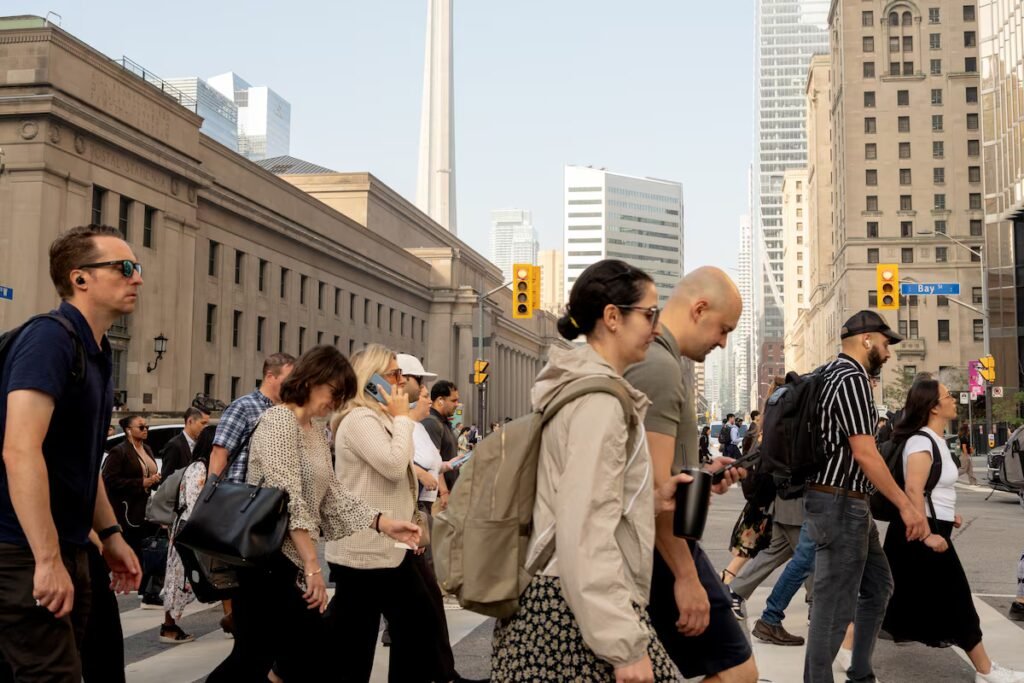
Pedestrians during the weekday commute in downtown Toronto on Tuesday.Will Cox/The Globe and Mail
In focus
The office is back (in Toronto, at least)
Hi, I’m Jason Kirby, an economics reporter with The Globe.
If you’ve spent time in downtown Toronto lately, you’ll have noticed the area has got a lot of its buzz back after a prolonged pandemic slump. Restaurants and coffee shops are bustling again, as is the underground path network that links the city’s skyscrapers.
Behind the shimmering glass facades of those buildings, there’s been tremendous change over the past year, with many of the largest, premium towers swinging from a glut of empty space to the tightest commercial real estate market in years.
My colleagues and I dug into the numbers. Real estate reporter Rachelle Younglai and labour reporter Vanmala Subramaniam joined me in writing our Saturday long read to understand what’s happening in the world of work.
The race for space
Back in May, 2024, The Globe tapped commercial real estate firm CoStar Group to crunch the vacancy and availability numbers on the 47 large office towers in downtown Toronto. One in three buildings were sitting one-fifth empty, and several were only half full.
We revisited those same buildings with CoStar again, and most of that empty space has been grabbed by companies – especially banks – scrambling to find enough room for their employees. As real estate advisers and others repeatedly told us, the power balance has swung hard from a market in which tenants could set the terms to a landlord’s market.
The memo heard across Bay Street
Another power dynamic has flipped – the one between employers and workers – and it directly explains everything we’re seeing.
As far back as 2022 and 2023, there were grumblings among businesses and bank executives about the Zoom economy, and about all of us office drones attending meetings in dress shirts and pajama bottoms. The banks called on their employees to spend two to three days in the office, but the uptake was slow.
Then in May last year, Royal Bank of Canada sent a memo informing its employees they’d need to be back at their desks four days a week, starting that September. Other banks and businesses quickly followed suit.
By then, unemployment rates were on the rise, job vacancy numbers had plummeted, and forces including the Canada-U.S. trade war and the rise of artificial intelligence were leaving workers uneasy about their job security.
But the downtown rebound isn’t all stick and no carrot. Return-to-office mandates created a critical mass of people downtown on a regular basis, providing a gravitational draw for other workers. And as several younger employees told us, there’s career value to being seen in the office – even if it means shelling out money again for lunches and commuting.
Not all office markets are alike
Not all cities have seen the same rebound. Vacancy rates in large office buildings in Vancouver and Montreal have levelled off, but are still higher than before the pandemic. By the vacancy metric, Calgary’s core has recovered to pre-pandemic levels, but the city was already dealing with a glut of empty space in 2019.
Even in the broader Toronto area and nearby smaller cities, office vacancies remain elevated.
But to the extent that any other parts of the country want to take their cue from Toronto, Hogtown’s downtown experience shows there’s a path back to something akin to the economic vibrancy cities offered before the pandemic.
Minted
Cash is king
Justin Tang/The Canadian Press
Canada’s new $20 bill features a vertical portrait of King Charles, an image of the Canadian National Vimy Memorial and unique security properties, Ian Bailey writes. It’ll enter circulation in February.
Quoted
“The food industry is more than just feeding Canadians – it’s an economic engine with still so much room to grow. To see that level of commitment was really exciting.”
— James Donaldson, chief executive officer at BC Food & Beverage
Industry associations in B.C. and Manitoba have pitched the construction of regional food terminals that would lessen reliance on American trade. Their proposals follow the rollout of Ottawa’s National Food Security Strategy, which pledged $3-billion over a decade to enhance domestic processing and grocery competition, Mariya Postelnyak and Susan Krashinsky Robertson report.
Up next
More files we’re following
Earnings: Ski-Doo maker BRP Inc. raised its financial forecast for the year, while apparel maker Lululemon’s outlook continued to deteriorate.
CPTPP: The 12-country Trans-Pacific trade pact is serving as Canada’s insurance policy against Donald Trump’s economic coercion, Rita Trichur writes.
Basketball: Kawhi Leonard’s pending return to the Toronto Raptors reflects well on MLSE, which refused to indulge his uncle’s outlandish demands, argues Andrew Willis.
Morning update
Global markets were mixed ahead of key U.S. payrolls data and August jobs numbers on this side of the border.
Wall Street futures were muted with the Dow pointing lower, while TSX futures were little changed.
Overseas, the pan-European STOXX 600 was up 0.02 per cent in morning trading. Britain’s FTSE 100 slipped 0.05 per cent, Germany’s DAX climbed 0.11 per cent and France’s CAC 40 declined 0.05 per cent.
In Asia, Japan’s Nikkei closed 1.26 per cent higher, while Hong Kong’s Hang Seng rose 1.74 per cent.
The Canadian dollar traded at 72.45 U.S. cents.


More Stories
Power Sustainable acquires B.C.-based Fine Choice Foods
Iran says 7 oil tankers damaged in Strait of Hormuz as fears of all-out war return
Canadian heavy oil discounts deepen on supply glut