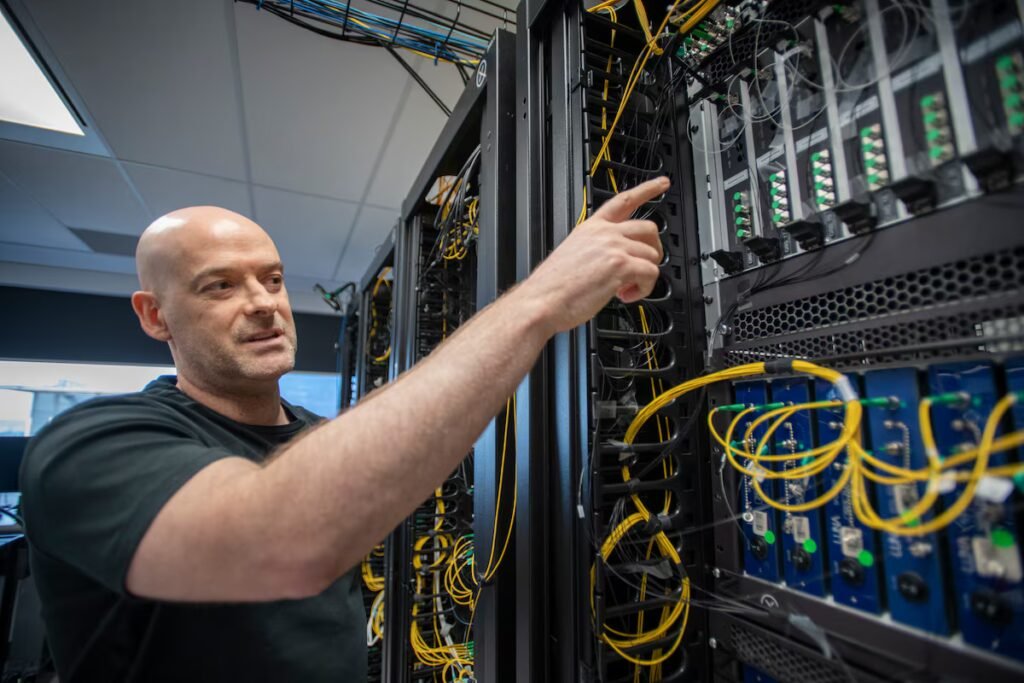

Christian Weedbrook, CEO of Xanadu, by Aurora, a prototype quantum compyter at the company’s Toronto office on Sept 8, 2025.Fred Lum/The Globe and Mail
Xanadu Quantum Technologies Ltd. XNDU-T has secured $195-million in federal funding to support the building of an advanced photonics research, development and manufacturing facility in Toronto.
The Toronto-based quantum computer developer, which went public in March, is also negotiating for up to an equal amount of funding from the Ontario government. The project, located in a 158,000-square-foot facility on the site of a former Campbell’s soup plant in Etobicoke, is expected to cost $893-million.
While the federal government has provided financial support Canada’s fertile quantum technologies sector, Ottawa remains under severe pressure to provide hundreds of millions more to keep domestic players from relocating abroad, a fate that has happened in other technology subsectors.
Several U.S. states including Illinois, Colorado and Maryland have been aggressively courting quantum companies from Canada and elsewhere with incentives to move or open satellite operations in their jurisdictions.
The U.S. government in May also agreed to invest a combined US$2-billiion in nine quantum computing companies. One of the recipients, Australia’s Diraq Pty Ltd., opened a technology hub in Los Angeles this week. Another, D-Wave Quantum Inc., redomiciled to Delaware from Burnaby, B.C., in 2022 and later moved its headquarters to the U.S. D-Wave is a past recipient of Canadian government funding and was once majority-owned by Canadian pension fund manager PSP Investments.
Julien Camirand Lemyre, chief executive of Sherbrooke-based quantum computing developer Nord Quantique Inc., said that despite heavy public-sector investment in quantum infrastructure in the region east of Montreal, it might not be enough to keep his company here if government funding at home doesn’t keep up.
He said U.S. states are offering tens of millions of dollars in incentives just to open satellite offices in the U.S., and more if companies move more or all their operations there. While he said the Canadian government has been supportive of the homegrown sector, “at the end of the day, money speaks. There is a strong pull from the U.S. to provide that capital to companies that are willing to set up a significant presence there. If the opportunity in Canada is no longer here, there’s a point where it doesn’t make sense for us to stay.”
He added Nord Quantique would “need sizable support in Canada for us not to move,” on the order of hundreds of millions of dollars. “Canada needs to act, it needs to act now, if we want to be competitive in that space, if we don’t want to repeat the story that we’re tired of hearing in Canada, about good companies leaving the country.”
Xanadu CEO Christian Weedbrook said in an interview, “It seems every quarter or so there’s this pull to the U.S. We’re proudly Canadian, we want to stay here, but we want to be on the world stage.” Xanadu has already announced an office in New York state.
Canada was an early leader in the development of quantum computers, which unlike conventional systems don’t derive power from manipulating bits of information, but by tapping the peculiar properties of matter and light at microscopic scales.
There are several ways to leverage these effects in a quantum computer, and no clear winner has emerged yet. But if proponents are right, quantum computers will be vastly more powerful than the world’s most advanced supercomputers and able to do calculations beyond the reach of conventional systems. That could open new applications in fields such as material science, drug discovery and financial forecasting.
Quantum computers could also enable bad actors to pick the locks on cryptography algorithms that secure the world’s digital economy.
The federal government has indicated that supporting its homegrown industry is of national importance. Three domestic companies – Xanadu, Nord Quantique and B.C.-based Photonic Inc. – have advanced to the second stage of a U.S. Defense Advanced Research Projects Agency competition challenging developers to show they can build a commercial-grade quantum computer by 2033.
Last December, Ottawa committed up to $23-million apiece to those three (plus a fourth company that isn’t in the competition) in matching funds to what DARPA has offered to those who complete the first two stages. Those that make it through a third and final leg of the competition could qualify for more than US$300-million apiece in American government funding.
“Strategic investments like this one help transform Canadian breakthroughs into globally competitive businesses, strengthen our quantum ecosystem, and create high-value jobs here at home,” Evan Solomon, the federal minister of artificial intelligence and digital innovation, said in a release about the Xanadu funding.
“Quantum technologies will be one of the foundational technologies of the 21st century. By supporting advanced manufacturing and commercialization in Canada, we are helping ensure that Canada remains a global leader in quantum innovation and that more of the economic benefits of that leadership are created here at home.”
Xanadu’s system performs calculations using packets of laser light connected by fibre optic networks. The method is different from other quantum computers whose chips need to be cooled to temperatures just above absolute zero (-273.15 C), to harness their quantum effects. Xanadu’s machines largely operate at room temperature.
Last year, Xanadu unveiled a chip capable of performing quantum error correction, a measure seen as essential for reaching reliable performance for practical uses. Continued efforts to correct errors and improve performance remain a key challenge for Xanadu and its rivals. Its system is also built via a modular approach, making it easier to network and scale up than other systems.
Xanadu has also developed open-source software called Penny Lane that has tens of thousands of active users across an array of quantum systems.
Xanadu is naming its new facility Inception, a nod to Mr. Weedbrook’s favorite movie director Christopher Nolan and his sci-fi film. Mr. Weedbrook, a one-time film student, said Xanadu’s advancement in 10 years to become one of the leading developers in the space “feels like we’re living in a dream.”
The operation will employ 275 people and serve as the company’s global facility for the manufacturing, packaging and assembly of quantum computing components.


More Stories
OpenAI engineer arrested over listening device found in conference room, say FBI, company
Saudi Aramco headquarters reportedly hit by ballistic missile as Houthi conflict escalates
Montreal-based software firm Lightspeed cuts 250 roles