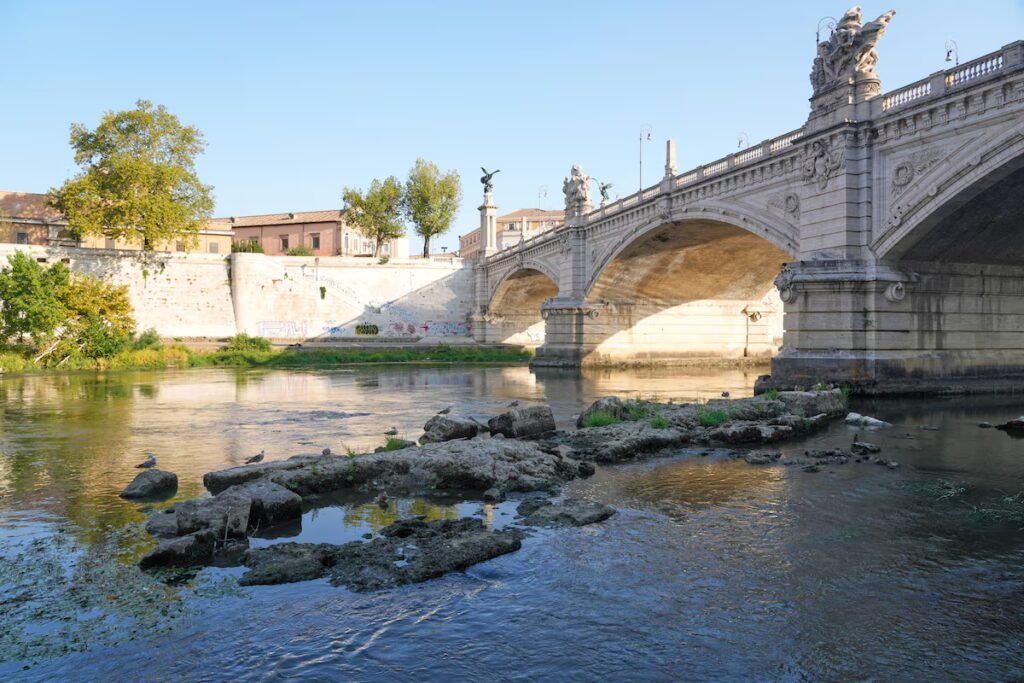

The water is so low in Rome’s Tiber River that the remains of Nero’s Bridge have broken the surface. Along the Danube in Budapest, the “Rock of Starvation,” so named because its exposure signals dangerously low water levels and probable crop failure, has surfaced in its entirety. In France, Spain and Italy, heat stress and the record-breaking drought have sent milk, eggs and cereals output plummeting. Wildfires in Spain, France, Portugal and elsewhere on the parched continent have torched hundreds of thousands of hectares.
The average citizen in Europe is suffering from the extreme temperatures, which have reached the low-40s C in some regions and have proved relentless. June and July in Western Europe were the warmest on record, according to Copernicus, the European Union’s climate observation service, and the temperatures by mid-August had barely dropped.
To add to Europeans’ misery, they soon will be suffering from a new supply shock that stands to push up inflation and interest rates, push down growth rates and raise industrial costs. For decades, climate change was broadly defined as an environmental problem; today, in Europe, the fastest-warming continent, it is becoming an economic and business problem, too.
The ruins of the ancient Roman Neronian bridge, emerge from the riverbed of the Tiber river due to drought, in Rome, Aug. 13.Gregorio Borgia/The Associated Press
The Dutch bank Triodos, which finances environmentally friendly projects, said in its new “Hot Summer Economics” report that the extreme heat could erase most or all of the EU’s forecast growth this year. “The main ways in which heat affects EU GDP are lower agricultural output and higher food prices, constrained energy production and increased transportation costs, and reduced labour productivity,” the report said.
Danube River sinks to record low as drought and heat grip Europe
Triodos estimated that the EU-wide impact could reduce growth by a full 1 per cent. While the figure seems minor, it’s enough to flatline the economy and possibly push it into a shallow, technical recession if the drought and heat wave persist. Before the heat wave hit, the European Commission had expected EU growth of 1.1 per cent in 2026; the International Monetary Fund had forecast 0.9 per cent.
The summer of 2026 has been hotter for longer. While temperatures in previous summers have spiked, they rarely remained this high for more than a few days. This summer has been sweltering since June.
Take Italy. Triodos noted that in the year to the end of July, the country had 53 “hot” days, defined as those at 30 C or greater. Based on the records of previous temperatures, the firm expects a total of 96 hot days in 2026, an excess of 47 days more than the long-term average. Spain and France are expected to have 33 and 41 excess hot days, respectively. The heat is being primarily blamed on a persistent, high-pressure “heat dome” that is exporting savage temperatures from North Africa, not El Nino – the periodic, naturally warming sea temperatures in the tropical Pacific Ocean that developed in June.
Firefighters try to hose down hotspots in the aftermath of a wildfire in Collserola, near Barcelona, Spain, August 14.Bruna Casas/Reuters
The main victims of the European heat waves have been workers’ productivity and water availability.
Simply put, when it’s hot and you don’t have air conditioning – AC in Europe is relatively rare compared with North America – you don’t want to break a sweat. According to Germany’s Allianz, the world’s largest insurance company, a worker’s output an hour falls 3 per cent when temperatures hit 30 C or more.
For the broader economy, the water levels are the biggest immediate threat. The levels in rivers and lakes, especially in the main rivers that are crucial transportation corridors, are falling everywhere. The efficiency of the agriculture, energy and transportation is driven by water availability.
Editorial: Europe’s burning question
The Rhine has been called Germany’s “blue highway” and is normally stuffed with long, low barges that carry everything from coal and iron ore to chemicals and heavy manufactured goods. They are the lifeblood of the industrial Ruhr region and can take their cargoes to and from Rotterdam, Europe’s biggest seaport.
Recently, the Rhine level at Lobith, the town where the river enters the Netherlands, was at its lowest since records began in 1901, at 6.1 metres. Its normal depth is 8.7 metres. The water was even lower in other parts of the river. To avoid running aground, Rhine barges are taking only about 20 per cent of their normal loads, driving up delivery costs. A factory now has to pay for four or five barge trips to get the same amount of cargo it could get with one.
Holger Schmieding, chief economist at Germany’s Berenberg Bank, said that freight rates on the Rhine have climbed sevenfold since early June and that the extra costs will ripple through the supply chains, driving up prices. Triodos said, “Economists estimate that if these transport disruptions persist, they could reduce German GDP growth by around 0.2 percentage points.”
Boats sail on the Rhine river with low water levels near Bendorf, Germany, August 11, during prolonged dry weather across Europe that causes massive consequences for German industry.Stephane Nitschke/Reuters
The heat is pushing up electricity prices. Air conditioners are running flat out, raising demand for power. At the same time, some nuclear plants that depend on water for cooling are shutting down or running at reduced capacity. This week, French power prices hit their highest level since January, 2025, as the country’s nuclear output fell. RTE, the French electricity transmission operator, said the nuclear fleet availability early this week was only 58 per cent of regular capacity. Capacity has been reduced at Swiss and Hungarian reactors, too. On Aug. 13, lack of Danube cooling water forced the closing of Romania’s sole reactor.
Agriculture is suffering the twin hit of soaring temperatures and drought. The EC said in July that crop losses brought on by heat waves and droughts have tripled in the past 50 years. During the particularly savage summer of 2003, corn yields fell by 21 per cent across the EU.
In Umbria, a largely agricultural region in central Italy, farmers this month were worried that the drought would hammer their crops. Already, the corn and sunflower fields were in dire shape and farmers like Fausto Venturi feared that their precious olive trees would be next on the hit list. Then, on Monday, the skies darkened and the region was treated to an unexpected downpour of rain.
Olive trees can survive in parched conditions, but only for so long. “The trees were suffering in the intense summer heat,” Mr. Venturi said. “But with this mid-August rain, they will surely regain their vigour.”


More Stories
No country for retail investors: Are your ETFs a great product – or are you the product?
Carney’s first-ever project of national interest, Stelco cites tariffs for layoffs and finance executives bet on prediction markets: Must-read business and investing stories for the week of October 3
Behind the rise of Canada’s lengthy ‘Frankenstein’s monster’ tax code