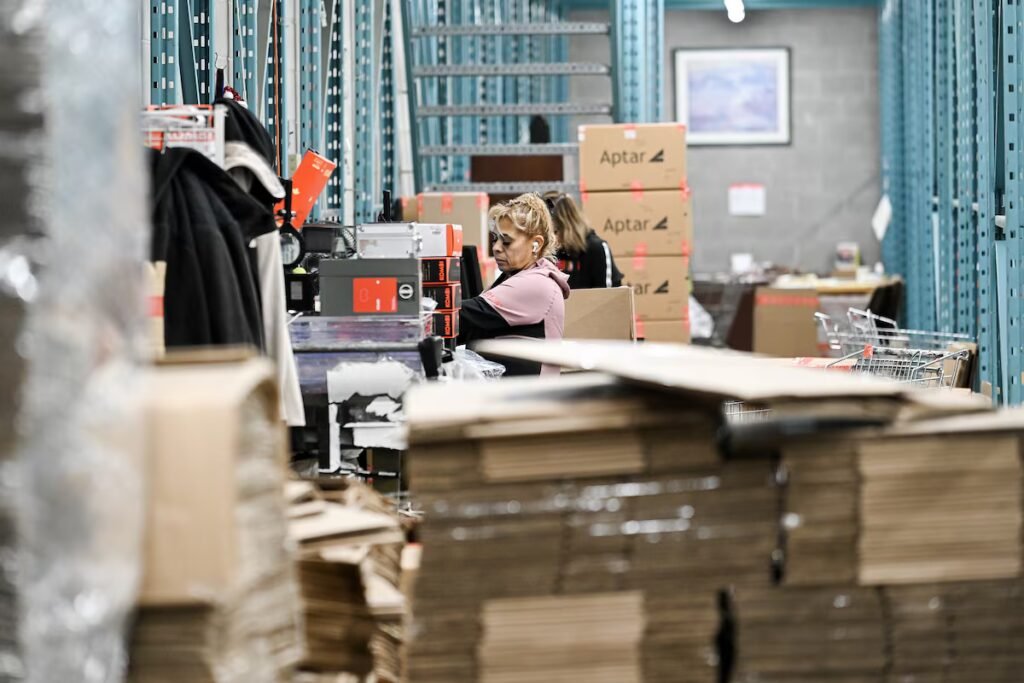

A worker checks inventory at winter accessories brand Kombi’s Montreal warehouse in 2024. The Canadian apparel and textile industries would be among those hit by new section 338 tariffs.Graham Hughes/The Globe and Mail
As Prime Minister Mark Carney and Canadian negotiators race to avert new U.S. tariffs on US$20-billion of goods, three scenarios loom: a deal, a delay in the tariffs or, in the worst outcome, no deal whatsoever.
If the latter happens, President Donald Trump has vowed to hammer hundreds of products imported from Canada with a 50-per-cent tariff starting Wednesday at 12 a.m., including electronics equipment, textiles, furniture and alcohol.
To do so, Mr. Trump has invoked section 338 of the Depression-era Tariff Act, which allows the White House to penalize countries for discriminating against U.S. products. In Canada’s case, the levies target this country for curbing imports of U.S. autos, alcohol and dairy.
Assuming the tariffs go ahead in the event of no deal, here’s how they would hit Canada’s economy, the industries and regions that are most at risk, what a revival of Canadian countertariffs could look like, and what the breakdown in talks means for Canada’s United States-Mexico-Canada Agreement (USMCA) negotiations.
What would be the hit to Canada’s economy from the new tariffs?
On the surface, the fallout from the section 338 tariffs appears limited, but the measure of trade pain is in the eye of the beholder.
The 50-per-cent tariffs would apply to only 5 per cent of Canada’s exports to the U.S., and the effect on Canada’s gross domestic product would be relatively small. Royal Bank of Canada pegs the impact at 0.4 per cent of GDP, while Capital Economics estimates the fallout at 0.6 per cent.
Even so, a collapse in those affected exports “would still be enough to push already-weak GDP growth back towards zero,” Bradley Saunders, North America economist with Capital Economics, wrote in a new report. Canada’s economy got off to a rocky start this year with annualized growth in the first quarter declining for the second consecutive quarter, but is on track for a rebound when second-quarter numbers are released later this month.
But below the surface, pockets of Canada’s economy and job market will be particularly exposed, according to a recent analysis by RBC. The tariffs could hurt roughly 20 per cent of production and jobs in industries such as apparel and electrical equipment.
What products do the tariffs hit and which industries are most exposed?
Since Mr. Trump unveiled his section 338 hit list in July, a lot of attention has gone to some of the particularly Canadian products at risk, such as hockey sticks and skates.
The reality is U.S.-bound shipments of hockey-related gear (around US$20-million a year) are dwarfed by other products, with US$4.4-billion worth of electronics and electrical equipment set to be hit by the tariffs.
Some companies in that sector have already warned that a 50-per-cent levy would be devastating. Likewise, furniture manufacturers have been bracing for a sharp slowdown in orders if the tariffs take effect.
Roughly 30 per cent of U.S. imports of Canadian dairy, a sector that has drawn Mr. Trump’s ire, are exposed to the tariffs. So, too, is a large share of Canadian alcohol shipments.
In earnings calls, companies have been pressed by analysts about the 338 tariffs. Dino Bianco, the chief executive officer of tissue-paper maker Kruger Products Ltd. KPT-T, said roughly 1 per cent of its total sales would be affected.
In the apparel sector, the tariff list includes men’s, women’s and children’s jackets containing “down and waterfowl plumage,” which seems aimed at Canada Goose Inc. GOOS-T
In the company’s first-quarter earnings call, chief financial officer Neil Bowden said a portion of its products would be affected and that the impact on Canada Goose’s 2027 operating margin “would be less than 200 basis points,” or two percentage points.
The company’s stock price has fallen 14.1 per cent since the tariffs were announced on July 20.
What regions would be hardest hit by section 338 tariffs?
Three provinces will bear the brunt of the new tariffs: Quebec, British Columbia and Ontario.
For B.C., the tariffs would affect roughly 14.5 per cent of the province’s shipments to the U.S., based on year-to-date trade numbers, leaving it acutely exposed. The lumber and electronics industries would be hardest hit.
Ontario, as Canada’s largest economy and manufacturing hub, would carry the steepest absolute burden, accounting for more than half of all the U.S. imports from Canada targeted by the White House.
But Quebec is also uniquely exposed. In a recent report, National Bank of Canada economists calculated the province already faces the highest effective tariff rate for goods shipped to the U.S., at roughly 7 per cent.
With the section 338 tariffs, that tariff rate would jump to 11 per cent, with the province’s dairy, furniture, electronics and paperboard sectors all coming under fire.
Already beset by tariffs, Quebec braces for another big trade hit
As hard hit as those provinces would be, the Prairie provinces escape largely unscathed as a result of Mr. Trump’s decision to spare energy and potash imports from new tariffs. Little more than 1 per cent of Alberta and Saskatchewan exports to the U.S. would face 338 duties.
Canada has threatened to retaliate. What would that look like?
Ottawa has signalled that it’s prepared to retaliate if the 338 tariffs come into force, although details of any plans remain a closely guarded secret. Mr. Carney has ruled out restricting oil exports to the U.S., but said that a range of other options remain on the table.
Last year, Canada imposed three rounds of countertariffs, covering more than $90-billion worth of U.S. exports, before carve-outs are taken into account. The countertariffs were set at 25 per cent, and covered hundreds of items, from orange juice to home appliances to motorcycles. In September, 2025, Ottawa withdrew around half of these tariffs (covering around $45-billion worth of goods) in an attempt to advance trade talks, but left tariffs in place on U.S. steel, aluminum and automobiles.
Ottawa could reimpose the levies it lifted last year. That would hit U.S. exporters but also raise costs for Canadian consumers.
A Bank of Canada study of the 2025 retaliatory measures found that the price of tariffed items in Canada rose by about 6 per cent, implying around a quarter of the 25-per-cent tariff was passed along to consumers. The impact of the tariffs on overall inflation was relatively limited, adding roughly 0.3 percentage points to the Consumer Price Index at the peak of the price shock.
One risk is that retaliation from Ottawa could lead to escalation from Washington. Last week, Jamieson Greer, the top U.S. trade official, warned that the U.S. is “not going to tolerate” retaliation. “We’ll take action,” he said.
What would it mean for broader U.S.-Canada trade talks?
The threat of section 338 tariffs has had at least one positive effect: It’s brought Canadian and U.S. officials to the negotiating table after months of impasse. If, however, the two sides fail to reach an agreement and the 338 tariffs come into force, trade talks would likely grind to a halt.
Janice Charette, Canada’s chief negotiator, has told her U.S. counterparts that the new tariffs represent a “cliff,” according to Globe and Mail reporting; if they’re imposed, Ottawa would likely walk away from the negotiating table and retaliate.
The current round of talks is happening against the backdrop of broader discussions about the future of the USMCA. On July 1, the Trump administration opted not to extend the agreement for another 16 years, pushing the trade pact into a period of annual reviews for a decade, after which it will expire if no extension is agreed upon.
If there is a breakthrough this week, Ottawa and Washington can move forward with deeper discussions about potential changes to the USMCA, including trilateral talks with Mexico about things like rules of origin for automobiles and other industrial goods. A breakdown in trade talks, by contrast, would make it difficult for negotiations to proceed, further calling into question the future of the USMCA.
Broadening the lens, Ottawa and Washington have the chance to reset the relationship between the two countries, opening the door to more collaboration in areas like energy and defence, and shoring up the continental industrial base to compete with China. Mr. Carney has said he’s open to a “Fortress North America” approach in key sectors. But if the U.S. moves ahead with 338s and trade talks break down, the “rupture” Mr. Carney has often spoken about will become wider.


More Stories
No country for retail investors: Are your ETFs a great product – or are you the product?
Carney’s first-ever project of national interest, Stelco cites tariffs for layoffs and finance executives bet on prediction markets: Must-read business and investing stories for the week of October 3
Behind the rise of Canada’s lengthy ‘Frankenstein’s monster’ tax code