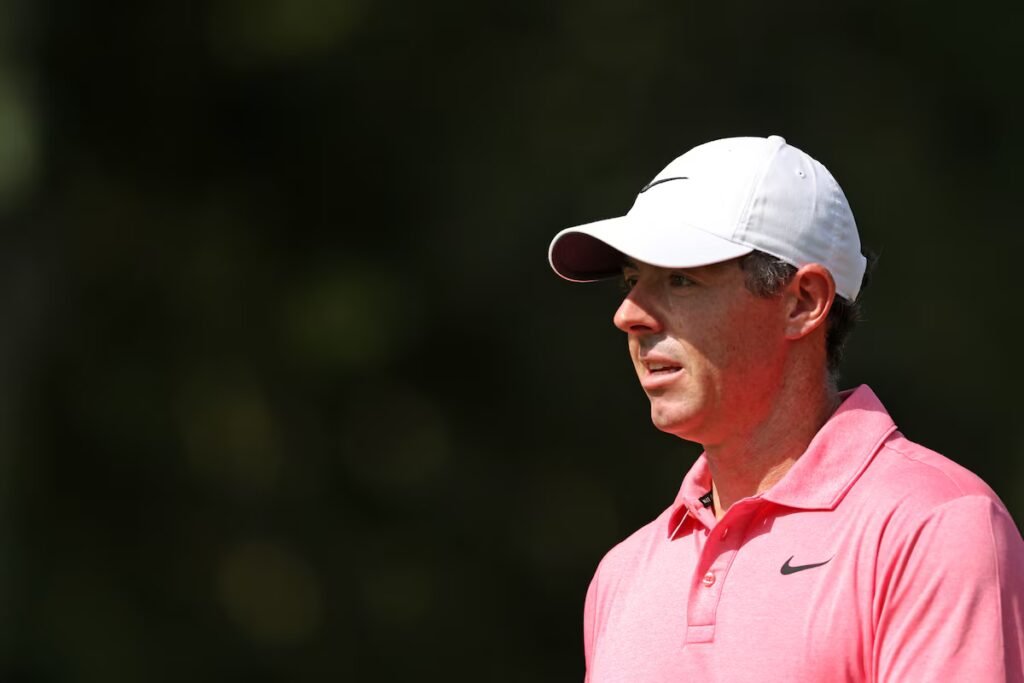

Rory McIlroy will play in 14 of the 15 required tournaments to remain in good standing with the PGA. The defending Masters champion isn’t too worried about it.Stacy Revere/Getty Images
Like any good part-time employee, Rory Mcilroy is happy to help out when he’s needed. He just doesn’t want to be tied to a schedule.
This year, the Irish golfer will not hit his minimum to remain a member in good standing on the PGA Tour. You’re supposed to participate in 15 PGA events. McIlroy will only play 14.
Adding more golf is apparently a non-starter. Instead, McIlroy has been on the horn with Brian Rolapp, head of the PGA Tour, trying to determine “what I can do with the Tour to fulfill the obligation to keep my membership.” Does Rolapp have a kid in need of a surprise birthday party guest?
Whatever it is, McIlroy is plainly unbothered. They’ll work something out, which is another way of saying ‘They’ll do what I want’.
Apropos of this, someone mentioned a story told by baseball manager Terry Francona about a golf date with Michael Jordan. As they drove to the course, Francona asked Jordan when their tee time was.
Cathal Kelly: Here’s a suggestion on the Kawhi Leonard-Clippers drama – forget it happened
“Whenever we get there,” Jordan said.
There are levels of power in sport, and this is the highest – when everybody else’s rules no longer apply to you.
Money used to be the measure of it. What you made as a pro expressed who you are. But that’s gotten harder to quantify.
I am as close to certain as I can be that the 1,240th ranked women’s tennis player in the world, Serena Williams, makes more than most (all?) of her colleagues in the top 10, but there’s nowhere to verifiably check that.
Jannik Sinner, who hasn’t competed since winning Wimbledon in July, passed on taking part in tournaments in Montreal and Cincinnati this summer.HENRY NICHOLLS/AFP/Getty Images
So the pros must find other ways to signal their dominance. The new one – work when you feel like working.
This is a big problem in tennis. Other than the rankings, there is no mechanism to induce the best players to take part in subsidiary tournaments, and the best players don’t sweat rankings. The money matters to some people, but not the sort of people you put on the billboards.
If Jannik Sinner is getting eight figures a year guaranteed from Gucci and Rolex, why would he care about a shot at making a single million in Montreal? If he doesn’t win the tournament, he has essentially paid his own way for a two-week work trip to Canada.
French Open champion Alexander Zverev got at this when it suggested to him that the ATP might consider paying larger bonuses for greater participation.
“You think Novak [Djokovic] will care?” Zverev said. “The guy is worth north of 400-million in his bank account.”
Djokovic has lost his undisputed leader status, but he is still an alpha because he is able to cancel last-minute on burgs like Montreal. It’s not that they want him. It’s that he feels free not to want them back.
Meanwhile, sports organizers continue to ask more of labour. If they wanted to, top golfers could play every week of the year. Which is why the best of them don’t want to.
Golfing (or tennissing or basketballing) constantly is a mark of the underclass. You need ranking points, money or a card or whatever. True excellence is wanting for nothing. Like Jordan, you need only decide when you feel like showing up. That’s when things will start.
In Europe, the biggest teams now have two teams’ worth of players. The good team that plays in the big events, and a slightly less good team that plays in everything else. Greatness is not demonstrated by how often you perform, but how little you can get away with doing so.
Kawhi Leonard, seen here at the National Bank Open in Toronto, hasn’t played 70 or more games since 2016-17. If the NBA wants to punish him, Cathal Kelly writes, it should make him suit up for all 82 this season.Dan Hamilton/Reuters
Eventually, this system will filter openly to North American team sports. For now, it’s left to a nudge-nudge wink-wink system. This or that star is undefinably injured or visiting a sick aunt.
In Toronto, everybody’s worried about Kawhi Leonard showing back up saddled by a long suspension for his salary shenanigans in L.A. Why? Did you think the guy was gong to play 80 games?
Forty games a year is about the amount Leonard prefers, and it’s not like the team can insist otherwise. If the league sits him for that long, it will be sparing the Raptors the hassle of explaining it to ticket holders.
Here’s a suggestion on the Kawhi Leonard-Clippers drama – forget it happened
If the league really wants to punish Leonard, it’ll make him play all 82.
If Connor McDavid came to the Oilers and said, ‘I’m thinking of taking most of February off,’ what would they say back? They’d say, ‘Roger that.’ Then they’d start spreading rumours about how McDavid has bravely overcome rickets.
If sports wanted to end this practice, they could. Don’t want to play in X number of tournaments or Y number of games? Great, no Masters for you. No Wimbledon. No first round of the playoffs. No exceptions.
But people don’t want to see the same old regulars every night. That’s 1990s thinking. They want to see the people who don’t want to see them. They want crazed hype and special guests and to feel like they’ve won the big-night-out lottery, which includes the peril of disappointment. They want the World Cup final and please let everyone know how much I blew on this, or otherwise it will all have been for naught.
That creates a two-tier scheme that lies on top of the existing one. There are the games and tournaments that the good players will go out of their way to be in, and the ones they are likely to skip. This new wrinkle doesn’t make the bad tickets any cheaper. It only makes the good ones harder to get.
The real framework for this set-up isn’t scarcity. It’s having a critical amount of suckers.
As long as there are plenty of those willing to pay whatever to see whomever, and then pay much more to see the people they refer to by first-name only, it doesn’t really matter what calibre of show you put on. What matters is that the house is full regardless.


More Stories
Ogunbowale scores WNBA playoff-record 45 as Wings win in OT to force deciding game with Valkyries
Yankees thump Red Sox 9-2 for Wild Card Series sweep
Cowan, Stolarz push Maple Leafs past Islanders 2-1