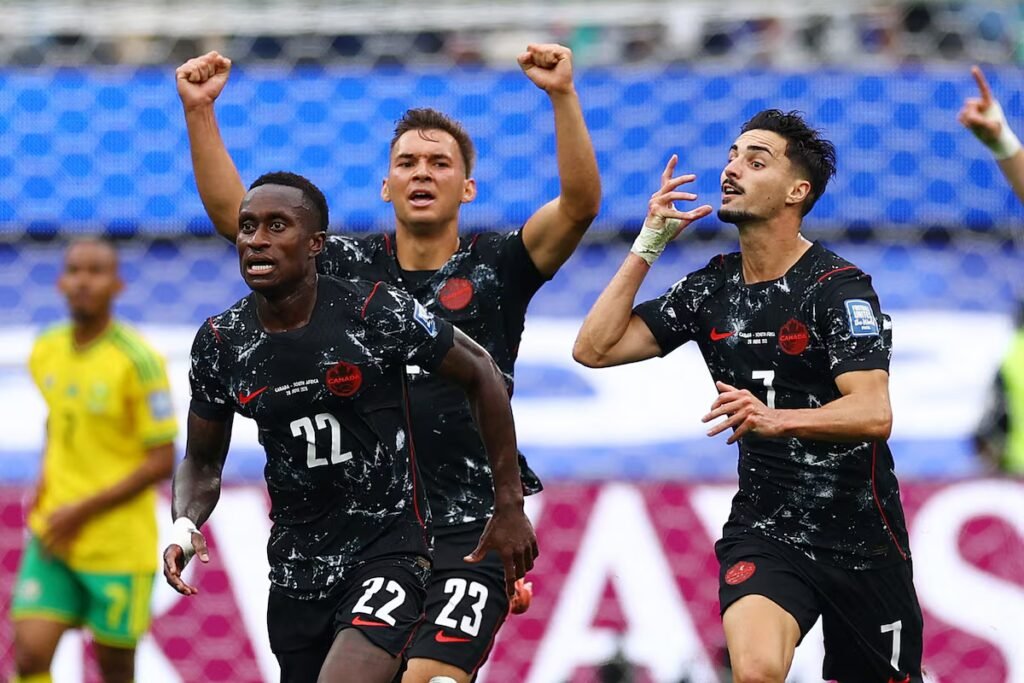

Canada midfielder Stephen Eustáquio, right, sparked a frenzied celebration back in June with his winning goal against South Africa in the World Cup round of 32.Matthew Childs/Reuters
It was a little more than two months ago that Spanish captain Rodri lifted the World Cup trophy in East Rutherford, N.J., with U.S. President Donald Trump and FIFA president Gianni Infantino standing awkwardly to the side.
While Trump and Infantino have remained front and centre ever since, Spain and other World Cup sides like Canada are only now stepping back into the limelight.
Top-ranked Spain visits No. 4 England at London’s Wembley Stadium on Saturday while No. 30 Canada hosts No. 49 Chile at Toronto’s BMO Field for the first of three games during the September-October international window.
It marks the first step toward the 2030 World Cup.
But for Canada coach Jesse Marsch and Canada Soccer chief executive officer Kevin Blue, it is a continuation rather than a new cycle.
“We’ve always, all along, thought of the World Cup as a mile-marker and not the destination,” Blue said in an interview. “We view the World Cup as an accelerant of the growth in the sport that has already been taking place.”
Marsch said there is no need to make drastic changes.
“Certainly there will continue to be a development and a cycling of how we progress to get ourselves really ready for 2030,” he told a news conference Friday. “But we felt like it was time to just continue to push the environment every day and continue to be great at the things we want to be great at, to introduce new players along the way to see how they fit and how they can meet the standards and challenges that we’ve set for what this national team is.”
Canada’s Promise David is confident he can thrive in his new life in England
In reaching the round of 16 – where it succumbed 3-0 to sixth-ranked Morocco after a dramatic first-ever knockout-round win over No. 54 South Africa – co-host Canada gave the country plenty to cheer about.
According to initial figures from Bell Media, 30.5 million unique Canadian viewers watched live tournament coverage.
And a Canada Soccer-commissioned poll by Abacus Data, conducted July 14 to 16 just ahead of Spain’s 1-0 championship win over defending champion Argentina, showed soccer as the respondents’ second-favourite sport (at 12 per cent) behind hockey (32 per cent) with baseball third (11 per cent), basketball fourth (9 per cent) and football fifth (tied with swimming at 8 per cent).
Soccer ranked No. 1 among respondents aged 18 to 29 (19 per cent compared to 17 per cent for hockey) and those not born in Canada (28 per cent ahead of basketball at 15 per cent and hockey at 13 per cent).
Canada Soccer’s mission now is to continue that growth on and off the pitch.
CONCACAF, the governing body that covers North and Central America and the Caribbean, could send up to seven teams to the next World Cup with Marsch looking to have his team crack the top 24 of the world rankings, so as to secure a more favourable draw from Pot 2 (as 2026 tournament co-host, Canada was in Pot 1 while it came out of Pot 4 at the 2022 World Cup in Qatar).
So results matter, with every ranking point valuable.
While CONCACAF World Cup qualifying kicks off in September, 2027, the Canadians – by virtue of their ranking – are expected to enter the second round of qualifying later that year.
Jonathan David, whose 42 goals are the most scored by a man for the Canadian national team, recently switched clubs, moving from Juventus to Atletico Madrid on loan.Juan Barbosa/Reuters
Canadian players were on the move this summer.
Recent transfers include Jonathan David to Spain’s Atletico Madrid (on loan from Italy’s Juventus), Stephen Eustaquio to Welsh team Swansea City (from Portugal’s Porto), Promise David to England’s Brighton (on loan from Belgium’s Union Saint-Gilloise), Nathan Saliba to Spain’s Villarreal (from Belgium’s Anderlecht), Liam Millar to Birmingham City (on loan from fellow English side Hull City), Theo Bair (on loan from France’s Auxerre) and Jayden Nelson to Bolton Wanderers (from Major League Soccer’s Austin FC), and Niko Sigur to France’s Toulouse (from Croatia’s Hajduk Split).
Moves up the club ladder are welcome, as long as they are accompanied by playing minutes.
Canada Soccer sporting director Kenneth Heiner-Moller notes that 90 per cent of the starting lineups of the eight quarter-finalists at the recent World Cup played for clubs in the top five leagues in Europe (England, France, Germany, Italy and Spain).
The numbers are the same on the women’s side, counting leagues in England, France, Germany, Sweden and the U.S.-based National Women’s Soccer League.
While Marsch and women’s coach Casey Stoney can do their bit to help find good club homes for Canadians, Heiner-Moller says it is the players’ performance that opens doors.
“That’s what took some of these guys to pretty prominent clubs,” said Heiner-Moller, who coached the Canadian women from January, 2018, to June, 2020.
Gary Mason: Turns out the World Cup is just what Canada needed
Following the World Cup, Heiner-Moller, Marsch and Stoney put their heads together over what style of play is needed to be successful.
“It’s aggressive, it’s direct, it’s high tempo and high energy,” said Heiner-Moller.
But given he hails from Denmark, with Marsch an American and Stoney English, Heiner-Moller is canvassing former Canadian players for their take on what constitutes Canadian soccer DNA.
Heiner-Moller says another take-away from the World Cup was that successful teams had a well-established, distinct identity.
“We need to do the same,” he said.
He is also looking at ways to improve the pathway for young talent, noting young players in parts of Europe get more playing time than their counterparts in Canada.
Young Canadians have excelled in recent months with the women reaching the quarter-finals of the FIFA U-20 World Cup and the men, with Marsch serving as coach, qualifying for the 2027 U-20 World Cup, a tournament they have not taken part in since hosting the event in 2007.
But there is no room for standing on one’s laurels.
“We need to improve just to keep our level, just to keep our competitiveness,” Heiner-Moller said.
Marsch celebrates Canada’s 6-0 smackdown of Qatar, the historic first World Cup win for the men’s program.DARRYL DYCK/The Canadian Press
With Canada Soccer’s bottom line back in the black – Blue says the organization will exceed the forecast surplus of $6,555,000 this year – there will be more funds for national youth teams.
While Blue is bullish on the future, he has repeatedly called for help in growing the sport – from corporate Canada and the media to fans buying tickets.
While the men’s tournament this summer drew big numbers across TSN, RDS, CTV, Noovo and Crave, Netflix holds the Canadian and U.S. broadcast rights to the the 2027 and ‘31 Women’s World Cups. That means just one provider – and perhaps a one-size-fits-all approach – to the tournament unless a Canadian broadcaster joins as a sub-licensee.
That is concerning.
In addition to drawing a bumper TV audience, Canada’s success this summer arguably triggered a tidal wave of national pride – a commodity all the more valuable given what is happening south of the border these days.
“International sport is a nation-building opportunity for Canada,” said Blue. “And it takes the form for Canadians as an opportunity to show the character, the kindness, the empathy, the diversity of our country on the biggest stage in global sport – in the men’s World Cup.”
Off the pitch, Canada Soccer is set to start consulting stake-holders for a new strategic plan that will help determine its investment priorities. Conversations continue with FIFA on what legacy funding Canada Soccer will get from the World Cup in its role as co-host, money that will help fund a planned national training centre.




More Stories
Elks squeeze out 37-35 win in overtime as Ticats eliminated from playoff race
Montreal beats Cincinnati 3-1 to snap a five-game losing streak
Canadian men defeat nine-man Chile in first outing since FIFA World Cup