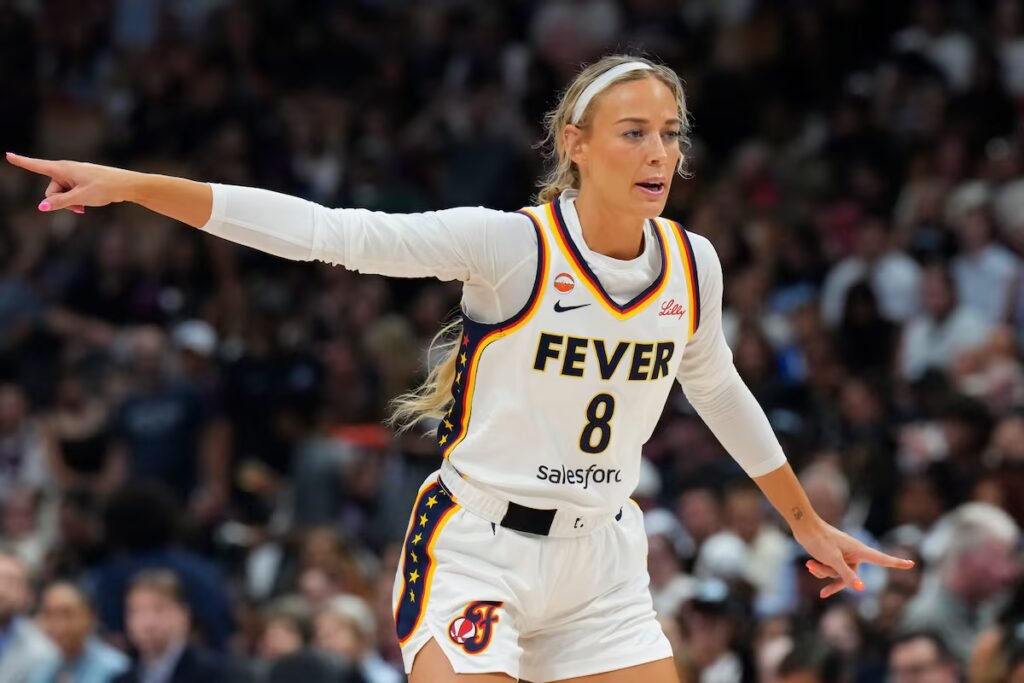

Sophie Cunningham of the Indiana Fever, seen here during Tuesday’s game against the Toronto Tempo at Scotiabank Arena, shared her opinion on transgender athlete participation last month. Those comments have led to an avalanche of attention on her, the Fever and the WNBA.Chris Young/The Canadian Press
Through the course of my writing career, I’ve upset many people. It’s kind of what I do.
The players don’t (usually) care. They are awash in critics. But the people in charge feel every printed slight. All the general managers and presidents of teams I’ve covered are unhappy when they are inevitably fired, but various degrees of delighted to see the back of me.
I once did a profile of an incoming Toronto Maple Leafs executive. Never met the guy. Upon being led into his office, the first thing he told me was that someone in his family had read what I’d written about his arrival and warned him off.
“Do you know Cathal Kelly? Because he hates you already,” she’d told him.
Not true. Hate suggests deep emotion, which I hold in precious reserve for the people I care about. But I get it. If you are used to being told you’re brilliant, anything short of fawning praise feels like an attack. So we both laughed, agreed that was a crazy position, and had a back and forth about as open-hearted as a KGB interrogation.
Cathal Kelly: Everyone but the WNBA has an opinion on what the league should say about transgender participation
I don’t think he was delighted with what I wrote about him that time either, but he never said anything. He certainly didn’t try to impede me. Whenever we saw each other, he was more than cordial. If he’d had a go at me I would’ve understood. But then he and I would both have known that I’d won, so he didn’t.
I can’t remember anybody trying to shut me up before the fact until this week. That’s when the WNBA’s Toronto Tempo gifted me a career first – they refused me a credential to cover a game. I’d begun to wonder if anybody would ever pay me this compliment. It was on my professional bucket list.
I’d applied in good time to cover Tuesday’s game between the Tempo and the Indiana Fever. The request is done through an online portal, and then you wait.
“Hi there,” Monday’s refusal e-mail began.
“Due to a large number of media requests for Tempo vs. Fever (August 18), we are unable to accommodate your media credential request at this time.
Thank you for understanding,
Tempo PR”
I gather that means they didn’t have enough space. That would be more plausible if they’d held the game in owner Larry Tanenbaum’s pool house rather than the Scotiabank Arena, which has hosted an NBA final.
Along with every Canadian journalist who’s ever laid on eyes on a basketball, every likewise American, a gaggle of Asians, Africans, South Americans, Europeans and about a million drones from ESPN, I was at that final. I remember it feeling full, but not bursting. There were empty chairs.
Also, I’d understand if I worked for a newspaper published out of my garage, or if the Globe never covered the team. But neither is the case.
That leads me to suspect this wasn’t a space, outlet or coverage issue. It could be a me issue.
I’ve written a couple of things about the WNBA recently and – I’m putting my hand up – they weren’t what you’d consider marketing copy. Nowhere in there did I say that it is your duty to support this struggling start-up valued in the hundreds of millions.
Both pieces hinged on Fever guard Sophie Cunningham’s take on transgender participation in women’s sport. I believe Cunningham has a point.
Caitlin Clark of the Indiana Fever arrives at Scotiabank Arena ahead of Tuesday’s game against the Toronto Tempo.Tara Walton/Getty Images
So it’s possible that in addition to being insufficiently supportive of the financial objectives of the Tempo ownership group, it’s also possible that I am an enemy of progress. If there was an ad hoc tribunal or struggle session I could apologize to, I wouldn’t, but I would ask them whether they got floor seats on Tuesday night. Those are great seats.
I am keenly aware that no one owes me an invite to anything. I’m taking up space that could be filled more usefully by franchise cheerleaders or, better still, sold to paying customers.
Excepting a few newspaper types, just about every contemporary sports correspondent is either working for or beholden to the teams, leagues and circuits they cover. The clubs used to be sheepish about this. Not any more.
So if the government of the United States can bar its haters in the press, why shouldn’t the local ball club adopt the Pete Hegseth Pentagon PR model?
The people running teams now seem to believe that journalism should work like the CCP – nobody is going to tell you what to say, but there are limits.
I have no such limits. Once in a while, an editor will say, ‘You sure that ‘slack-jawed incompetent’ is how you want to put it?’ Everything else is a free-fire zone.
Mostly, what I wanted to do here was thank the Toronto Tempo. One can lose sight of the point of doing this job, which is upsetting the right people.
I’m disappointed to miss the game, which I’m sure was fun. I trust that whoever made the cut ahead of me had only nice things to say about what went on there, and got the sponsored logos in their posts. I want everybody to not only feel good about the occasion they hosted, but that they were able to extract maximum value from the hosting.
If there was any negativity around Cunningham’s presence, I expect no one had the gall to do it around the merchandising kiosks, where it might impede commerce. If that negativity was expressed where it could be seen by children or other sensitive minds, I trust it was the corporately endorsed sort of negativity, and not the other kind.
In future, I hope all Tempo games are as well reviewed as a Soviet orchestra. I’m sure that, bound together by a like-minded sense of purpose, everyone will do their best to increase shareholder value in this essential local enterprise. I’ll be cheering along from home.


More Stories
Shaffelburg’s brace leads Canada past Peru 2-0
Canada’s Leylah Fernandez ousted in second round of China Open
Stampeders hold off Riders to continue hot run