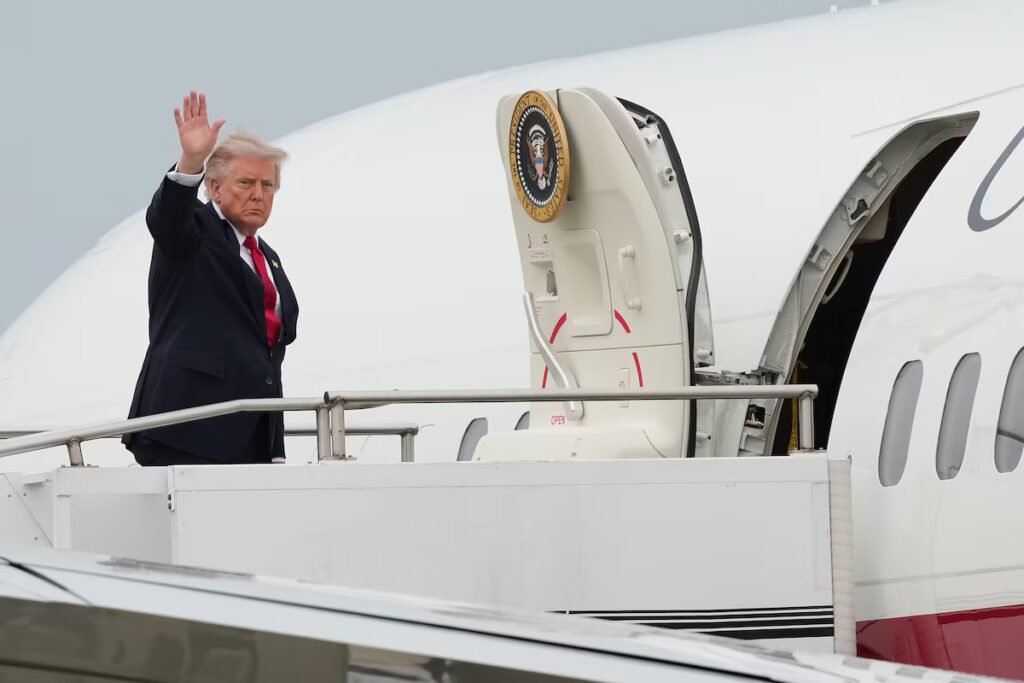

U.S. President Donald Trump boards Air Force One as he prepares to depart from Oakland County International Airport on July 27.Andrew Harnik/Getty Images
This isn’t over.
U.S. President Donald Trump likes to win. He also often likes to play make-believe. He has a habit of declaring victory on social media based on few discernible facts, or none at all.
When he has something to market, he markets it. When he doesn’t, he’s liable to fake it until voters believe that he’s made it.
How many times has he announced that Iran is finished? That a peace deal is imminent? That the Strait of Hormuz is open, oil has never stopped flowing and Oceania has always been at war with Eastasia?
I can’t count that high without an abacus.
The former reality TV star also loves to engineer a cliffhanger. Hence his decision to build a tariff time bomb – a 50-per-cent levy on $28-billion a year of Canadian exports – and set it to go off at 12:01 a.m. on Aug. 19.
And then, just in the nick of time, he announced that all was saved, and he had defused the device.
Less than two hours before midnight, he wrote on Truth Social that the threatened tariffs were paused because, “Canada and the U.S.A., subject to the finalization of documents, have a DEAL!”
Prime Minister Mark Carney’s presentation of the situation, published an hour later, was rather more circumspect.
“Substantial progress has been made,” the PM wrote, “although there is important work still to be done.” He added that the U.S. had agreed to pause the tariffs because “this work is ongoing.”
Trump made new trade deals with countries around the world. Here’s how they played out
Recent days of intensive talks between Canada and the U.S., like the months of not-much-talks that preceded them, have been marked by an extreme level of opacity. Neither Ottawa nor Washington has itemized in public what demands the U.S. has made of Canada, what Canada has asked of the U.S., what has been put on the table by both sides, and what horse-trading has taken place.
And yet there are many things we know.
We know that Mr. Trump wants most imports, including from his partners in the United States-Mexico-Canada Agreement, to be subject to U.S. tariffs. He’s made exceptions for products such as oil and potash – he doesn’t want to visibly raise the prices Americans pay for gasoline or food – but he appears set on subjecting manufactured imports to tariffs.
That is a rather large problem for the integrated North American auto industry, and many other Canadian industries.
He also wants the rest of the world to meekly accept his tariffs and not hit back. Mr. Trump hasn’t appreciated that Canada, unlike almost every other country, put up its dukes and retaliated.
But retaliation has given us negotiating leverage.
In the face of Mr. Trump’s demands for tariff acquiescence, Canada’s trade negotiators appear to have spent months ragging the puck. They had reason to.
Rita Trichur: Artificial intelligence is Trump’s next cudgel against Canada on trade
The USMCA is a binding legal agreement, signed by Mr. Trump and ratified by the U.S. Congress. Standing on it makes sense. The President appears to want Canada to accept treaty-violating tariffs, and for Canada to agree to a rewrite of the USMCA that would render Mr. Trump’s treaty violations treaty-compliant.
That said, Mr. Trump could also do with a political win. Or at least something he can market as a win.
Right now, American voters have 99 problems with his administration, and a trade war with Canada ain’t one. If he can turn a trade war most Americans have never heard of into a claim of trade victory, it might subtract from the list of reasons to vote against his party in November.
The only specific Mr. Trump mentioned in his social media post celebrating a trade deal was the alleged possible revival of “the great Keystone XL Pipeline.”
It’s a long-time Trump obsession. It’s also a project that Canada badly wanted, but that two Democratic presidents blocked. If Mr. Trump thinks of restarting Keystone XL as a win for him? Hallelujah.
But there’s something else we know.
Trump trade policy – like Trump foreign policy – has become a dysfunctional version of Deal or No Deal. It’s Deal and No Deal.
No price is final, even after final sale.
Adversaries and partners have learned that Mr. Trump is not bound by law, treaty or friendship, and has no compunction about breaking written commitments he eagerly signed not five minutes ago.
If an interim deal between Washington and Ottawa really is inches from the goal line, that still leaves a whole trade relationship in the balance – because this president’s term in office still has 29 months left on the clock.
It remains unclear how this week’s talks connect with broader negotiations over the future of the USMCA.
Mr. Trump wants to turn what was the world’s most important free-trade deal into a creature with aspects of one-way free trade. He wants us to agree to give him the freedom to build tariffs walls against us, while demanding that we recommit to low or no tariffs against the U.S.
That’s why this isn’t over. It won’t be so long as that man is in the White House.


More Stories
Russia to supply more than 300,000 tons of diesel to U.S. and global market, Trump says
Pitching in: Fundraising for Princess Margaret Hospital one goal at a time
Interest rates are rising. It’s not clear why. But soon something will break