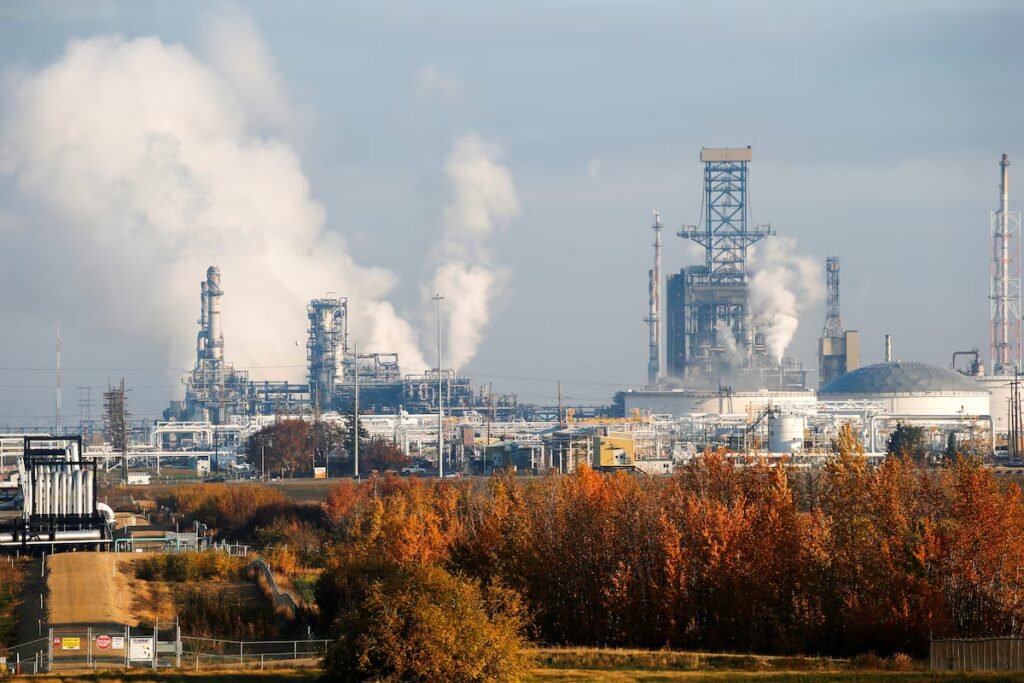

The pain from the trade war will be temporary, and while retaliation may feel satisfying, it also hurts the domestic economy and distracts from the real task at hand, says Charles St-Arnaud.Todd Korol/Reuters
Charles St-Arnaud is the chief economist at Servus Credit Union.
After trade talks collapsed, some have argued that Canada should consider using its energy resources to put more pressure on the United States.
That includes Ontario Premier Doug Ford and former Alberta premier Jason Kenney, who found himself in odd company with New Democratic Party Leader Avi Lewis – and off base with his successor Danielle Smith.
Prime Minister Mark Carney has not explicitly entertained the idea of weaponizing this country’s commodities. But he has said “Canada fuels America’s growth … I don’t think they want us to stop sending any of that energy,” making clear, in my view, that the Canadian government has been considering the option.
Alberta projects $2-billion surplus after oil-price surge
That would be an exceedingly stupid idea.
The temptation to hit back at the U.S. with export levies or restrictions on our energy resources is high because it is believed that doing so will cause significant economic pain south of the border. But it will also have significant consequences for the Canadian economy because the U.S. is unlikely to restrain itself from hitting back with all its might.
There is a reason why retaliating with the Canadian energy sector has been called “the nuclear option.” Just like the nuclear arms race during the Cold War, using the nuclear option is the action that inflicts the most losses on the other side. However, it is well understood that the counterstrike will result in severe losses on the initial mover, likely leading to the annihilation of both sides in the conflict.
Any measure that restricts oil exports to the U.S. would be foolish and impractical. Canada exports 85 per cent of its oil production to the U.S. and there is no spare pipeline capacity to divert the production to other markets. That means restricting exports would result in shutting down production, because Canada also doesn’t have an excess of storage capacity. This would lead to significantly reduced economic activity, especially in Alberta, where oil extraction accounts for 20 per cent of GDP.
Opinion: How Canada can best respond to threats from the United States
An export tax may seem like it would apply pressure without causing excessive domestic harm. Yes, it would mean charging more to U.S. customers. Yes, it would have little impact on oil volumes exported to the U.S., because it would be difficult for refineries in the Midwest to find new supply in the short term, since oil cannot easily flow to those facilities from the ports along the Gulf of Mexico.
But the U.S. is unlikely to stay idle and can also use energy to retaliate against Canada.
While Ontario’s four refineries use mostly Canadian oil as an input, this Canadian oil reaches them only via the U.S. pipeline network that runs through the American Midwest. The same also holds true for refineries in Quebec, where about half of the oil refined comes from the U.S. Any export curtailment or export tax would significantly affect the availability and prices of oil and refined products in these provinces, as the U.S. could reduce flows or impose a tax.
Canada could bypass U.S. pipeline networks, using crude-by-rail to alleviate the resulting pressure, but that would be costly and inefficient. Moreover, increased freight traffic poses a risk of clogging Canada’s rail network, with consequences for industries that rely on it. The energy shock on the economies of Ontario and Quebec could result in a severe recession.
These are only the short-term impacts. The long-term damage could also be significant. Faced with more expensive, export-tariffed Canadian oil, the U.S. would seek alternative energy suppliers. This will not be easy in the short term, but once American refiners have found them, they may not go back to Canadian oil, even if the surtax is lifted.
Opinion: Canada’s furious, I get it. But by retaliating, we punish only ourselves
That means, in the long run, we would need a new customer. And finding new markets for the 4.5 million barrels per day Canada exports to the U.S. would require significant investment and take years. To put it in perspective, the proposed pipeline to the West Coast announced in July would carry one million barrels per day and cost an estimated $40-billion to build, meaning four additional pipelines of a similar size would also be required.
Ms. Smith and Saskatchewan Premier Scott Moe were right to say that using Canadian energy as a retaliatory measure would do significant damage to the Canadian and U.S. economies, both in the short and long term.
The pain from the trade war will be temporary, and while retaliation may feel satisfying, it also hurts the domestic economy and distracts from the real task at hand. We need to channel anger and frustration into improving the economy, rather than let it become a distraction from the task at hand. Sometimes the best way to deal with a bully is not direct confrontation, it is standing up and becoming the best version of yourself.


More Stories
Why are so many trades apprentices struggling to complete their programs?
Staying in Canada is the best option for Alberta businesses
Collective confidence is the glue that can make your team more effective