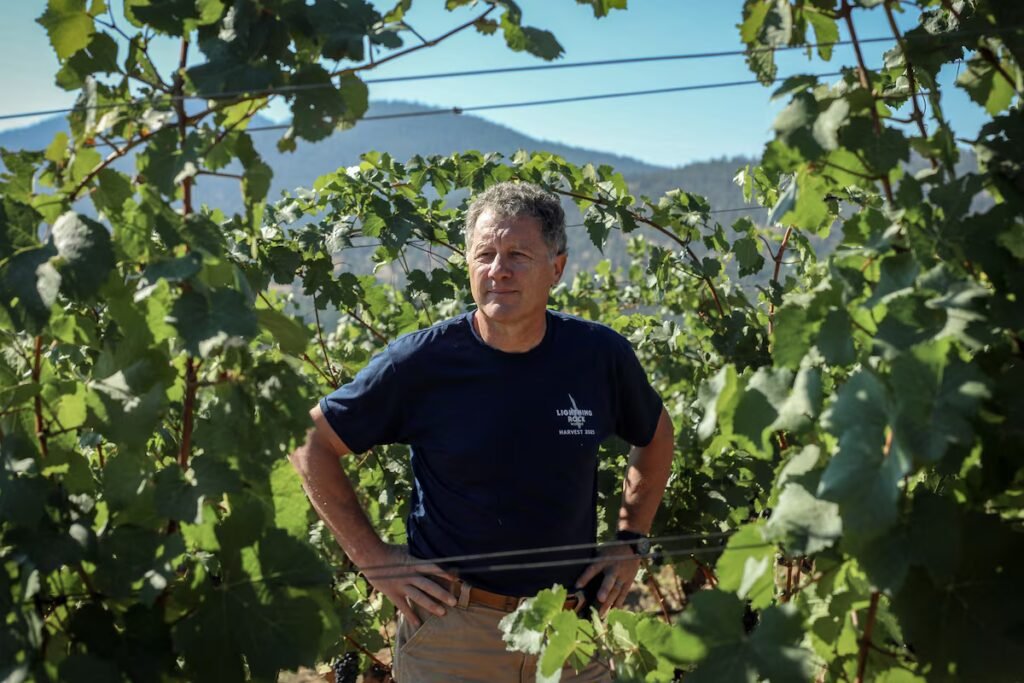

Ron Kubek, owner of Lightning Rock Winery, said the planned expansion of his winery that he had spent months working toward ‘died’ when the Trump administration’s latest tariffs came into force.Aaron Hemens/The Globe and Mail
Ron Kubek was preparing to make a big bet on the United States. After getting products from his small, family-owned B.C. winery into seven stores and restaurants across Seattle last year, he was working on a direct-to-consumer expansion that would have increased Lightning Rock Winery’s U.S. exports from about 8 per cent of its production to as much as half.
Then came the 50-per-cent U.S. tariff on Canadian alcohol that kicked in Saturday. Mr. Kubek, owner of Lightning Rock, sent one final palette carrying 50 cases of wine across the border before the tariffs took effect last week and doesn’t expect to send another any time soon. As for the expansion he had spent months working toward: “That’s died,” he said.
Alcohol has emerged as one of the most persistent pressure points in the Canada-U.S. trade war. Most provinces are still keeping American booze off their shelves after pulling it in March, 2025, in retaliation for U.S. President Donald Trump’s initial round of tariffs. Now, Canadian producers are facing another problem: A 50-per-cent U.S. duty that had appeared avoidable while trade negotiations were under way, but took effect after talks between the two countries broke down.
For Canadian wineries and distilleries that had been looking south for growth, the tariff is forcing a rethink of where they distribute, and renewing calls to make it easier to sell alcohol domestically. Producers say that if access to the U.S. market is going to be more expensive and unpredictable, dismantling Canada’s long-standing interprovincial trade barriers has become more urgent than ever.
Ford trades barbs with Trump, says Ontario won’t lift American booze ban
“For individual businesses that have invested years building relationships with American importers or distributors, restaurants, and customers, the 50 per cent tariff effectively slams the door shut on that market,” said Jeff Guignard, chief executive officer and president of Wine Growers British Columbia, an association with over 200 winery members.
In 2024-2025, Canada exported $1.4-billion worth of alcoholic beverages to the United States, up 4.1 per cent year over year, according to Statistics Canada, accounting for about 90 per cent of the country’s alcohol exports.
The Canadian spirits sector contributes approximately $5.8-billion to Canada’s GDP and supports over 48,800 full-time equivalent jobs across the country, according to an economic impact report by Spirits Canada.
Mr. Guignard said that when the tariffs were announced, many members tried to expedite their orders to the U.S. before they kicked in. Some Canadian wineries had their future orders cancelled by their U.S. partners, he said. “It’s really frustrating because we’re now just in an uncertain loop.”
Canadians can boycott U.S. travel and alcohol. But investments are a different story
Lauren Skinner Buksevics, managing director of Painted Rock Estate Winery in Penticton, B.C., was contacted by her U.S. importer after the tariffs were announced in July, and told it would have to “hit pause” on any more orders. “She was very clear that a 50-per-cent tariff on Canadian wine does not allow for a profit margin on the other side.” The U.S. accounts for about two per cent of exports for the winery.
For some producers, the trade war has halted plans for expansion south of the border.
Before it broke out last winter, Paul Speck, president of Henry of Pelham Family Estate Winery located on the Niagara Peninsula, and his two brothers who own and operate their family business said they were looking to “aggressively build the business around the border states,” but the trade uncertainty caused them to back off, and they ultimately decided they didn’t want to waste their resources.
For David Farran, owner of Alberta-based Eau Claire Distillery, the uncertainty made it difficult for his company to invest and expand further in the U.S., including hiring people, and setting up delivery and distribution sites.
“We’ve been spending the last year in this fluctuating tariff-no-tariff environment so we’re very much focused on ensuring that we have other markets.”
David Shribman: Whether it’s Iran or Canada, for Trump, the result is the same
Mr. Farran said less than 20 per cent of the distillery’s exports now go to the U.S. But still, he said Eau Claire distributes in 17 U.S. states and the new 50-per-cent tariffs “will be devastating.”
Canadian alcohol producers who spoke with The Globe and Mail said the priority should be reducing steep interprovincial trade barriers that make it difficult to list their products and sell in other provinces.
“We just need to, even within our own country, have the ability to trade across our own borders,” Mr. Farran said.
But those may be easing. In July, a day after the Trump administration announced the Section 338 tariffs that just came into effect, nine Canadian premiers signed a deal to introduce direct-to-consumer alcohol sales, which will allow Canadian producers to sell their wine, beer and spirits directly to Canadian consumers outside of their home provinces.
British Columbia, Alberta, Saskatchewan, Manitoba, Ontario, New Brunswick, Nova Scotia, Prince Edward Island and Newfoundland and Labrador signed the deal while Quebec and Yukon have indicated their support for the initiative and are anticipated to sign at a later date.
“In light of what’s happening in the U.S., I think it’s really important for us as Canadians to start looking at ourselves as one market, a common market,” Mr. Farran said.


More Stories
Staying in Canada is the best option for Alberta businesses
Collective confidence is the glue that can make your team more effective
France open to defence deals with Canada despite its push for arms autonomy, envoy says