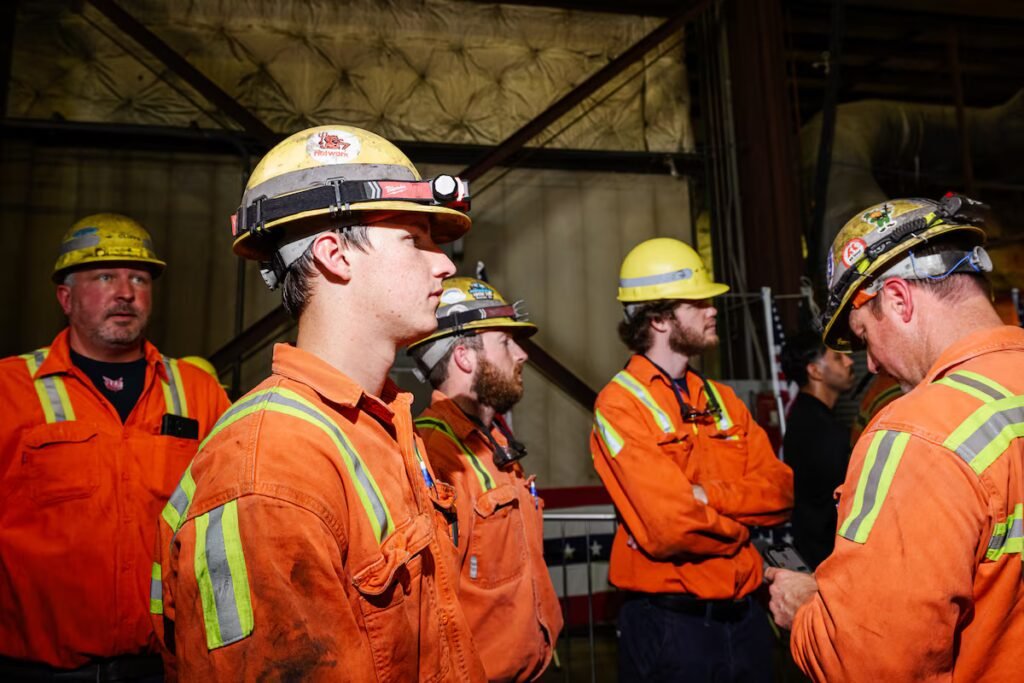

Workers gather in the audience ahead of U.S. Vice President JD Vance’s speech at a steel plant Middletown, Ohio, Aug. 21, 2026. The state, along with Illinois and Pennsylvania, will be among the hardest hit by Canadian counter-tariffs, with $2-billion to $3-billion worth of goods affected in each state.Jon Cherry/The Associated Press
As American businesses brace for new Canadian countertariffs, many are already voicing concerns about a greater, long-term threat: that the trade war will endure and their customers north of the border will permanently turn their supply chains away from the United States.
That’s a major worry for Kip Eideberg, senior vice-president of government and industry relations for the Association of Equipment Manufacturers, based in Milwaukee. His industry expects to take some of the biggest hits from Canadian tariffs.
“I think what you will see is Canadian manufacturers looking to source parts that were coming from the United States from Asia and Europe,” said Mr. Eideberg, who predicted those shifts could ultimately lead to job losses in the U.S.
“It takes time to establish these supply chains. That means once you’ve moved those supply chains, you’re a lot less likely to shift them again.”
Canada’s retaliatory tariffs, announced Tuesday after trade negotiations with the U.S. broke down last week, will take effect on Sept. 8. The list of American products being targeted includes nearly 900 items, or about $28-billion worth of goods ranging from networking equipment to bakery mixes.
Industry Minister Mélanie Joly said during a Tuesday news conference that there is a political element to Canada’s choice of tariffs. “We’re also targeting products that will target states in the U.S. and so we’re being wise and strategic to put political pressure,” she said.
An estimated $5-billion in American goods will face wide-ranging tariffs in the equipment and mechanical appliances sector, according to a Globe and Mail analysis of trade data sourced from Statistics Canada. The vast majority of goods in the sector will face tariffs of between 15 per cent and 25 per cent, such as parts for construction machinery. Roughly $79-million of goods will face 50-per-cent tariffs, including refrigerators.
Mr. Eideberg said small to medium-sized businesses will likely take the biggest hit, as they don’t have the same ability as larger corporations to withstand the financial impact from tariffs.
“We saw that during the COVID pandemic, where supply chains were stressed and the hardest impact was on smaller manufacturers, and a fair number of them didn’t survive and didn’t come back,” he said.
“Many of these small manufacturers are in small towns where they are usually a primary employer. So the trickle-down effect on small towns is going to be felt pretty hard.”
As American businesses wrap their heads around the impact that Canadian trade retaliation will have on their operations, many are concerned about a long-term deterioration of relationships that will outlast the immediate pain of tariffs.
The Globe’s trade data analysis found that Ohio, Illinois and Pennsylvania will be among the hardest-hit states, with between $2-billion and $3-billion of goods affected by tariffs in each state. Among the most affected sectors will be steel, machinery, paper and fisheries.
Opinion: CEOs become foot soldiers in the Canada-U.S. trade war
Other trade associations said they support U.S. President Donald Trump’s push to grow domestic industries, but the conflict with Canada will ultimately hurt business while they ramp up capacity. That was the message from Charles Johnson, president and chief executive officer of the Aluminum Association.
“These measures will negatively impact segments of the industry by limiting opportunities for U.S. producers to compete in Canada at a time when America should be well positioned to meet growing aluminum demand,” he said in a statement.
Heidi Brock, president and CEO of the American Forest & Paper Association, echoed those sentiments. She supports attempts to clamp down on what the Trump administration considers unfair trade practices, but said supply chains are deeply integrated between the two countries.
“Escalating tariff disputes between the U.S. and Canada will disrupt the cross-border supply chains that help mills and manufacturers invest, compete and deliver essential products people depend on every day.”
Even businesses not heavily affected by the tariffs are concerned about the long-term implications.
Edmund Schweitzer, founder of Schweitzer Engineering Laboratories, said his Washington State-based company will face 50-per-cent tariffs on telecommunications products such as ethernet switches and modems that it supplies to customers such as BC Hydro.
The impact on his company will be small, but his greater concern is that innovation and relationships between firms in both countries will be eroded.
“Now some leadership have started to say they’re not letting their folks go to the United States for conferences, so the exchange of ideas stops,” Mr. Schweitzer said. “It goes far beyond the dollars. Frankly, the dollars are probably the least of the problem.”
Companies in his industry also face a risk of supply chains being permanently altered if Canadian buyers start sourcing parts from Europe and Asia.
Carney to address EU Parliament in push to grow non-U.S. ties
Lori Steele, executive director for the West Coast Seafood Processors Association in Oregon, said her members see the tariffs as a mixed bag. She represents some companies that trade with Canada, but they haven’t been concerned enough about the levies to reach out to her.
Meanwhile, other companies that focus on domestic trade are happy to see a greater emphasis on bolstering sales within the U.S. Ms. Steele added that seafood products are so localized that she believes Canadian demand will return if the trade war is resolved.
“I can’t say it’s something that everybody is really upset about,” Ms. Steele said.
The same may not be true in Maine, where the lobster industry is heavily integrated on both sides of the border.
Republican Senator Susan Collins of Maine criticized Mr. Trump’s trade war earlier this week, calling it a mistake. She said her state’s exports of blueberries and lumber, among other products, will also be affected.
“I really want us to go back to the very friendly, economically beneficial relationship that we have with our Canadian neighbours,” Ms. Collins said.
With reports from Jason Kirby and the Associated Press


More Stories
Russia and Ukraine reach energy ceasefire, Trump says
Trump sticks with tariffs despite widespread disapproval among U.S. voters
Roblox side hustle helped this 25-year-old buy a five-bedroom home in Windsor