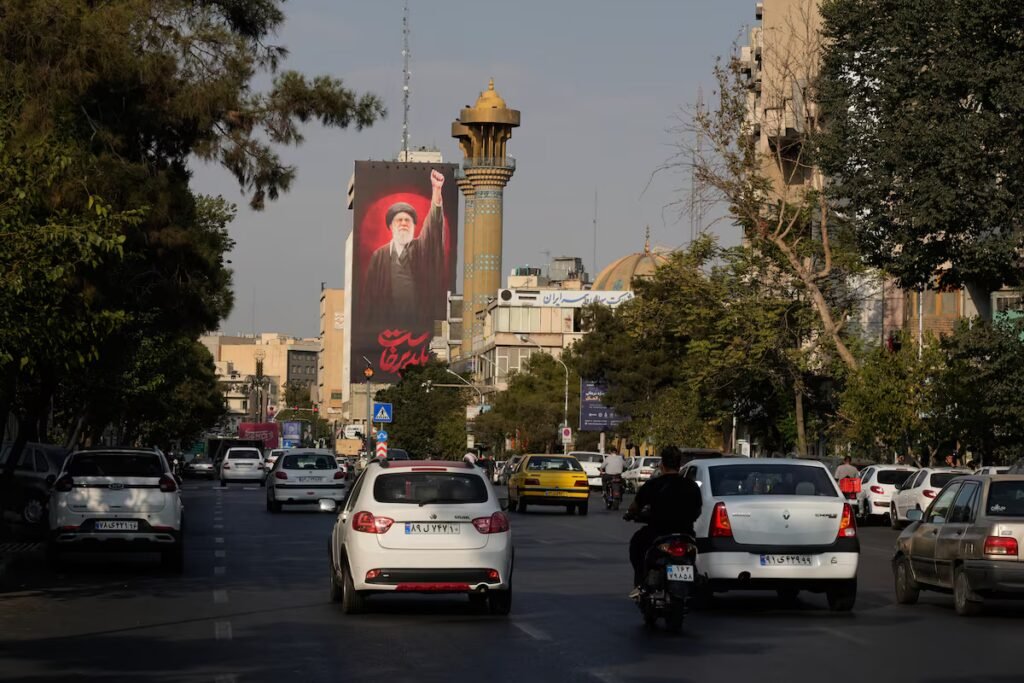

A billboard with a message that reads in Farsi: ‘We must rise up’ and an image of the late Iranian Supreme Leader Ayatollah Ali Khamenei towers over downtown traffic in Tehran, Aug. 15.Vahid Salemi/The Associated Press
U.S. President Donald Trump warned of economic consequences against any country that provided “any type of lifeline to Iran” as the United States looks to resolve a war it began alongside Israel nearly six months ago.
Thousands have been killed in the war, which quickly drew in Gulf nations and shocked global markets as Iran flexed its ability to curb shipping through the Strait of Hormuz, which carried about a fifth of the world’s traded oil before February.
The U.S. and Iran have twice announced ceasefire deals, in April and June, aiming to restore the free flow of shipping through Hormuz on a path toward ending the conflict, but both quickly crumbled, even as Israel has largely withdrawn from the fighting.
Iran has faced years of sanctions
In a social media message on Wednesday, Trump promised “Economic Warfare and Isolation on an unprecedented scale,” although details were scant.
Iran has weathered continuous punishing economic sanctions for nearly 50 years, since the Islamic Revolution of 1979.
“ANY country that allows its financial institutions, businesses, airports, or government entities to provide any type of lifeline to Iran will itself face TREMENDOUS Economic Consequences,” Trump wrote.
UAE suspends trade with Iran after coming under renewed fire, adding economic pressure
Iranian Foreign Minister Abbas Araqchi called Trump’s comments an attempt to divert American public opinion from domestic financial problems, including record debt and rising interest rates.
He said Washington’s insistence on policies he described as failed would bring further failures and alienate Iranians.
“America’s economic terrorism threatens the global economy and the national sovereignty of countries around the world,” he said on X.
Trump has yet to achieve the objectives he set out at the start of the war: dismantling Iran’s nuclear program, curbing its ability to attack regional rivals and creating conditions for Iranians to overthrow their clerical rulers.
Vessels near the Strait of Hormuz, as seen from Musandam, Oman, Aug. 17.Stringer/Reuters
China calls for diplomacy
Trump’s social media threats and announcements do not always get implemented as written. He did not say what specific steps the U.S. would take or name any country, though the warning would appear to extend to U.S. allies that have helped mediate peace talks.
On Tuesday, the United Arab Emirates, which hosts a major U.S. military base, said it was suspending all trade activities, commercial exchanges and financial transactions with Iran until further notice.
The step came after the UAE defence ministry said it had detected two missiles launched from Iran that fell into the sea, a report Iran dismissed as baseless.
China buys more than 80 per cent of Iran’s shipped oil, 2025 data from analytics firm Kpler shows, but the U.S. risks retaliation should it engage in further economic warfare with China, a major exporter of items such as vital rare earth minerals to the U.S.
“Sanctions and pressure will not solve the problem,” Chinese Foreign Ministry spokesperson Lin Jian told reporters at a regular press briefing. “China calls on all parties concerned to take responsible measures to resolve the issue through political and diplomatic means.”
Canada announces sanctions on five Iranian officials over Strait of Hormuz blockade
Iran remains open to dialogue with the U.S. but does not confuse negotiations with surrender, Mohammad Mokhber, an adviser to Iran’s supreme leader, said on Tuesday, according to the semi-official Fars news agency.
Military pressure and sanctions would not break Iran’s resolve, Mokhber added.
On Tuesday, Trump said no talks were taking place with Iran. A day earlier, Jared Kushner, his son-in-law and special envoy, struck an upbeat tone, saying talks were still under way and “probably more robust” than ever.
Trump wants to seize Iran’s stockpile of highly enriched uranium and is seeking a new, more restrictive agreement curbing its nuclear energy and research programs, to replace one from which he unilaterally withdrew the U.S. in 2018.
A signatory to the Non-Proliferation Treaty, Iran has said for decades its nuclear programs were peaceful.


More Stories
The Iran oil shock should mean EV sales are surging – so why aren’t they?
SpaceX targets U.S. wireless carriers with spectrum acquisition
Key economic bill clears first vote in House of Commons