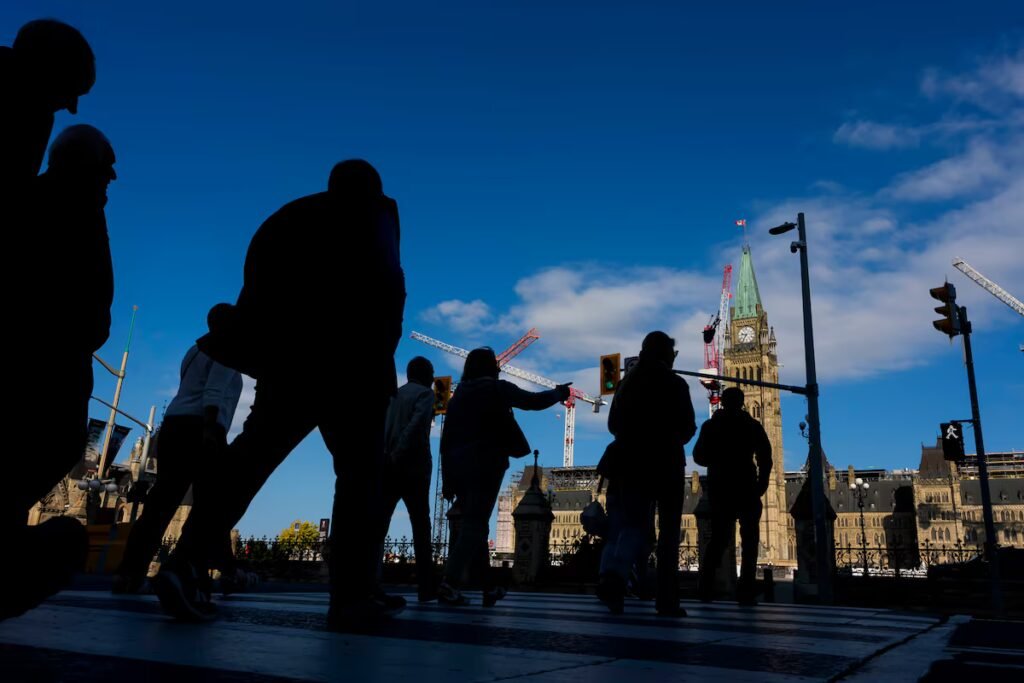

People cross Wellington Street toward Parliament Hill. As faith in the future erodes among younger generations, political parties must prove they can deliver for Canadians of every age.Justin Tang/The Canadian Press
“The battle brewing in Canada is generational, and they are country miles apart.”
That warning from pollster Nik Nanos recently appeared in a Hill Times headline. Drawing on polling from Abacus Data and Nanos Research, the article suggested that “the generational split will increasingly become a more-contentious political division than the traditional left-right divide.”
The headline won’t surprise my regular readers, who know that diverging financial fortunes are at the root of intergenerational tension. Older Canadians have lower poverty, higher incomes, more home ownership and the most wealth. By contrast, home ownership has become a waiting game for younger Canadians. Renting has become a race. Both teach the same dispiriting lesson: The promise that hard work will be rewarded feels increasingly out of reach.
Opinion: Young adults can’t afford homes to raise families, and city governments are at fault
While unsurprising, Mr. Nanos’s warning frightens me. The widening gap in hope between younger and older generations is a bellwether not only for economic stagnation, but also democratic decline. Pollsters worry partisanship may incline politicians to exploit intergenerational friction: A party “can’t be for both sides,“ judged Abacus chief executive officer David Coletto.
That may be a shrewd electoral calculation, but it would be a profound mistake for the country. Political parties can and must be for both young and old alike. Those courting the boomer vote should appreciate that most don’t want to be remembered for pulling the ladder up behind them. Like parents everywhere, boomers want their children and grandchildren to inherit a country as hopeful, generous and secure as the one they inherited and helped shape.
Hope that better days are ahead is one of a country’s most valuable public assets. It gives people confidence to start businesses, invest in communities, raise families, trust democratic institutions and sacrifice today for tomorrow. When hope erodes for younger people, so does much of what allows a country to flourish.
That’s why rebuilding hope for younger generations must become a defining nation-building project of our time.
We’ve seen what happens when partisanship becomes tribal in the United States, when Democrats and Republicans don’t just disagree, but despise each other.
We cannot afford a style of politics that treats generations as competing camps. If millennials and Gen Z come to see boomers as obstacles, and boomers come to see younger people as threats, we erode the intergenerational care on which our systems of medicine, retirement income, housing, education and climate action all depend.
Canada can renew our generational bargain without pitting young against old. It starts by acknowledging that Canadian policy has become better at protecting the living standards people have already achieved than creating comparable opportunities for those still trying to build them.
Young Money: Young Canadians are increasingly miserable. Government priorities show why
Old Age Security is an egregious example, as I’ve discussed in previous columns. It delivers about $18,000 in annual subsidies to retired couples even when they have household incomes exceeding $180,000. This is difficult to justify as supports for families with children and grants for postsecondary students are phased out when their household incomes are more than $100,000 lower.
Since Ottawa is on track to spend $17.5-billion on OAS subsidies for retirees with six-figure household incomes by the end of this decade while still anticipating that 400,000 seniors will remain poor, modernizing OAS offers an intergenerational win-win. It would be beneficial for many seniors and young people, proving that public policy need not turn one generation against another.
It’s no wonder that three-quarters of Canadians under 35 and over 65 support a vision of OAS that begins to phase out retirement subsidies for households that exceed $100,000 in income, more like we do for other cash supports. The reform would leave OAS benefits for 80 per cent of seniors unchanged or improved, because most seniors do not have such high incomes. The savings could lift every poor senior above Canada’s official poverty measure, help a million young people afford rent, strengthen Canada Student Grants, support underemployed youth and create 100,000 additional $10-a-day child-care spaces.
Gone are the days when politicians should fear updating OAS because of the boomer vote. Most boomers think it appropriate to ask the minority of retirees with six-figure household incomes to take a little less so poor seniors can escape financial insecurity and younger Canadians can get ahead. They want public policy to reflect what they already do around their kitchen tables: help their children build a future worth hoping for.
Dr. Paul Kershaw is a policy professor at UBC and founder of Generation Squeeze, Canada’s leading voice for generational fairness. You can follow Gen Squeeze on X, Facebook, Bluesky and Instagram, as well as subscribe to Paul’s Hard Truths podcast.


More Stories
Startups are hiring low-paid gig workers to train robots on manual labour
In this uncertain economy, ask yourself, if my job disappears, what value would I take with me?
Buying a home with points, where our cities are shrinking and the Home of the Week: Canadian real estate news for the week of Oct. 9