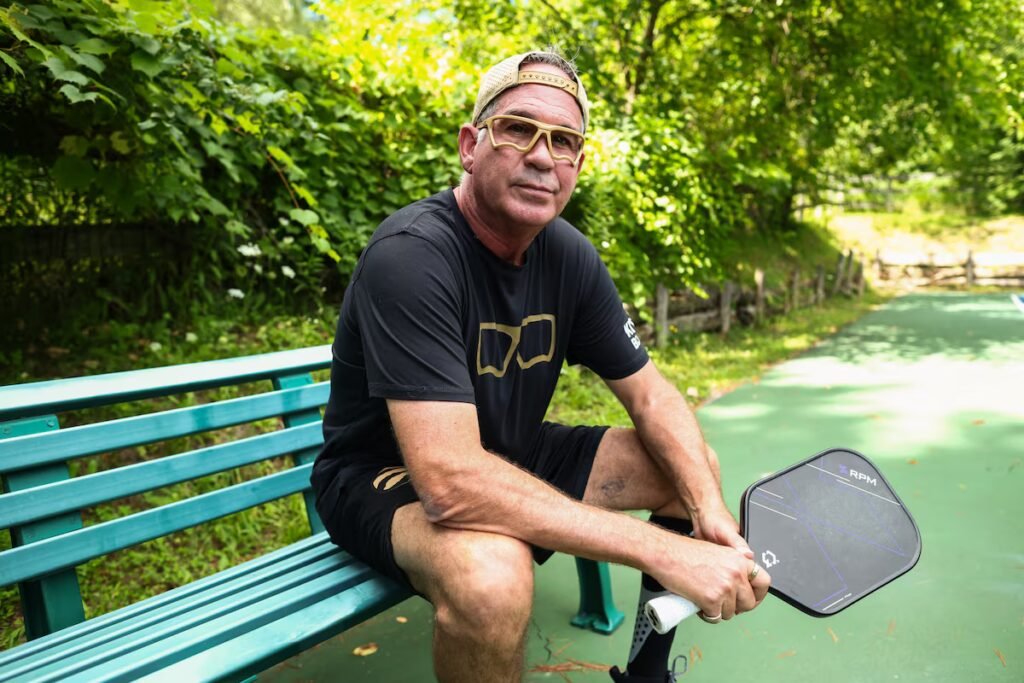

Brad Robins, founder of Kitchen Blockers, created the lensless eye protection for pickleball players after getting a black eye.Cole Burston/The Globe and Mail
Former sports marketer Brad Robins was charmed by pickleball for the same reasons the game has recently shot up in popularity: It offers a low barrier to entry and a level of social connection many were starved of during the pandemic.
But as the sport started to boom and Mr. Robins became hooked, a safety risk became painfully obvious to him.
The fast-paced game is played on courts smaller than those used for tennis. While competing in the amateur segment of a 2024 tournament in Cincinnati, he got smacked in the eye socket by an oncoming ball. Participants are most in danger of that injury while standing near the “kitchen” boundary line, which is seven feet out from the net on each side.
In the kitchen zone, players are not allowed to hit the hollow neon ball directly out of the air. In effect, opponents can rally just 14 feet away from each other. This closeness, combined with the sport’s accessibility, make for a unique form of fun, Mr. Robins said. But these factors also increase the possibility of face and eye injuries.
He said that because the sport is open to everybody, reaction times can be different. “It’s an acrylic ball, and you can lose or jeopardize one of your most valuable and precious human gifts: your sight,” said the 66-year-old, who used to be a university-level tennis athlete. He later switched to the smaller-court game after his “body broke down.”
His black eye served as the catalyst for the product that took Mr. Robins out of professional retirement: Lensless eye-protection frames called Kitchen Blockers.
Mr. Robins says he has impact-tested the protective half-moon-shaped frames himself using a ball machine.Cole Burston/The Globe and Mail
Launched 18 months ago with his business partner, Dave Katz, the eyewear is made of a mixture of regular plastic and stronger polycarbonate, he said. The protective half-moon-shaped frames sit on one’s cheekbones. Mr. Robins calls this patented curve the “speed bump,” which acts as a guard to the ball. The product retails for $89.95 and does not have lenses, to avoid issues of scratches or glare in the indoor sport.
Mr. Robins said he has impact-tested the eyewear himself using a ball machine.
Despite the arguably funky look of Kitchen Blockers, the Canadian entrepreneur believes the eyewear could become as recognizable as a hockey or bike helmet within the growing sport of pickleball.
Since launching 18 months ago, the company says it has sold more than 100,000 pairs, which translates to about $6.8-million in sales to date. The frames are manufactured in China, and garner “healthy profit margins,” Mr. Robins said. Kitchen Blockers are available in 54 countries and are sold at various stores including the online retailer, Pickleball Central.
But given the lucrative industry of sports fashion, what about the players who are worried that Kitchen Blockers will ruin their outfit?
Kitchen Blockers are available in more than 50 countries.Cole Burston/The Globe and Mail
Mr. Robins recognizes that the look of his product is not for everybody, but implores pickleball players to think about eye protection.
“Find something that’s right for you and that matches the outfit you want, and please get on the court wearing something on your eyes,” he said. The brand’s top-selling colour is clear, and it has also launched a line of slim frames for smaller faces.
Some users have pointed out that Kitchen Blockers do not fit all face and nose shapes. With a surge of pickleball popularity in Asia, Mr. Robins said the brand is working on a new adjustable nose piece to accommodate a greater diversity of players.
The brand plans on staying in the lane of eye protection, but is also targeting the padel market. The sport is growing in North America, and involves hitting the ball off the wall, like in squash, but borrows the scoring system used in tennis.
Mr. Robins previously ran an advertising agency and later landed in athlete representation. He completed a leadership stint at IMG, where he did off-ice branding for big name hockey clients.
With this background, Mr. Robins seems to have capitalized on the already friendly nature of pickleball. “Going on 18 months, I have yet to make a proactive sales call,” he said.
While Kitchen Blockers may not be for everybody, Mr. Robins encourages players to think about eye protection when playing the sport.Cole Burston/The Globe and Mail
In between matches, chit-chat on the court has spread the word about Kitchen Blockers. Rob Krizmanich, a Toronto-based wealth manager at CIBC Wood Gundy, picked up pickleball during a 2020 holiday to Florida after tennis courts were shut down, and soon became “addicted” to the sport, which he plays on the weekends.
Mr. Krizmanich, 60, has quickly shot up the ranks of pro-level pickleball, and met Mr. Robins while competing at the Canadian nationals in Kingston, Ont., in 2022. At that tournament, Mr. Krizmanich won the men’s singles, doubles and mixed-doubles games in the seniors category.
He picked up a pair of Kitchen Blockers after seeing a senior pro player in Florida wearing the lensless product, not knowing that they were Mr. Robins’s idea.
On the court, he appreciates the product’s comfortable design that eliminates concerns about fogged, smudged or scratched lenses.
“It was a no-brainer for me. If I’m outside and it’s really bright, I’ll wear my sunglasses, but I will not go on court without,” he said.
Mr. Krizmanich is set to represent Team Canada at the Pickleball World Cup in in Vietnam in September. “I’ve seen enough players and buddies that got hit in the retina,” he said.
“Pickleball, a lot of times, if that ball’s up high … you just don’t have time to react.”


More Stories
NATO innovation exercise puts emerging defence technologies to the test in Nova Scotia
Canadian housing policy wants you to live in shoebox condos in the middle of nowhere
Russia and Ukraine reach energy ceasefire, Trump says