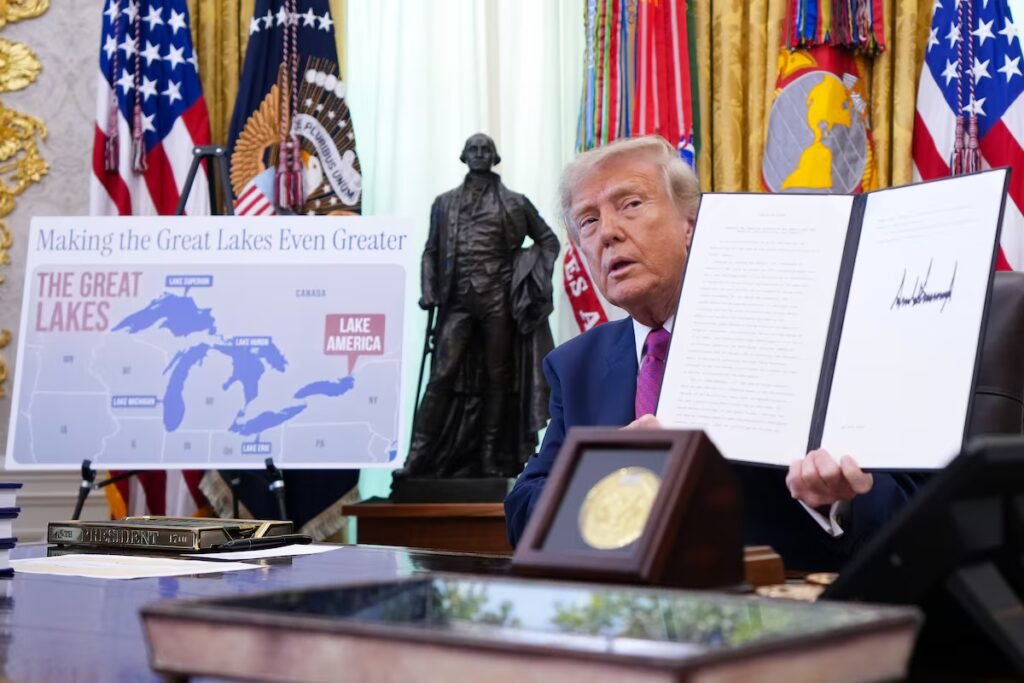

Even at the Oval Office ceremony where Mr. Trump signed his proclamation on Lake Ontario/America, it was the least relevant thing on the agenda, writes Keller.Andrew Harnik/Getty Images
The Globe and Mail’s house style is to refer to the country across the English Channel from Europe as Britain. That country calls itself the United Kingdom – the short form of its official name, and the name on the desk at its permanent seat on the UN Security Council – but this newspaper prefers the more colloquial term, Britain.
That choice has never sat right with me – but if I were to draw up a list of things worth getting worked up about, this would be as far from making the cut as London is from Newfoundland. Whichever moniker you use changes nothing about what Britain is, or how life is lived there.
A rose by any other name, and all that.
That’s how you should react to President Donald Trump’s announcement that the U.S. government, or at least some parts of it, will henceforth call the smallest of the Great Lakes “Lake America.”
Canada’s response should have been a shrug.
Focus on the game, not the chirps.
Instead, Canadian politicos eagerly picked up this shiny distraction and allowed it to become the subject of Canadian complaints – and U.S. news.
Prime Minister Mark Carney wrote on social media that Ontario is an Indigenous word, and would be the lake’s name “then, now and always.” Ontario Premier Doug Ford unveiled a really big sign with a similar message, then held a press conference.
Opinion: Welcome to the map resistance
Come on. Canada’s real issues with Washington are tariffs and threats to our sovereignty. Stop helping Mr. Trump change the subject.
Taunting Canada plays well with Mr. Trump’s base. It requires no knowledge to play along, just jingoism. Our politicians know that responding plays even better with voters here, for similar reasons.
Do Canadians have to stop calling it Lake Ontario because Mr. Trump said so? No. Does anyone else? No. Is anything changing about the water? The fish? Pollution? The border? No.
Let’s make some Freedom Fries – sorry, French fries – and move on.
Even at the Oval Office ceremony where Mr. Trump signed his proclamation on Lake Ontario/America, it was the least relevant thing on the agenda. As soon as he put down the pen, he returned to questioning free trade with Canada.
“They want to be treated like a state,” yet they don’t want to become a state, he said for the umpteenth time.
“So we’re going to be doing tariffs on their cars… We don’t want them to make cars for the United States of America… Likewise for many other products.”
Mr. Trump continued in this vein on Sunday, on social media. “Let all Canadian Companies that are doing business with America move to the United States, immediately,” declared one post. “When you move back, there are no TARIFFS!”
Another post: “For many years, the USA has been losing more than 60 Billion Dollars a year with Canada. Why??? Our long ago stolen businesses are now coming back to America in order to avoid paying tariffs. They are lining up, just like the rest of the World!!!”
Opinion: As insults fly between Ford and Trump, consequences loom
Ignore the mirage of Lake America. The constantly threatened end of free trade in autos and “many other products” – which Mr. Trump constantly returns to – is rather more serious.
In response, Canada has two paths. Both must be pursued. Call them Plan A and Plan A1.
Plan A1 accepts that Mr. Trump is changing the U.S. Even after he’s gone, it may retain this new appetite for protectionism. That means Canada must forge stronger ties with other trading partners, break down internal trade barriers and spur economic growth by making it easier to get things built here. We have to act with speed and purpose to fix those things that we control.
The Carney government has spent the past year and a half mostly talking about Plan A1.
However, it has also quietly pursued Plan A. That’s what the recently collapsed trade talks were about.
Plan A is an attempt to keep the status quo – to preserve our long-standing and highly successful free trade relationship with the U.S., or at least as much of it as Washington is willing to keep.
Plan A can only succeed to the extent that we persuade Americans that free trade is worth keeping.
Canada normally gets zero interest from the American news media. We’re top of the news now, and top of mind for many U.S. politicians, but it won’t last. Our five minutes are almost up.
To First Nations, Trump’s threat doesn’t hold water
Spending any of our precious time arguing about whether Americans should refer to a body of water by a MAGA name or an Indigenous name is a waste. It’s a matter that just doesn’t matter.
Our spokespeople need to be talking about how Mr. Trump’s moves against our long-standing and mutually beneficial relationship will alienate America’s best friend and ally; reduce exports to America’s biggest customer; hamstring auto manufacturers by cutting supply chains; and harm American businesses, workers and consumers by raising the prices of “many other products.”
Americans don’t get how big and how serious this is. Canadians have to explain it to them. We haven’t much time.


More Stories
Worried about index concentration? Don’t be
U.S. importer files lawsuit challenging Trump’s new tariffs on Canadian goods
Alberta migrant groups express alarm over referendum results on immigration reform