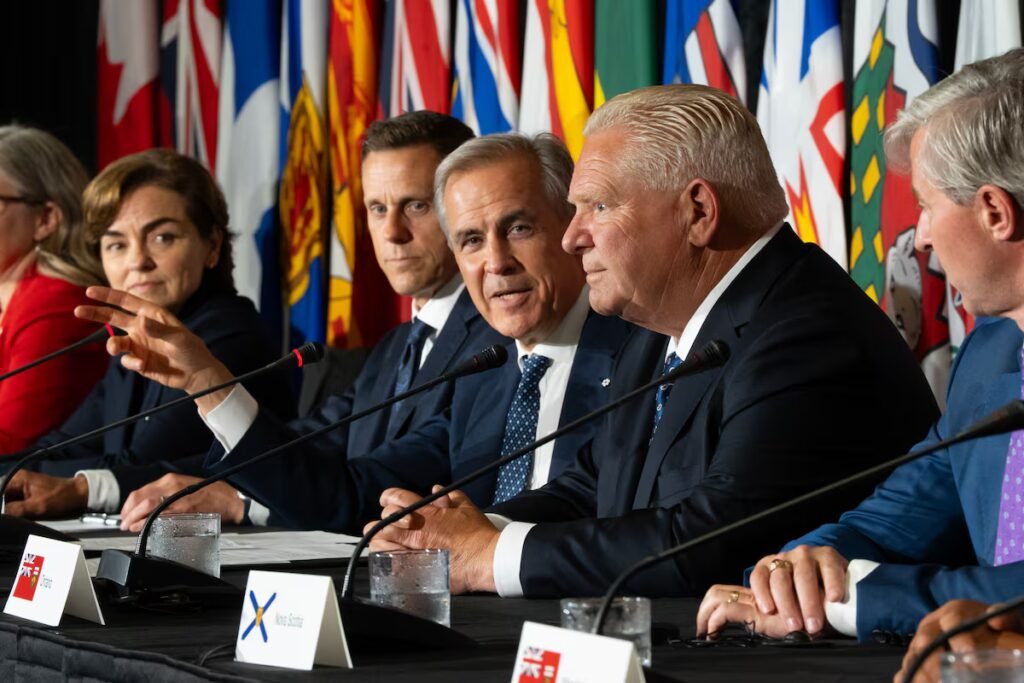

Provinces have arrived at the moment where their weight is felt at the negotiating table. Now, they deserve a place at that table, writes Mark Lawson.Darren Calabrese/The Canadian Press
Mark Lawson is the former deputy chief of staff to the Premier of Ontario and the former chief of staff to Ontario’s minister for economic development and trade.
In early 2025, premiers stepped into the breach when U.S. President Donald Trump first announced 25 per cent tariffs on Canadian goods.
Travelling to Washington, appearing in U.S. media and undertaking their own retaliatory measures, the premiers attracted their share of praise and criticism. But they carried the weight of the country and showed that together, they are a force to be reckoned with. Now, provincial and territorial premiers have found themselves in a new fight as negotiations with the United States have been terminated and new tariffs imposed.
Provinces have arrived at the moment where their weight is felt at the negotiating table. Now, they deserve a place at that table. Rather than approaching premiers at the end of trade negotiations, it’s time for the federal government to start bringing them in at the beginning.
Carney to address EU Parliament in push to grow non-U.S. ties
Provinces have already played an enormous role in the country’s response to Mr. Trump. Domestic procurement laws passed by provincial governments over the past year, such as the Buy Ontario Act, have been used to prioritize Canadian-made goods and services. Provincial liquor monopolies have shown themselves to be valuable foreign policy tools, wielding their purchasing power to such effect that Prime Minister Mark Carney reportedly asked premiers last week to plan to withdraw their alcohol bans as a key component of negotiations with the U.S.
While the Council of the Federation is a formal organization that hosts an annual meeting of the country’s premiers, Canada lacks a format and forum in which matters are discussed and decided by all of our country’s leaders as a team.
First ministers’ meetings – which bring together the premiers and the prime minister of the day – only happen on an ad hoc basis. They began as meetings where participants arrived by train or steamship for multi-day sessions to decide the shape of the country. Since that time, technology and the velocity at which issues of national importance arise have led premiers’ joint engagements with the prime minister to become virtual meetings, rather than in-person, multi-day undertakings.
The U.S. trade situation makes clear that there needs to again be a forum for provinces and the federal government to negotiate and make decisions, together. At which point should oil exports become a negotiating chip? What can be done to support the auto sector in the event of a substantial tariff increase? How should critical minerals play a role in unlocking a new deal? These strategic topics merit a sustained, co-ordinated body serving all thirteen premiers and the prime minister.
Opinion: Canada’s response to Donald Trump is a nation-defining moment
There is no time to waste. Mr. Carney has indicated that new, significant trade deals with other countries are on the horizon. He stated Wednesday that Canada is set to begin “intense discussions” with the European Union, aimed at building a “much stronger and deeper economic and security partnership.”
Rather than learning the details near the end of a process, provinces could instead become a key component of shaping these new deals.
With premiers at the table, countries with whom Canada has new and solid trade pacts could be worked into the frameworks of provincial Buy Canadian laws. Provincial liquor monopolies could offer them shelf space in exchange for supporting our domestic alcohol producers. Provinces could adapt their licensing standards and encourage labour mobility to be a piece of trade deals.
All of this has the makings of a joined-up plan that takes the needs of all provinces into account in the creation of a deal. This forum for trade could even be developed with an eye to creating a broader economic strategy for the country – enshrining and equipping first ministers’ meetings with a formal agenda, set cadence and clear goals.
To First Nations that named Lake Ontario, Trump’s threat doesn’t hold water
Some will say that this is the purview of the federal cabinet and provinces should stick to health care and highways. But this is an antiquated view. Rather than adding volatility, creating a formal role for premiers would enhance certainty in future negotiations. Premiers are anchored to the realities of their local economies, and trade wars do not override constitutional responsibilities. Provinces are not subordinate to the federal government. They are equal parts of our Confederation. Treating them otherwise is how federal governments have historically found themselves in deep trouble.
If relations with the United States merit a return to the negotiating table, the Prime Minister will undoubtedly have the support of premiers, as he has this week following the termination of the latest round of negotiations. His hand can only be strengthened by returning to that table with a clear set of conditions and the strength of thirteen premiers behind him.


More Stories
Democratic wins in U.S. midterms could bring scrutiny for Wall Street, crypto firms
Shift toward supporting Canadian brands may outlast the politics that sparked it, experts say
How two generations have kept this family flower farm in bloom