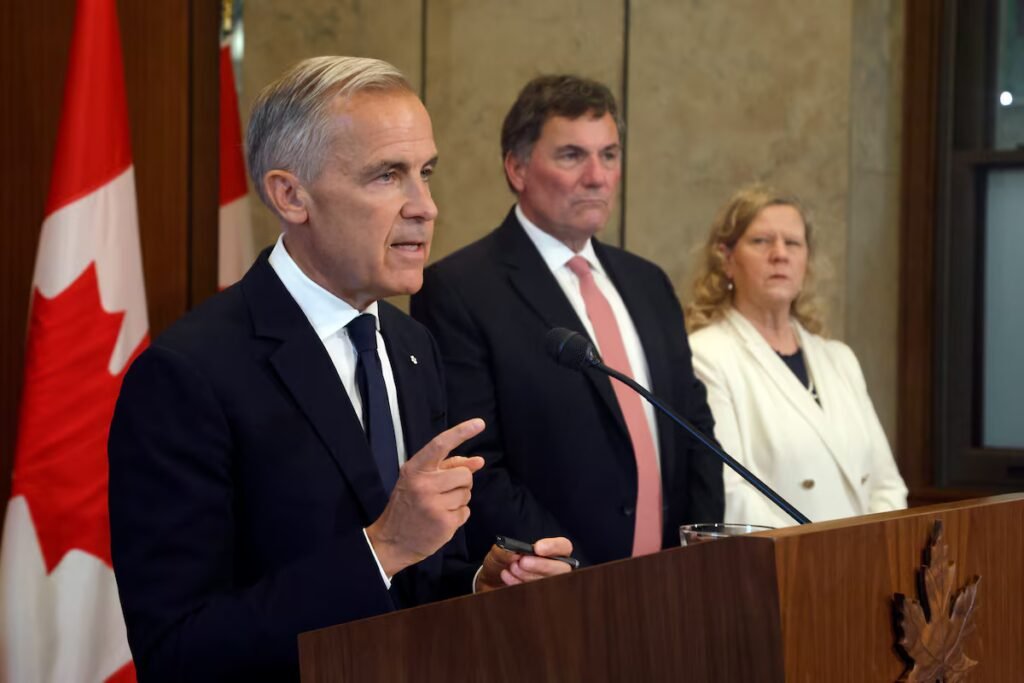

Prime Minister Mark Carney speaks about Canada’s response to new U.S. tariffs as Canada-U.S. Trade Minister Dominic LeBlanc and chief trade negotiator Janice Charette listen during a news conference on Parliament Hill in Ottawa on Saturday.PATRICK DOYLE/The Canadian Press
Eighteen months into the Canada-U.S. trade war, Prime Minister Mark Carney faces the same dilemma his predecessor did at the outset of the conflict: how to retaliate against a powerhouse economy without shooting yourself in the foot.
In that sense, dusting off the tariff playbook pursued by former prime minister Justin Trudeau might be a wise move, according to several experts.
After U.S. President Donald Trump imposed 50-per-cent tariffs on roughly $28-billion of Canadian exports to the United States, Mr. Carney vowed to fight back with dollar-for-dollar tariffs on U.S. imports set to take effect on Sept. 8.
However, the government has yet to release any details of what products will be targeted, reviving a guessing game among trade watchers that led up to Mr. Trudeau’s imposition of broad-based retaliatory tariffs in March, 2025.
Analysis: Americans, too, are wondering why the U.S. and Canada are embroiled in a trade war
Consumer products bore much of the brunt when the federal government first slapped countertariffs on $30-billion worth of American goods in the first round of its response last year.
“That’s a good way to do it in that it’s likely to impose the least harm on the Canadian economy,” said Joseph Steinberg, a University of Toronto professor specializing in international economics and trade policy. He said putting more focus on manufacturing inputs would have raised production costs for Canadian businesses and potentially caused broader economic damage.
“Of course, the downside of focusing tariffs on consumer products is that it’s the lowest-income people in the country who bear the brunt,” he said. “Those who are the most price-sensitive.”
Even though the initial round of countertariffs was in place for less than six months, Prof. Steinberg estimates it contributed about half a percentage point to inflation during that period, meaning prices were roughly 0.5 per cent higher than they otherwise would have been.
“Canadians will bear the brunt of any kind of retaliatory measures,” he said.
Yet those retaliatory tariffs did leave a mark on U.S. exporters. Trade numbers show imports of items covered under that first round of retaliatory tariffs, which lasted from early March, 2025, until Mr. Carney removed them on Sept. 1, 2025, declined by close to 17 per cent during that period compared with the same period in 2024.
That was a steeper drop than the 5-per-cent decline in overall U.S. imports over the same time frame.
The flip side to that is the inflationary effect retaliatory tariffs have here at home, since tariff costs incurred by importers are inevitably passed on to consumers and domestic producers.
Carney calls Trump tariff threat unsurprising, says trade deal remains possible
According to Bank of Canada research, prices of those tariffed products rose about 6 per cent relative to untariffed goods by mid-June, 2025, or about one-quarter of the 25-per-cent tariff.
It comes down to striking a balance between showing force and minimizing the burden on Canada’s economy, said Randall Bartlett, deputy chief economist with Desjardins Group. That means targeting products that are either produced here or are easily substituted with imports from other countries.
“It’s a playbook that makes a lot of sense when you’re trying to minimize the domestic economic impact but have sufficient impact to bring the other side back to the table,” Mr. Bartlett said.
The real test is whether a tariff can move “an American boardroom” to lobby Washington to de-escalate the trade war, “without moving a Canadian grocery bill or factory cost,” said Andreas Schotter, international business professor at Ivey Business School. “Ottawa should target finished goods with ready substitutes and political leverage, while protecting inputs and necessities.”
For example, the Carney government could target premium consumer and leisure goods such as spirits, wine, cosmetics and recreational equipment, he said. “These are visible, deferrable and easier to substitute.”
Another strong option would be finished appliances and electronics, targeting only models and categories with strong non-U.S. supply, Prof. Schotter said. He suggested they “carve out repair parts, specialized equipment and inputs used by Canadian firms.”
The U.S. midterm elections in November will factor heavily into Canada’s response, with Ottawa hoping the balance of power in Washington shifts in its favour.
Ottawa readies tariff-relief plan for businesses
The Carney government would maximize the impact of its response if it aimed countertariffs at states such as Michigan, Ohio, Maine, Alaska and Iowa, according to a Monday analysis from global strategy and advisory firm Capstone DC.
Andrew LaScaleia, the firm’s vice-president, said Ottawa could direct those tariffs “where they are politically most punishing for the United States, for Trump.”
Maine, for example, might be targeted for its exports of lumber and seafood, while Iowa and Ohio have machinery and agricultural-equipment manufacturers such as John Deere.
These states are either part of Mr. Trump’s base or have senators up for re-election. “That’s sort of the sweet spot because then you create political damage for Trump while at the same time bolstering your own domestic industry,” Mr. LaScaleia said, “and limiting the harm to consumers.”
Economists cautioned any tariff response from Canada is almost certain to garner another tariff attack from the U.S.
On Monday, Mr. Trump threatened to double auto tariffs on Canada from 25 per cent to 50 per cent starting in January, and said the tariffs would apply not only to finished vehicles but, for the first time, auto parts as well.
Such threats shouldn’t cause Canada to back down, said Kevin Milligan, director of the Vancouver School of Economics.
“A bully takes your lunch money. And you say, ‘How much, sir? Can I give you more?’ That just leaves the bully to come back for one more, 20 more,” he said. “You’ve got to push back. You’ve got to push back smart.”
A timeline of Trump’s trade war with Canada
He said he doubts a dollar-for-dollar tariff response will have much sway on the U.S. administration because of the sheer size of the American economy.
As such, Canada should pursue tougher measures on par with the provincial bans on U.S. alcohol sales, he said. That could mean curbing energy and electricity exports, he added, echoing comments made by Ontario Premier Doug Ford on Monday.
“We should not back away from things that do have a cost on us because the goal here is to inflict pain on them in some way,” Prof. Milligan said. “And if that also includes some pain on us, that’s the cost of doing business here.”
Ultimately, the Canada-U.S. trade war is as much about optics as it is actual trade flows, so Canada’s eventual tariff list will likely “add in some goods for political theatre in the same way that the U.S. targeted hockey sticks to make headlines,” said Bradley Saunders, North America economist at Capital Economics.
Yet, Mr. Saunders said the history of the trade conflict makes him optimistic Canadian negotiators will be back in Washington within “a month or two” working to get the United States-Mexico-Canada trade deal renewed.
“We’ll see both sides trying to act fierce and announce all these measures, but I doubt they’ll actually lead to much.”


More Stories
McCain Foods acquires Indian frozen food company as relations with Canada thaw
NATO innovation exercise puts emerging defence technologies to the test in Nova Scotia
Canadian housing policy wants you to live in shoebox condos in the middle of nowhere