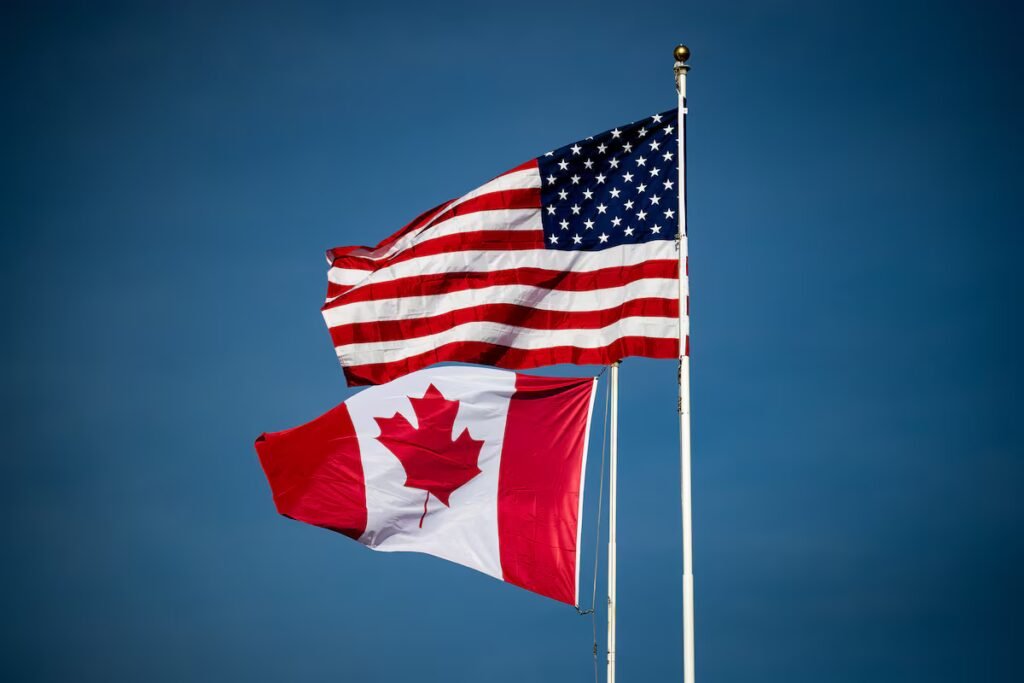

The talks were about how much higher U.S. tariffs would go, relative to the pre-2025 status quo of near-zero tariffs, and what Canada would give and get in return, writes Keller.DARRYL DYCK/The Canadian Press
“America wants to tariff everybody on everything.”
Prime Minister Mark Carney said that on Saturday morning. It was an aside within a larger point, but it speaks volumes. It’s the alpha and omega of where we are, and how we got here.
It’s a short but comprehensive explanation for the breakdown of trade talks between Canada and the United States.
It also sums up what Canada has been facing since the fall of 2024, when U.S. President Donald Trump invited the previous prime minister to dine at Mar-a-Lago, and informed him that, along with meatloaf, we were on the menu.
Last week, there was a widespread fear that the Carney government would fail to secure a deal to avoid the latest volley of U.S. tariffs. But as the days passed and a deal appeared imminent, a different concern came to the fore: that Ottawa was about to sign a bad deal.
The fear was that the federal government was on the verge of locking in major concessions, in return for nothing much. And the wolf, having threatened to blow our house down unless we opened the door, would pocket our concessions – and be back in no time, demanding more.
Mr. Trump’s tactics over the past month were his latest take on an established approach. He threatened to hit Canada with 50 per cent tariffs on roughly $28-billion of Canadian exports unless Canada came to the table.
Retaliatory tariffs could be dangerous for both Canada and U.S., trade experts warn
Agree to some of my violations of the United States-Mexico-Canada Agreement, or I’ll violate it even more.
Let me punch you, or I’ll punch you even more.
The Carney government ultimately decided to call Mr. Trump’s bluff, in the hope that doing so can pave the way to a less-bad outcome.
There will be short-term pain. There may be long-term pain.
But there is no zero-pain, all-gain option on the table. Mr. Trump has never offered a return to tariff-free trade between our two countries. That’s not what he’s after.
The talks were about how much higher U.S. tariffs would go, relative to the pre-2025 status quo of near-zero tariffs, and what Canada would give and get in return.
The Trump administration has imposed trade arrangements on all trading partners that are worse than those that existed prior to 2025. Washington told countries to choose between being hit with higher tariffs, or even higher tariffs. It gave them a choice between Bad and Badder – and told them to pay a ransom if they wanted to be hit with merely Bad.
Previous U.S. administrations believed in the possibility of mutual benefits. They of course wanted America to be great, powerful and successful. They weren’t running a charity. But they believed that both sides could win if trade was free, or at least freer.
In dealing with Canada, Washington operated on the assumption that lower tariffs between two wealthy, advanced and highly integrated economies would deliver a win-win. Barriers became the exception; free trade became the rule.
The result was a series of trade agreements stretching back decades, and a relationship where nearly all goods crossed the border tariff-free.
Since the 1965 Auto Pact, our two economies have been increasingly integrated. We make things together, with the automobile sector the best-known example. There are no purely American-made or Canadian-made cars; there are North American cars. The industry is more efficient and productive, and more internationally competitive, because of free trade. It’s win-win.
That is not the Trump administration’s vision.
Mr. Trump and his crew have repeatedly said that they don’t want to import cars, steel or other manufactured goods from Canada. From everything we know of U.S. demands over the past year and a half, and the past few weeks, it’s clear that Mr. Trump’s words are not just rhetoric. These are policy goals.
But here’s the thing: negotiations weren’t taking place in a legal vacuum. The continental trade table is not a tabula rasa. We have the USMCA – a binding treaty, signed by three countries and ratified by the U.S. Congress.
As Mr. Carney put it on Saturday, “we have a deal, we have side letters… all those are being violated, day in and day out.”
The PM has repeatedly said that, even with everything Mr. Trump has done, Canada has the best trade arrangement with the U.S., with the lowest average tariffs.
That’s true. It’s also not true.
Because Washington has until now respected many provisions of the USMCA, the average tariff on Canadian exports to the U.S. is lower than those of other countries. However, the average U.S. tariff on Canadian exports is also considerably higher than under the old North American Free Trade Agreement, or the letter of the USMCA. It’s higher than before Mr. Trump returned to office.
Premiers present united front behind Carney, but divisions emerge on next steps
Calling this the world’s “best” trade access to the U.S. is a politic way to describe things. But it’s really the world’s least unfavourable U.S. trade arrangement. It’s the least bad, compared to the pre-Trump status quo.
The past month of Canada-U.S. negotiations were about how much more unfavourable of a trade relationship we could be forced to accept. The White House was pushing to see how much higher a tariff barrier Canada would agree to, relative to pre-2025, and what we’d concede to avoid even worse.
What comes next?
If you’ve been reading and watching U.S. news media this summer, you’ll have noticed that the trade war on Canada simply didn’t exist until Friday night.
Calling Mr. Trump’s bluff has pushed the matter onto the front page and the top of the news hour. This is an opportunity.
Our best path of persuasion is at the back door of the White House – through pressure brought by American businesses, American politicians and American voters.
That pressure will be induced by Canadian counter-tariffs, which should be levied in the hope of encouraging Americans to speak up, and Washington to back down.
But we have another weapon.
Mr. Trump’s occasional attempts to characterize Canadians as “nasty” doesn’t conform to Americans’ perception. We’re the country that polls have historically shown Americans have the most positive feelings toward. They will scratch their heads at this declaration of trade war.
Talk-show monologues will mock the president for picking a fight with the nicest people on earth.
Opinion: Canada didn’t chicken out. We did the right thing
The message Canada needs to send is that we still want to be that best friend, best neighbour and best trading partner. We need to get our spokespeople on U.S. airwaves once again, particularly those who can speak to swing voters open to swinging against Mr. Trump.
Get Doug Ford back on U.S. TV. And call on Manitoba Premier Wab Kinew; he will receive a friendly hearing from many Republicans.
The pitch is that Canada wants to keep the relationship, which goes back generations and includes shared sacrifice on the field of battle. Americans won’t understand why Mr. Trump is so intent on severing our partnership, and neither do we.
If you’ve lost Canada, do you have any friends left?
To have any hope of changing the behaviour of the U.S. government, we have to appeal to Americans and American business.
We also have to be prepared for the U.S. ship of state to stay the course.


More Stories
U.S. consumer sentiment near record low as frustration over economy mounts
Plans advance for floating nuclear plant in New Brunswick, a first among G7 countries
AI-centered U.S. stock bull market nears four-year mark