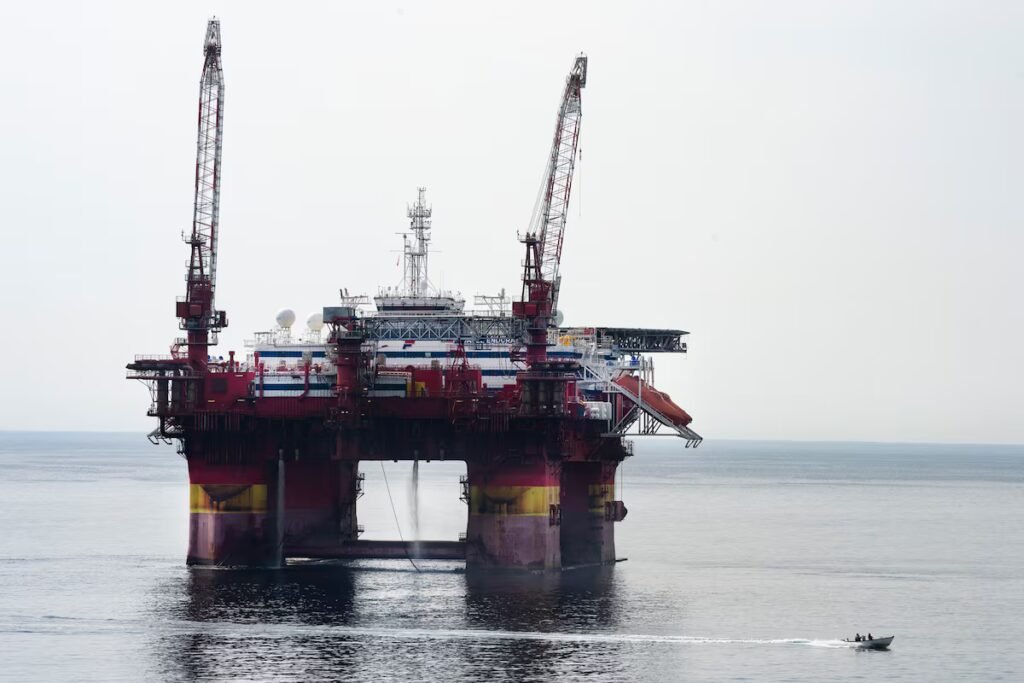

Three years after Norway-based Equinor ASA paused the Bay du Nord oil project, planned for the deep, cold waters off the east coast of Newfoundland, the potential development seems closer to becoming a reality.
Although Bay du Nord’s future is no sure thing – a final investment decision from the energy company is slated for early 2027 – its fortunes have turned.
Equinor has submitted a detailed development plan application and has launched calls to supply everything from pipes and valves to catering and medical services for the project. In addition, on July 6, Equinor said it would buy BP Inc.’s 37-per-cent stake in Bay du Nord to become the project’s sole proponent, giving it more flexibility in the lead-up to the final investment decision.
Equinor to acquire BP’s stake in Bay du Nord offshore oil project
Anders Opedal is the president and CEO of Norwegian multinational energy company Equinor. Three years after his company paused the Bay du Nord oil project, there are signs the development may be closer to becoming a reality.Richard Drew/The Associated Press
The province hopes Equinor greenlights the $14-billion project to help drive more development in the as-yet untapped Flemish Pass Basin and spur investment in its broader offshore sector.
Industry groups, politicians and even nearby Nova Scotia see the Bay du Nord project as a harbinger of a future in which Atlantic Canada can fully tap into its energy ambitions.
Bay du Nord would also provide a much-needed economic boost to Newfoundland. The province is facing a $688-million deficit for the 2026-27 fiscal year, rising to $1.1-billion by 2029-30, according to its most recent budget.
Oil and gas accounts for 18 per cent to 25 per cent of Newfoundland’s annual GDP. The third largest oil-producing province in Canada, it pumped out 87.6 million barrels of oil in 2025, according to the Canada-Newfoundland and Labrador Offshore Energy Regulator (C-NLOER).
All of it came from four offshore fields in the Jeanne d’Arc Basin, the centre of which lies roughly 340 kilometres east of St. John’s.
The Hibernia oil platform is towed to the oil field in Jeanne d’Arc Basin, southeast of St. John’s, in May, 1997. Later that year, it began production, kickstarting the offshore petroleum industry in the province.Jonathan Hayward/The Canadian Press
The first offshore field to begin production was Hibernia, which has been operated by ExxonMobil Corp. XOM-T since 1997. Terra Nova, operated by Suncor Energy Inc. SU-T, began production in 2002. White Rose, operated by Cenovus Energy Inc. CVE-T, started up in 2005. Lastly, there’s Hebron, also operated by ExxonMobil, where oil was first produced in 2017.
Bay du Nord consists of several oil discoveries in the Flemish Pass Basin, about 500 kilometres east of St. John’s. The first phase of the project would tap roughly 400 million barrels of oil, with production due to begin in 2031. It would be Canada’s first deepwater oil development.
Ottawa has committed to helping de-risk Bay du Nord. In 2022, it approved the project’s environmental assessment and it has agreed to cover any fees that could be due under a United Nations convention because it sits outside Canada’s exclusive economic zone.
And, in March this year, after Equinor and the province signed an agreement on how to divvy up the development’s anticipated rewards, federal Natural Resources Minister Tim Hodgson said that advancing offshore development would improve energy security, unlock billions in royalties, create jobs and “produce oil with an emissions profile we can be proud of.”
Jim Beresford, Equinor Canada’s vice president, has spent the bulk of his career at the company.
“I can tell you that if Bay du Nord were a book, it would be a damn exciting read,” he told the industry group Energy NL’s conference in St. John’s in June.
The story has “more than a few plot twists and some hard pivots,” he said, including the massive setback in 2023, but it also “has the potential to shape the future of our province for generations.”
That setback a few years ago came when Equinor put the project on hold for up to three years, citing rising costs. But changes the company has since made to the plan mean it’s now more tenable.
Charlene Johnson, CEO of Energy NL, speaks at the 2026 Energy NL conference. Ms. Johnson believes that the oil fields off Newfoundland present a broader development opportunity for the province.Greg Locke/The Globe and Mail
Charlene Johnson, the chief executive of Energy NL, said in an interview she can’t picture a reality in which Bay du Nord does not go ahead.
Between its potential economic windfall and the fact it would produce barrels with some of the lowest emissions in the world, the province and Canada need the development, she said.
There are several reasons Ms. Johnson believes that the oil fields off Newfoundland present a broader development opportunity: the vast volume of reserves under the ocean floor; the region’s proximity to the European market; projects are already in the sea, so they can avoid overland pipelines, and; emissions are far lower than other means of production, including the oil sands.
That doesn’t necessarily cut it for environmental groups.
Members of the Sierra Club Canada demonstrate against the Bay du Nord oil project outside the Federal Courthouse in Ottawa in 2023.Sean Kilpatrick/The Canadian Press
After Ottawa approved Bay du Nord’s environmental application in 2022, the Sierra Club Canada Foundation, a green charity, and Mi’gmawe’l Tplu’taqnn Inc., a non-profit representing eight Mi’gmaq First Nations in New Brunswick, took the government to the Federal Court of Appeal. They argued that the approval process overlooked significant environmental issues and Indigenous rights, particularly around marine shipping. The court dismissed the appeal last month.
Also in June, C-NLOER launched its annual call for bids on exploration licences. While the past three calls drew zero interest from industry, the province is confident that companies will this time raise their hands.
Greg Locke/Globe and Mail
Jim Keating is the CEO of Newfoundland and Labrador’s Crown corporation for oil and gas, called OilCo, which leads offshore activities in the province. Much of his time is spent speaking with industry to attract investment, and he said countries that typically rely on the Middle East are now looking elsewhere for fuel.
“I get calls all the time – almost on a weekly basis – particularly from European refiners and commodity traders looking for new sources of supply, and they see the East Coast of Canada as a nice one. They just wish there was more of it,” he said. “Every barrel that we can produce is going to find a home.”
Newfoundland eyes development of significant offshore natural gas reserves
Mr. Keating also pointed to federal policies from Prime Minister Mark Carney, which offer more support for oil and gas development than those of his predecessor, Justin Trudeau.
Premier Tony Wakeham agreed. Canada has been “afraid to talk about” developing its natural resources for the past 10 years, he said in a recent interview. But the current federal government supports that development, whether it’s for critical minerals, hydro electricity, mining or oil.
Newfoundland and Labrador Premier Tony Wakeham attends the 2026 Energy NL conference. His government has introduced direct engagement with oil companies in the bid process in an effort to drum up more interest.Greg Locke/The Globe and Mail
Like Mr. Keating, Mr. Wakeham is optimistic about the next round of licence bids, citing “a significant increase of interest” in the province’s offshore sector since it signed the benefits agreement.
Under the agreement, the Bay du Nord project would provide up to $6.4-billion in direct revenue to the province over its first 25-year phase, through royalties, taxes and a possible equity stake. Equinor will also provide the government with a $200-million “fabrication fund” to build a floating dry dock capable of serving ships weighing more than 18,000 tonnes.
Mr. Wakeham’s Progressive Conservative Party government has changed the bid process by introducing direct engagement with oil companies, in an effort to drum up more interest in exploration and development. And its most recent budget earmarked $90-million over three years to encourage new offshore exploration activity.
Nova Scotia also wants in on the offshore oil and gas action.
Nova Scotia Premier Tim Houston has spent the past year pitching his province’s energy development potential to oil and gas companies.Darren Calabrese/The Canadian Press
If Premier Tim Houston’s plans come to fruition, they would lay the groundwork for an Atlantic offshore sector that could bring billions of dollars in royalties to a region that desperately needs cash and jobs.
Nova Scotia and Newfoundland and Labrador are different – his province has no icebergs, for starters – but a regional, Atlantic Canada industry “would be very complementary,“ Mr. Houston said in an interview.
“Their success would be our success, and vice versa. When you look at the big world out there, a confined area having that much natural resource is good for the country.”
Mr. Houston’s motivation is largely fiscal.
“We’re the worst-performing economy in North America. If we want to provide the services that we think Nova Scotians have a right to expect – in health care and education and roads and support – we have to have a better performing economy.”
An oil rig is towed into Halifax harbour for a scheduled refit before it heads to Nova Scotia’s Panuke oil field in September, 1997. The Cohasset-Panuke installation produced about 44 million barrels of oil between 1992 to 1999.ANDREW VAUGHAN/CP
Commercial offshore oil and gas development would be nothing new for Nova Scotia; it was home to Canada’s first such project. Called Cohasset-Panuke, the installation ran from 1992 to 1999 and produced about 44 million barrels of oil. Two later offshore gas projects – Sable and Deep Panuke – were decommissioned in 2018.
The province estimates it has up to 148 trillion cubic feet of offshore natural gas. Oil is estimated at around 22 billion barrels, though that figure is unproven.
Mr. Houston has spent the past year pitching Nova Scotia’s energy development potential to oil and gas companies. At first they were confused, often saying, “We haven’t thought about Nova Scotia in 15 years.”
That is slowly changing. In February, the Impact Assessment Agency of Canada began a regional assessment of oil and gas exploratory drilling off the coast of Nova Scotia. Its goal is to figure out how to reduce timelines for project-specific impact assessments.
Last July, the Canada-Nova Scotia Offshore Energy Regulator issued a call for bids for exploration licences in 13 areas. It only received two successful bids, both of which went to Halifax-based Inceptio Oil and Gas Ltd., but Mr. Houston said it was a good start.
Meanwhile, Equinor’s Mr. Beresford is optimistic about the prospects for the oil project off the coast of St. John’s, Newfoundland.
Bay du Nord faces a tight timeline, and its success will require clear regulatory processes and work that progresses “with focus and at pace,” Mr. Beresford said.
“Timing matters, clarity matters, predictability matters.”
The Decibel: The pressure is on for Canada to meet growing energy demand
Since the war in Iran began, North American energy exports – such as petroleum and liquefied natural gas – have increased. Now, there is pressure on Canada to meet the increased demand.
The Globe’s energy reporter, Emma Graney, joins the show to explain how some Canadian companies are changing course to try to meet that demand, what’s getting in the way for other Canadian companies to do the same and what all this means for a transition away from fossil fuels.


More Stories
Key economic bill clears first vote in House of Commons
Stephen Jarislowsky was a patriot and the Leonardo da Vinci of Canadian business
Stephen Jarislowsky dies at 101