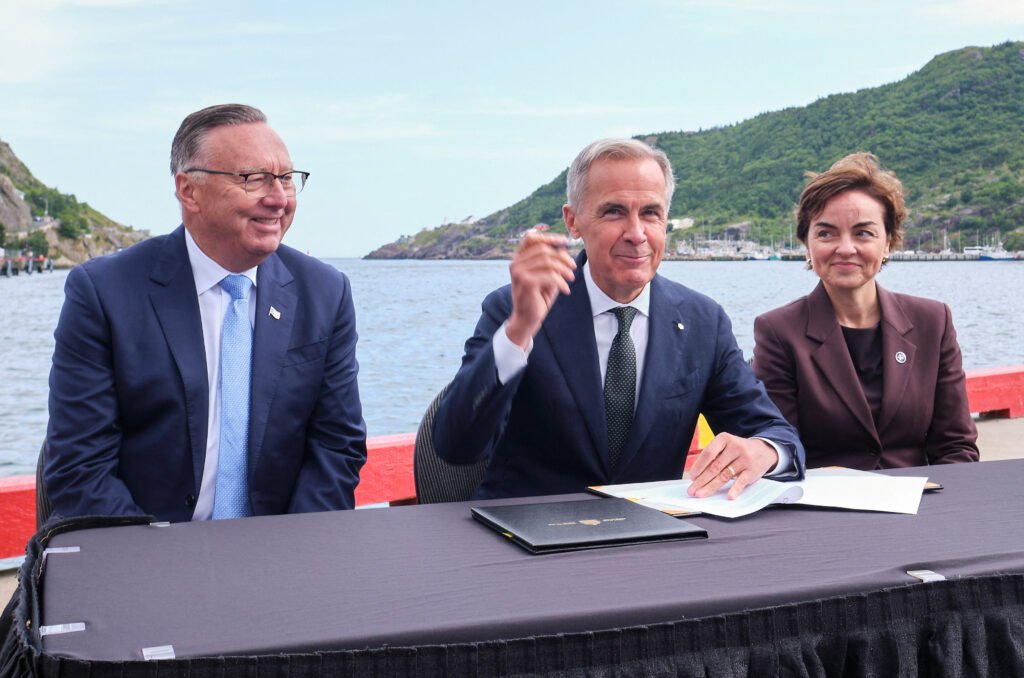

Newfoundland and Labrador Premier Tony Wakeham, Prime Minister Mark Carney and Quebec Premier Christine Frechette at the announcement of a Quebec-Newfoundland agreement in St. John’s on Monday.Greg Locke/Reuters
Canada became even more important to U.S. President Donald Trump on Monday, when the premiers of Quebec and Newfoundland and Labrador set aside years of bad blood to announce a $70-billion renewable power agreement.
Prime Minister Mark Carney joined Newfoundland’s Tony Wakeham and Quebec’s Christine Fréchette on St. John’s waterfront to unveil a reworked version of plans to develop hydro and wind power projects along the Churchill River, and new transmission lines to get that electricity to markets in Canada and south of the border.
The deal’s key component is an opportunity for the two provincial utilities to dramatically boost electricity sales to U.S. utilities that are starved for supply as they try to feed power-hungry data centres.
Given the animosity most Newfoundlanders hold toward the 1969 agreement with Hydro-Québec that paved the way for the Churchill Falls generating station, Mr. Carney was more than justified when he said: “This is co-operative federalism at work.”
The agreement paves the way for decades of low-cost renewable power in eastern Canada. The side benefit is also a strong card for Mr. Carney to play as negotiators try to hammer out a trade deal with their U.S. counterparts.
Opinion: The Trump threat is tragic for Canada – but it can also be cathartic
There is a line from a bestselling book on how to win negotiations that goes like this: “Leverage is having something the other guy wants. Or better yet, needs. Or best of all, simply can’t do without.” The author of The Art of the Deal is the current U.S. President.
Electricity, from Eastern Canada’s hydro plants or Western Canada’s oil and gas, is something America’s economy simply can’t do without.
While the Prime Minister said last month he doesn’t “see the value” in using energy exports as a bargaining chip in trade talks, Mr. Carney has also made it clear that everything will be on the table if negotiations fail and the Trump administration follows through on tariff increases on Wednesday.
Meeting America’s demand for power gave both Ms. Fréchette, the premier of Quebec, and Newfoundland’s Mr. Wakeham the opportunity to declare a win from this agreement, which replaces a 2024 memorandum of understanding, or MOU, between the two provincial utilities.
The fact that previously contentious politicians in Quebec and Newfoundland managed to resolve their differences, for the greater good, is a tribute to the backroom skills of former Quebec Hydro CEO Michael Sabia, who is now one of the Prime Minister’s key advisers as Clerk of the Privy Council.
Ms. Fréchette and provincially-owned Hydro-Québec negotiated the right to double generation capacity in Labrador to up to 10,000 megawatts, while locking in relatively low rates for domestic customers for the next 50 years. The previous MOU set a target of 7,200 megawatts.
To put this in perspective, the new generation plants will produce enough electricity to power all the homes in Montreal, Toronto and Vancouver, combined.
Newfoundland and Labrador Hydro won the long-sought ability to sell up to 985 megawatts of power to U.S. customers, through Hydro-Québec transmission lines, at market rates. In the past, the provincial utility could not sell power to the Americans. The utility also got $2-billion in federal backing for a massive wind farm and a transmission network in Labrador, projects that will potentially power nickel mines and other industrial sites.
By striking a deal with Newfoundland’s government, Hydro-Québec chief executive officer Claudine Bouchard said on Monday the company is taking the next step in a strategy to “consolidate its North American leadership in renewable energy.”
The utility has already built transmission lines into New England and New York, regions where the costs that come with data centre construction are a hot-button political issue.
Last year, Hydro-Québec tried to score points with domestic customers by including a pair of dramatic charts in its annual report.
The utility showed homeowners in Boston and New York City paid roughly six times more for power than Montreal residents. Commercial clients in New England and New York State paid about five times more for electricity than major power consumers in Quebec.
Higher power price from U.S. customers mean larger profit margins for the two provincial utilities.
In 2025, Hydro-Québec sold $1.7-billion of electricity outside the province. New England utilities bought 41 per cent of this power, clients in New York took 5 per cent. New Brunswick and Ontario were the other major customers.
Last year, the Quebec utility could have sold more electricity to Americans, but opted instead to refill reservoirs. As the Churchill River projects come on line, far more power will be available for sale to U.S. customers.
Monday’s agreement means Hydro-Québec, allied with Newfoundland and Labrador Hydro, can credibly claim to be an electrical superpower and an indispensable element of the U.S. grid.


More Stories
British online retailer ASOS warns customer data may have been breached, shares fall
France’s Mistral says its Le Chonk AI model outperforms some Chinese rivals
Ottawa asks Cleveland-Cliffs to provide steel job plan or face possible legal action