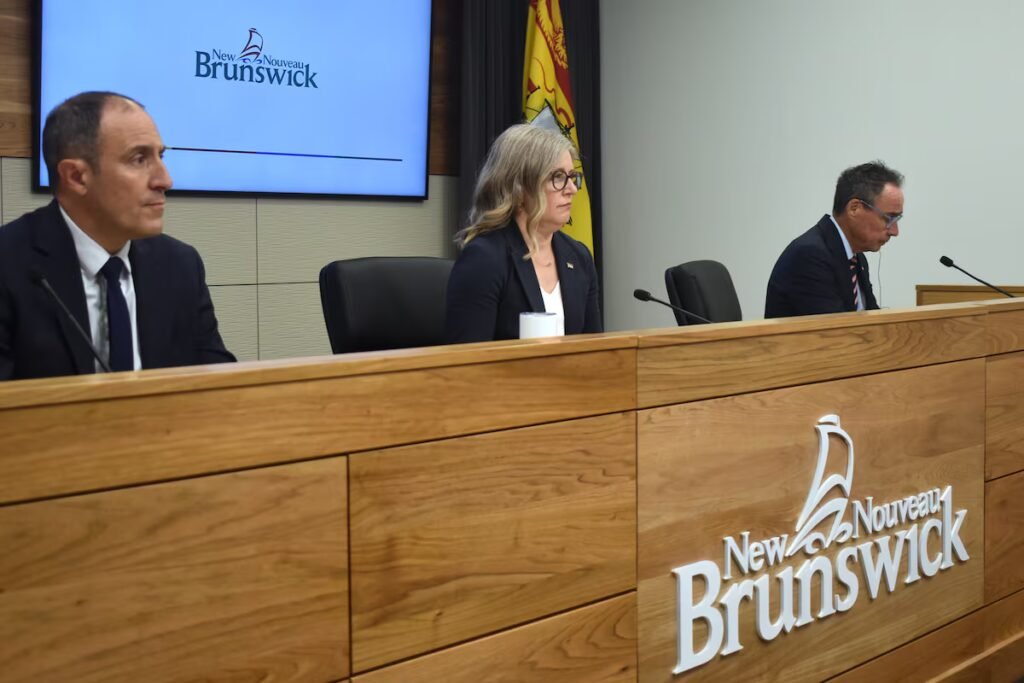

New Brunswick Premier Susan Holt flanked, centre, Indigenous Affairs Minister Keith Chiasson, left, and Natural Resources Minister John Herron address reporters in Fredericton on Wednesday.Eli Ridder/The Canadian Press
New Brunswick’s Liberal government is considering whether it should drop its long-standing ban on extracting the province’s large natural-gas reserves as it looks for ways to boost its economy and secure Canada’s energy independence.
Premier Susan Holt announced a public review into the fracking ban on Wednesday, saying she’s looking “at all options” to support growth in her province amid Canada’s escalating trade war with the United States.
“We need to double down as trade with our closest neighbour is thrown into question yet again. Now is the time to secure our autonomy and protect our sovereignty,” Ms. Holt said Wednesday.
Former Liberal premier Brian Gallant placed a moratorium on hydraulic fracturing in 2014 amid concerns from First Nations, scientists and advocates about the impacts that fracking had on the environment, including groundwater supplies.
Opinion: Canada’s response to Donald Trump is a nation-defining moment
Fracking is a process in which fluids or gas and chemicals are pumped underground at high pressure to fracture layers of shale rock to release trapped pockets of shale gas.
Ms. Holt has opposed a return of widespread shale gas fracking her entire political career.
But in recent months, she has touted New Brunswick as a key player in Canada’s goal of being an energy superpower – and questioned Wednesday whether the province can play that role if it relies on the U.S. for natural gas.
“We see a global dynamic shift in relationships and energy, we see our allies in Germany and Poland who are looking for natural gas,” she said.
“The only responsible thing to do at this point in time is to revisit the conditions of the moratorium to determine if this is something that can benefit New Brunswickers or not.”
The Maritime province currently relies heavily on natural gas piped north from U.S. shale fields via the Maritimes and Northeast Pipeline, with costs that can fluctuate drastically from day to day.
Efforts by the Holt government to persuade Quebec to extend a natural-gas pipeline from Quebec City to New Brunswick have so far been unsuccessful.
The public review process is likely to receive a range of feedback. The province’s opposition Progressive Conservatives have ramped up calls this year for the ban to be removed, while environmental groups say fracking is a threat to the water supply.
Atlantica Centre for Energy, a non-profit advocacy group, said in a statement that it backed the province’s review process as a discussion as opposed to a final decision.
The organization’s president, Michelle Robichaud, noted it comes as New Brunswick considers how it will meet increasing energy demands from businesses and residents.
Mr. Gallant won the 2014 election, in part, because of a promise to end fracking in the province after protests against gas development in 2013 that at one point turned violent.
Ms. Holt said on Wednesday a return of widespread natural gas development could create an income stream for the government through royalties. Her cash-strapped government has predicted multimillion-dollar budget deficits until at least 2028.
But the Premier also emphasized the review was the “start of a conversation” that would include First Nations communities, local governments, industry stakeholders and regular New Brunswickers.
“This is not a green light to start getting drills in the ground,” Ms. Holt said.
“This is a deliberate five-month-long dialogue with many partners in our province and with you as New Brunswickers to determine whether this is something we want to move forward with together.”
Ms. Holt noted there wasn’t an interested private-sector company at this point.
When the ban first came into place, private interest in New Brunswick’s gas reserves went cold.
In 2019, a Progressive Conservative government created an exemption to the fracking ban in the Sussex area of southwestern New Brunswick.
That carveout allowed natural-gas extraction to continue supplying local industrial users and maintain the existing infrastructure in the region.
Glen Savoie, the Opposition’s interim leader, said by phone the Liberals were announcing the review to change public perception as the province continues to run deficit budgets.
Ottawa lays out strategy to hit back at $27.6-billion in U.S. products
Mr. Savoie added he wouldn’t trust Ms. Holt’s government to roll out a large-scale return of the natural gas industry if the ban was removed.
Natural Resources Minister John Herron said the review would examine how the fracking exemption was affecting the environment and establish conditions for moving forward.
“If we can’t be certain that this can be done safely, it won’t be done at all,” Mr. Herron said.
Indigenous Affairs Minister Keith Chiasson said First Nations rights, interests and priorities must be central to the review, adding that Indigenous leaders have given their support to the consultation process.
New Brunswick sits on an estimated 77.9 trillion cubic feet of recoverable natural gas underground that could be worth hundreds of billions of dollars, according to government figures.
A recent review of New Brunswick’s power utility included a recommendation for the province to increase natural gas production for home-heating purposes and as a relief for high electricity prices.


More Stories
McCain Foods acquires Indian frozen food company as relations with Canada thaw
NATO innovation exercise puts emerging defence technologies to the test in Nova Scotia
Canadian housing policy wants you to live in shoebox condos in the middle of nowhere