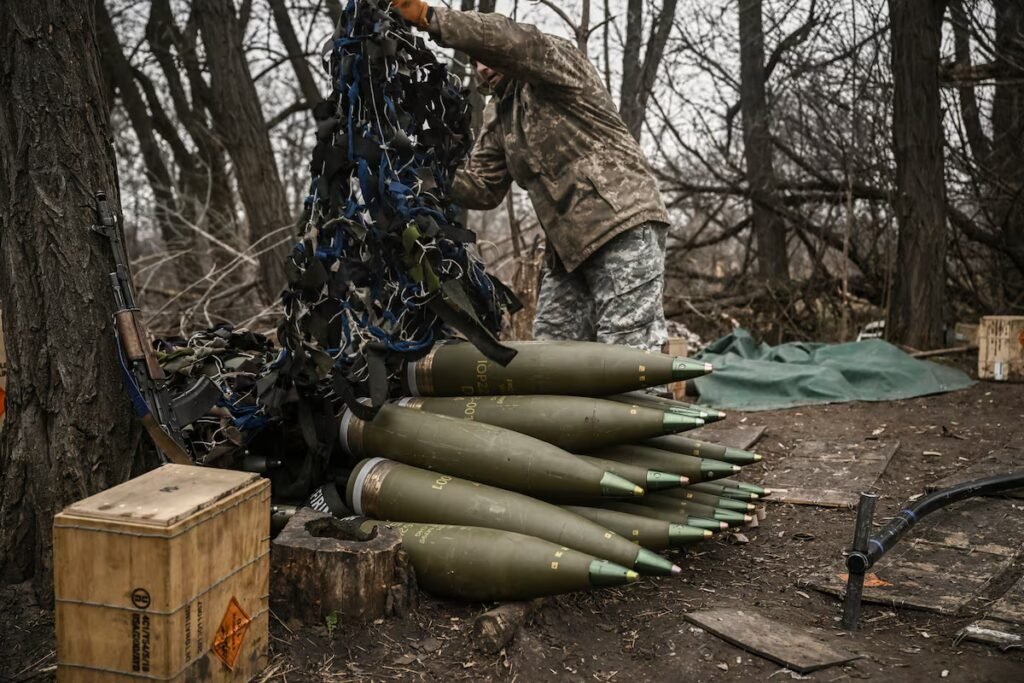

A Ukrainian serviceman prepares 155mm artillery shells near Bakhmut, Ukraine, in March, 2023. Many NATO countries currently face severe shortages of such munitions.ARIS MESSINIS/AFP/Getty Images
A new Canadian company led by former Quebec MP Patrick Gagnon has picked New Brunswick for an explosives plant that will help put Canada back on the munitions map as demand for artillery shells soars.
The New Brunswick government has provided Mr. Gagnon’s private company, Nalagx Corp., with a commitment letter to provide 1,500 acres of largely empty Crown land in Belledune, on the Bay of Chaleur in the province’s north, for the factory.
The selection follows a year-long process that saw several provinces make pitches for the project, whose value could reach about $2-billion over time as the product line is expanded and extra fabrication modules are built.
“The project represents a potential positive development for New Brunswick’s continued economic growth,” John Herron, the province’s Minister of Natural Resources, said in a July 30 letter to Nalagx.
New Canadian firm and France’s Eurenco plan explosives factory in Canada to meet NATO demand
He added that Belledune “has been identified as a favourable location for the facility due to its proximity to roads, rail infrastructure and the Port of Belledune.” The letter called the land a “potential lease area,” a suggestion that Nalagx would not own it outright.
Mr. Gagnon said those features sold his team on the site, since making propellants and explosives – together known as “energetics” – and delivering the finished products to military and civil customers in North America and Europe will require an efficient sea and land transportation network nearby. “The province has made the land available to us on very favourable terms,” he said.
Mr. Gagnon was a Liberal MP for the Quebec riding of Bonaventure from 1993 to 1997 and is now managing partner of Parliamentary Group, a government relations and lobbying firm. He and his business partner, Jared Mintz, a New York private equity executive who is Nalagx’s chief financial officer, devised the idea in 2025 to build an energetics factory. Their analysis determined that they would find a ready market in many NATO countries, most of which face severe shortages of munitions such as the 155mm artillery shells used by Ukraine against Russia.
“Patrick and I have been working on cross-border projects for a decade,” Mr. Mintz said. “We believed in the energetics defence thesis even before Mark Carney’s emphasis on growth in defence and the Iran war.”
The key condition imposed by New Brunswick on the land-transfer deal is that Nalagx find a “credible operating partner” by the end of this year.
Last year, when Mr. Gagnon and Mr. Mintz announced their intentions to build an energetics factory – location then unknown – they held discussions with France’s state-controlled Eurenco, Europe’s top maker of military explosives and propellants. Nalagx and Eurenco signed a letter of intent to build a factory somewhere in Canada.
The two companies later decided they were not a good fit. “We realized that we needed an operator who knew, and was focused on, North America, preferably with a Canadian presence,” Mr. Mintz said. “We still have an excellent relationship with Eurenco and they may be a buyer of our products one day.”
Nalagx expects to announce the identity of a new operating partner in two or three months and start construction of the factory late next year, after the environmental review is finished and the engineering plans and project financing are firmed up. The first phase of the project, valued at about $600-million, will mostly make TNT explosives and its derivatives. It will have about 250 employees.
Later stages will add propellants and could take employment up to 1,000, Mr. Gagnon said.
Eventually the factory buildings will cover 144,000 square feet on the 650 acres that will be designated for industrial use. The rest of the land package will be buffer and safety zones, given the potential dangers of factories that make explosives. In 1917, during the First World War, Halifax was virtually levelled when a French cargo ship laden with high explosives collided with a Norwegian ship. The French ship caught fire, triggering a detonation that killed 1,963 people and injured 9,000.
Mr. Mintz said the New Brunswick factory will be financed by a combination of private equity and debt from commercial banks, with a possible package from Export Development Canada, the government-owned export credit agency. Nalagx is pursuing other incentives, including tax credits from the New Brunswick government and funding from various federal programs, among them the Canadian Defence Industry Resilience Program.
The private equity needed will come to US$200-million, Mr. Mintz said. “We have circled $100-million equity so far out of the total, so we need to raise up to $100-million more. Later phases will need additional equity.”
Canada does make finished ammunition. The biggest supplier is Quebec’s General Dynamics Ordnance and Tactical Systems-Canada Inc., which is owned by General Dynamics Corp. of Virginia. Its 1,200 employees make a broad range of ammunition, as well as shell casings and hand grenades, for the Canadian Armed Forces.
Canada was once one of the world’s biggest makers of munitions. During the Second World War, it made about 1.9 million artillery shells a month.


More Stories
A licence to be a barber? Ridiculous red tape holds Canada back
McCain Foods acquires Indian frozen food company as relations with Canada thaw
NATO innovation exercise puts emerging defence technologies to the test in Nova Scotia