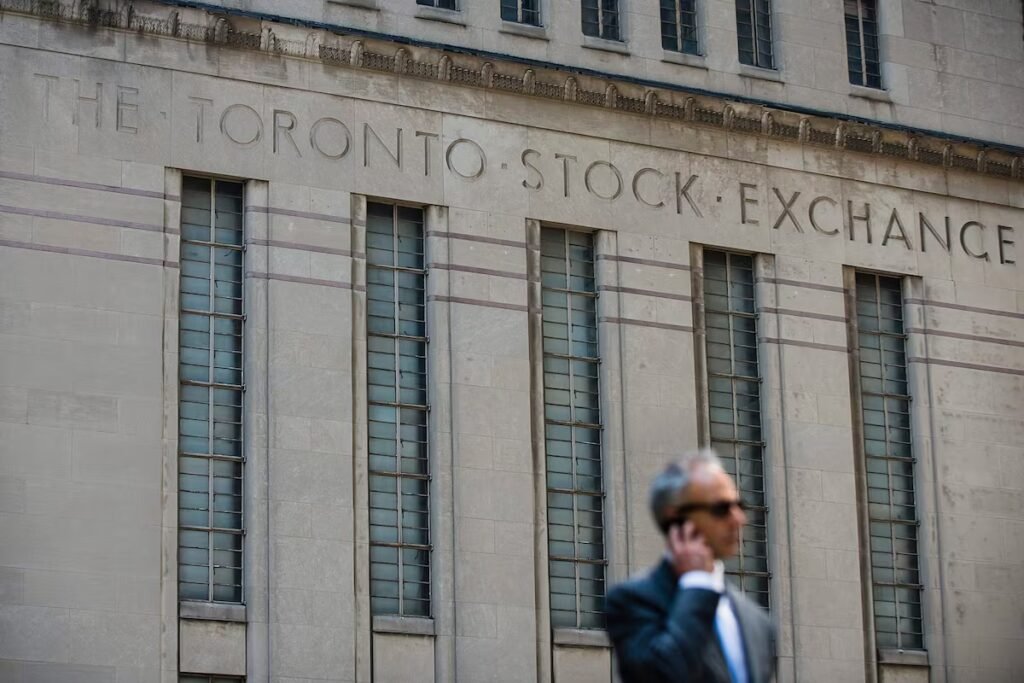

The auto industry, along with other sectors hit by tariffs such as lumber and dairy, only make up a small share of the Toronto Stock Exchange’s benchmark S&P/TSX Composite Index.Aaron Vincent Elkaim/The Canadian Press
Even a bruising trade war can’t rattle Canada’s surging stock market.
After a deal between Canada and the U.S. collapsed late Friday night, the Canadian stock market largely shrugged off news that 50-per-cent tariffs hit a variety of Canadian industries and that Ottawa would retaliate with countermeasures.
Shares of Ontario’s three largest publicly traded auto-parts suppliers slumped on Monday after the breakdown in talks and fresh news that Trump would double auto tariffs to 50 per cent from 25 per cent as of Jan. 1, 2027, and apply them also to auto parts, which have so far been exempted.
But the auto industry, along with other sectors hit by tariffs such as lumber and dairy, only make up a small share of the Toronto Stock Exchange’s benchmark S&P/TSX Composite Index.
“It’s important to remember that the TSX is not the economy,” said Greg Taylor, chief investment officer at PenderFund Capital Management.
The S&P/TSX reached a record closing high of 36,957.63 on Tuesday, before retreating Wednesday by nearly 150 points.
The Canadian benchmark is expected to outperform its U.S. counterpart for the second year in a row. In 2025, the index posted a roughly 28-per-cent annual return while the S&P 500 posted around 16 per cent.
The three largest sectors making up the Canadian benchmark – financials, energy and materials – have heavily contributed to the total index’s 30-per-cent gain over the past 12 months. The S&P 500 was up 18 per cent over the same period.
Global forces have boosted the Canadian stock market, despite any disruptions to the country’s trade relationships. Over the past year, rising commodity prices have lifted the Canadian index, which have contributed to the energy and materials sector leading the index’s overall gains.
Since the Iran war broke out in early spring, oil prices soared, reaching more than US$100 a barrel. The uncertainty – which is expected to persist – has kept the price per barrel high throughout the year as investors price in a geopolitical risk premium.
Canada withstands tariff upheaval, says National Bank CEO, as quarterly earnings beat expectations
Additionally, supportive policies that translate into new pipeline projects will help Canadian producers sell overseas at higher prices, Mr. Taylor said.
The S&P/TSX Capped Energy Index – that tracks the performance of Canadian energy companies listed on the TSX, including Canadian Natural Resources Ltd. and Suncor Energy Inc., is up 60 per cent year over year.
“Historically, the safer way to tap into the oil markets is by buying Canadian energy stocks or the TSX,” said Philip Petursson, chief investment strategist at IG Wealth Management.
Oil’s not the only commodity to rally recently. The S&P/TSX Capped Materials Index – mostly made up of metal mining stocks – is up a whopping 66 per cent over the past 12 months.
The sector includes Agnico Eagle Mines Ltd., Barrick Mining Corp. and Wheaton Precious Metals Corp, all of which are up more than 50 per cent.
The gold miners have benefited from a historic gold rally that has seen the precious metal rise around 37 per cent since last August, driven by central bank buying, sticky inflation expectations and more recently, mounting concerns over fiscal debt.
Robert Cohen, senior portfolio manager at Scotiabank Global Asset Management, said the bigger force affecting gold has been the U.S. deficit building every year.
“They never fathomed this kind of amount of debt in the system. At what point are people starting to get really panicky? And based on what I see going on in the gold price over the last couple of years – they’re waking up to it,” Mr. Cohen said.
At the same time, demand for copper and other metals critical to the build out of the power grid, data centres and EVs is higher than ever.
The largest pure-play copper miner listed on the TSX, First Quantum Minerals, traded at $48 a share Wednesday – up around 100 per cent year over year.
Opinion: Five ways to create financial certainty in uncertain times
But compared with other asset classes, commodities are highly susceptible to boom-and-bust cycles. The last commodity super cycle ended in the 2010s and led to a lack of investment in the industry over the past decade. This is expected to keep metal markets tight – and prices elevated – moving forward as demand is expected to outpace supply.
But investors such as Mr. Cohen – who’s been in the industry for more than 30 years – are very optimistic.
“The people that are early are already there, but the masses haven’t come yet,” Mr. Cohen said.
Mr. Petursson of IG Wealth said the Canadian stock market’s performance is also highly dependent on the financial-services sector.
The S&P/TSX Capped Financials index – home to the Big Six banks, major asset managers and insurance companies – gained 39 per cent over the past year.
Given that financials are the biggest sector of the TSX, the main near-term risk would be if investors begin to question the valuations of the banks, which have climbed beyond historical norms this year, Mr. Taylor of PenderFund said.
“People are just overlooking these tariff short-term headlines, thinking they won’t have any impact on the banks, but the longer that drags out, it just might have some degree of impact.”


More Stories
Boots is an iconic brand – but challenges await the Weston family
Investigators hunt French supermarket fridge hackers, no claim of responsibility
Apple unveils new smart home products, showcasing updated Siri AI