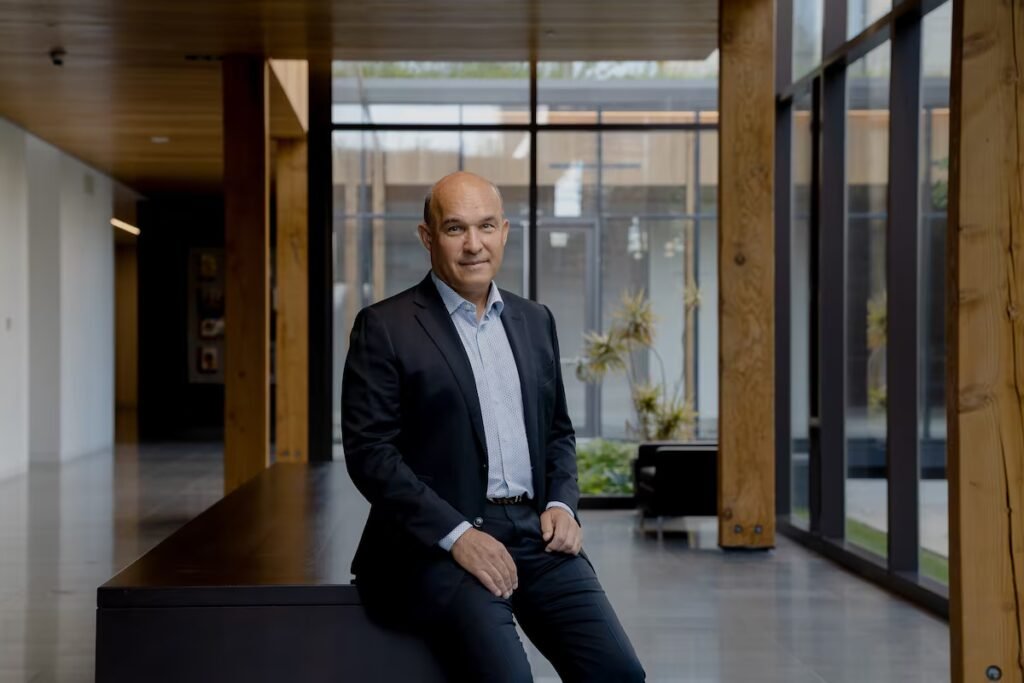

Jim Balsillie says he began anonymously contributing to food banks after the initial economic shock of the pandemic.Supplied/Supplied
In the past decade, the Food Bank of Waterloo Region has undergone a drastic transformation: The number of staff has more than doubled to 54, the storage square footage has shot up to accommodate millions of pounds of food annually and the trucks that transport that food have gotten even larger.
Although based in one of Canada’s most prosperous regions, the food bank’s growth has been a response to a surge in demand for emergency food support.
Data released last year from the Kitchener, Ont.-based food bank, which serves dozens of smaller agencies in the area, found that food hamper visits, the largest regular program the bank runs with its partners, were up by 205 per cent since 2019. That translated to more than 621,000 visits between July, 2024, and July, 2025, the highest recorded number ever.
Tech executive-turned-philanthropist Jim Balsillie has taken notice. On Tuesday, he announced a donation of $1.5-million to the Food Bank of Waterloo Region as well as $1-million each to other Ontario food banks in Cambridge, Fergus and Guelph.
Mr. Balsillie, who has been vocal about Canada lagging behind the U.S. in gross domestic product per capita, is the former co-CEO of Research in Motion, the company famous for creating BlackBerry mobile devices, which helped put the Waterloo-Kitchener corridor on the map as an innovation and academic hub.
“The prosperity doesn’t spread uniformly,” Mr. Balsillie said.
The food bank’s chief executive, Kim Wilhelm, said growing food bank demand is a reflection of the overall high cost of living that those in her community are facing, including rising housing costs, which have become especially challenging for those with unstable employment. As wages have not kept up with inflation, food is increasingly becoming a discretionary item for many Canadians, she said.
This year, her organization’s budget for food purchases is more than $3-million, compared to about $200,000 before the pandemic.
“We are a high-tech community,” said Ms. Wilhelm. Yet, those who rely on food support come from all backgrounds, she said.
She believes the rising need is an economic warning sign that Canada should no longer treat the issue of hunger as charity.
“While we’re so deeply grateful for the investment, philanthropy alone cannot solve food insecurity,” she said.
Mr. Balsillie is also a proponent of policy changes to address the challenge. However, the urgent “here and now” compelled him to take action, he said.
Opinion: Canada’s new Food Security Strategy won’t end food insecurity
The philanthropist, who has previously made large donations to Wilfrid Laurier University and the University of Waterloo, said he began anonymously contributing to food banks after the initial economic shock of the pandemic.
Now, he hopes the public gift will inspire people to learn more about this issue as many food banks are facing a harsh choice: Expand or leave those seeking the necessities to feed their families empty-handed and hungry.
“At the end of the day, people still need to eat, and if they have to choose between rent and food, somehow some kind of support’s got to come,” he said.
The rise in demand signals that pay cheques are not keeping up with the cost of living, Mr. Balsillie said. “That’s a natural consequence of inattention to these issues.”
The entrepreneur often speaks about the importance of nations owning their intangible assets, such as intellectual-property and data, to thrive in today’s global economy. He argues that Canada didn’t take advantage of the shift in value from tangible to intangible assets, resulting in a relatively lower GDP per-capita. Mr. Balsillie has stated that poverty and food insecurity are outcomes of this.
On the potential for the federal government to reverse course on patterns that put food out of reach for Canadians, Mr. Balsillie sounded somewhat optimistic. “Maybe we’ll see the pressure on this food insecurity ease up because we’re paying attention to prosperity drivers.”
For the Food Bank of Waterloo Region, Mr. Balsillie’s gift will act as a bridge through a transitional period where the food bank is working at capacity, while also looking for a new building to call home. Currently, the food bank is leaning on some off-site storage to manage the overflow.
“What’s especially meaningful is that it allows us to think beyond our immediate needs and help us plan for the future,” Ms. Wilhelm said.
The money will also help the Guelph Food Bank process more local food, the Cambridge Food Bank complete its new facility and the Centre Wellington Food Bank, located in Fergus, expand its network.
Mr. Balsillie is confident he will see the value of his investment come to fruition, adding that food bank operators are lean, hard-working and adaptive.
“The demand for what they do is growing, but, my goodness, do they put your money to good use.”


More Stories
China, U.S. agree to establish AI safety channel after summit
BlackBerry signs automotive software deal, Canada Labour Code changes and West Coast pipeline project in focus: Must-read business and investing stories for the week of Sept. 26
Anand to give Canada’s UN speech this afternoon – National