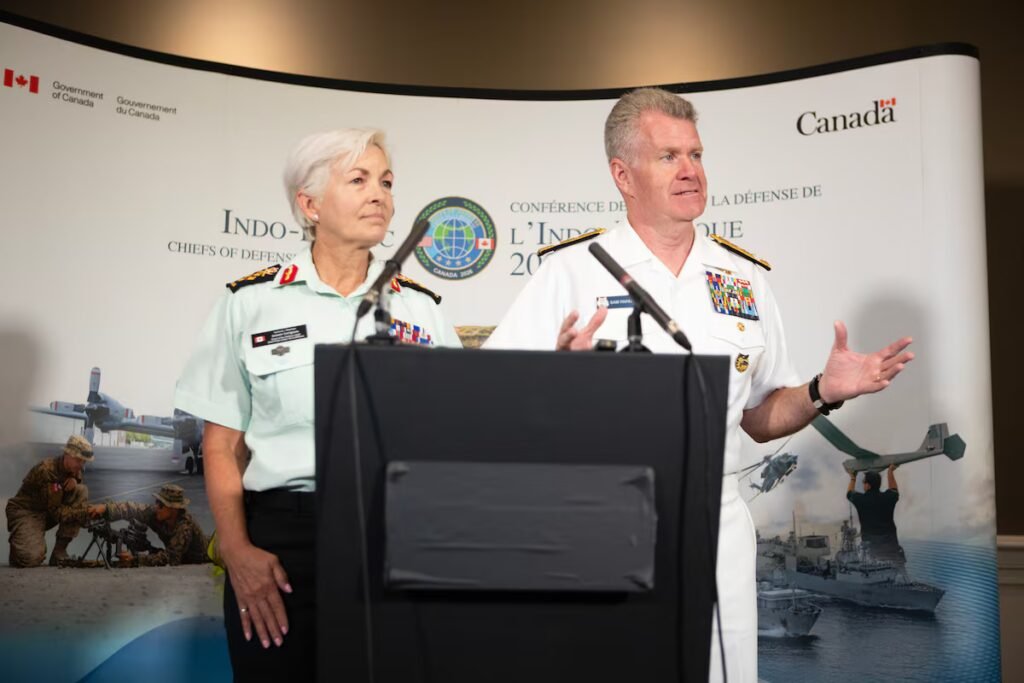

Gen. Jennie Carignan, left, and U.S. Pacific Command Adm. Samuel Paparo hold a joint press conference during the Indo-Pacific Chiefs of Defence Conference in Victoria on Wednesday.Chad Hipolito/The Canadian Press
The commander of the United States Indo-Pacific Command dismissed a question about whether he would obey orders to launch military action against Canada, saying the country is a close ally and the scenario was “preposterous.”
The commander, Admiral Samuel Paparo, sputtered with disbelief while responding to the question from a reporter Wednesday morning in Victoria, where a conference of the chiefs of defence for the Indo-Pacific moved into its third and final day.
The question was “needlessly emotional,” Adm. Paparo said, but he added, “I follow the orders of the president.”
“Will you ask me, please, also, what my attack plans are for the Martians?” he said.
Standing beside him unflinchingly at the press conference was General Jennie Carignan, chief of defence staff for Canada, who reiterated her point made earlier this week about the separation between Canada and the U.S.’s military-to-military relationship, versus its political relationship, especially in the context of the conference.
“We are really here to have the conversation that needs to be had on Indo-Pacific security,” she said.
Canada, U.S. remain close on military front despite rising political tensions, top soldier says
The two senior military officials are this year’s co-hosts for the annual conference that’s held in rotating locations across the Indo-Pacific. The 2026 edition brought together 29 countries to discuss topics such as multilateral co-operation, artificial intelligence and defence industrial bases.
Adm. Paparo called Canada an “indispensable partner,” highlighting the two countries’ collaboration in the Indo-Pacific and through North American Aerospace Defense Command.
He added, on the topic of defence procurement, that “there’s no demand on the United States’ part that Canada procures U.S. equipment.” It’s a sovereign decision for Canada, he said.
However, Adm. Paparo’s remarks come after trade talks between Canada and the U.S. broke down last month, with reports of the U.S. pressuring Canada to follow through on its purchase of American fighter jets as part of negotiations.
Adm. Paparo maintained that militaries across the Indo-Pacific are “designed to remain apolitical and ruthlessly focused on the facts of the geography.”
The deterrence of conflict in the region has been a theme at this year’s conference. Gen. Carignan said Canada’s persistent presence in the Indo-Pacific region is a growing priority for the country, with the goal of promoting deterrence. “If we are not present, then there can be miscalculation as part of being away from the theatre.”
A delegation from China was also in attendance at the event this year. Prime Minister Mark Carney formed a new strategic partnership between Canada and China earlier this year during the first visit to the country by a Canadian prime minister since 2017.
Carney’s summit to push Canadian resources, defence and tech to global investors
Gen. Carignan said she didn’t have any bilateral meetings planned with China at the conference but pending further conversations, that could change.
“There is a clear demand from the government to recalibrate and realign our relationship with China,” she said in an interview with The Globe and Mail.
Admiral Giuseppe Cavo Dragone, chair of the military committee for the North Atlantic Treaty Organization, also attended the conference in Victoria, where he said he met with officials from several countries including India, China, Singapore and Sri Lanka.
Prior to his meeting with General Yang Zhibin, China’s commander of the eastern theatre, he told The Globe he planned to emphasize that NATO was not at the conference to assert its presence, but rather to have an open dialogue about confrontation in the region.
NATO currently has four Indo-Pacific partners: Australia, Japan, the Republic of Korea and New Zealand. Adm. Cavo Dragone said no other countries in the region have requested partnership status at this time but they are welcome to do so.
Canada has taken several steps over the past few years to increase its own work within the Indo-Pacific, including the release of a region-specific strategy in 2022 and the appointment of an inaugural senior military representative to the Indo-Pacific earlier this year.
Hit by tariffs, Canadian tool-and-die makers eye opportunities in defence industry
Lieutenant-General Derek Macaulay has been busy the past few months after stepping in to this new role, meeting with other senior military leaders and defence officials in countries such as Japan, New Zealand, Australia, Vietnam and Malaysia. He said Canada’s contribution to the region goes well beyond military equipment and into other efforts such as training.
“It’s not just about ships. It’s not about just planes. It’s about training to a point of English lessons, from a military perspective,” Lt.-Gen. Macaulay said.
The three-day conference concludes Wednesday, and a separate defence industry event is planned for Thursday, Gen. Carignan said, to “highlight Canadian industrial strength, encourage international partnership and reinforce our collective efforts to transform innovation into warfighting advantage.”


More Stories
Green investment guidebook authors hold off on adding carbon capture for oil, gas after pushback
Six charts that show how B.C.’s fiscal outlook has gotten worse
Strategic maple syrup reserve close to empty, producers say