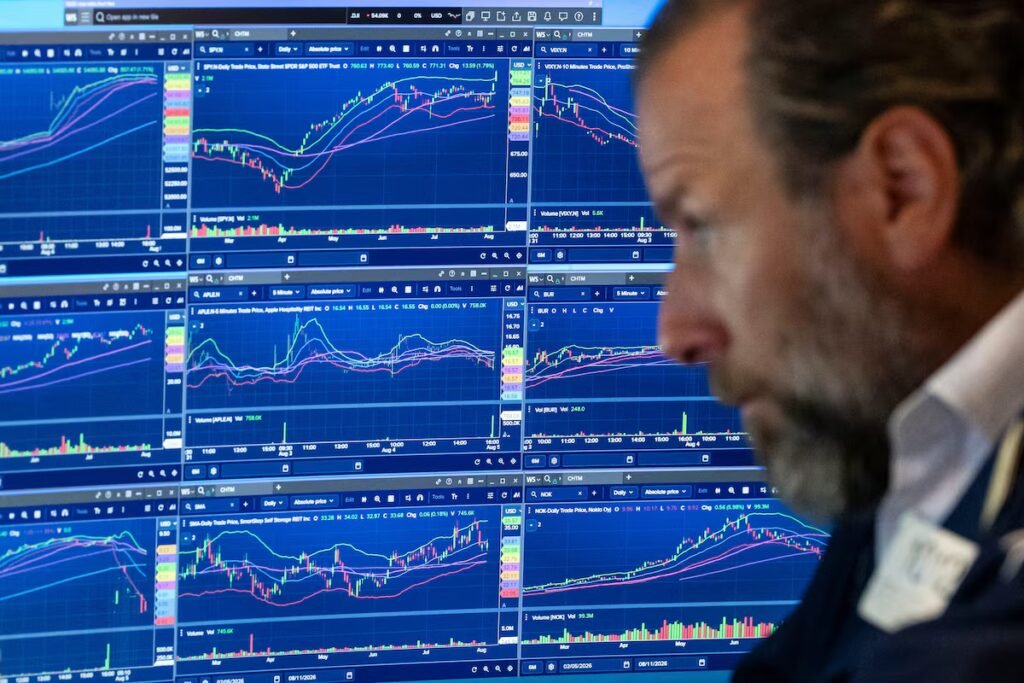

AI tools should give professionals something to check rather than asking them to accept a generated answer at face value, writes Andrea Mosconi.Yuki Iwamura/The Associated Press
Andrea Mosconi is the global head of Bloomberg’s Terminal business.
Banks, pension funds, traders and analysts are managing a lot more information than they were a decade ago, in less predictable markets. Bloomberg’s Terminal, for example, is now regularly processing more than 500 billion individual pieces of information a day – twice as much as a few years ago.
Financial professionals have access to an ocean of information at their fingertips, making it much more difficult to separate the good from the bad. Agentic artificial intelligence is helping to address this, and Royal Bank of Canada has gone as far as setting a commercial target of creating $1-billion in enterprise value from the technology by 2027, showing how fast AI is embedding into the day-to-day operations of major financial institutions.
Citadel LLC chief executive Ken Griffin recently said that AI agents across the financial services sector are doing in hours what PhD-level researchers previously took weeks to achieve. I’ve seen first-hand data consumption work compressed from more than four months to just two days using AI.
Competitive advantage no longer comes from finding information first, because it’s everywhere and available almost instantly. AI removes much of the early legwork, helping portfolio managers review earnings, analysts cover more companies and traders monitor market developments much more efficiently.
The U.S. fiscal hole has an AI problem at its core
But the hard part is knowing what information is reliable and then differentiating that from questionable sources. AI shouldn’t be deciding what’s important or making decisions. Markets are dynamic and a company’s apparent health can change significantly. Although AI can indicate a pattern or provide facts at pace, you need a human to question if it’s worth acting on.
Let’s take 2021’s GameStop example, which demonstrated that financial markets aren’t simply data driven. Traditional valuation measures suggested GameStop’s share price should plummet, yet enthusiasm among retail investors – much of it fuelled through social media – meant it rose sharply. No matter what large language model you’re using or how well your AI model is trained, it cannot predict real-time investor thoughts and, importantly, action.
We live in a world where AI can process huge amounts of data in seconds to give you almost instant answers. Because of this, it’s set to revolutionize global industries and our entire perception of work. However, in many sectors, including finance, credibility and trust is something you have to earn, not something you can buy. AI might help to speed up an admin process or help quantify some basic data, but it can’t do what the experienced finance professional is trained to do: Checking, validating and, critically, challenging data.
The Bank of Canada’s 2026 Financial System Survey, which hears from risk management experts in the financial sector, makes this distinction very clear. It found that AI is being used to complete existing tasks faster, particularly in information gathering and analysis, but is not replacing human judgment or fully automating critical decisions. Those who took part in the survey recognize that the final decision should still belong to experienced professionals because the wrong decision can carry financial, legal and reputational consequences.
Opinion: Data centres’ carbon emissions are rising, and companies are getting a free ride. Time for an AI tax
The CFA Institute has made a similar point in asset management, arguing that firms need to balance automation with human oversight, while maintaining governance and accountability. We know that AI can support research and data analysis, but it can’t become the unchallenged source of the answer.
When AI summarizes a market development or flags an opportunity, investment professionals must be able to identify and validate the exact source of where that information came from. That is why AI tools, such as Bloomberg’s ASKB, need to show where their information comes from, giving professionals something they can check, rather than asking them to accept a generated answer at face value.
Recent Bloomberg Intelligence data shows the world’s largest tech firms are realizing where AI can help and what it cannot replace. They’re no longer spending money and resources on just building smarter AI models and moving toward faster deployment at scale. As that happens, the importance of human oversight doesn’t decrease; it increases. That means firms need stronger controls, clearer accountability and greater confidence in the data feeding their models.
AI won’t give financial firms a competitive edge simply by making information easier to access. The advantage will come from professionals who can test the evidence, understand the context and decide which signals are worth acting on.


More Stories
AI-powered stock funds believe bots can outperform humans
Fairfax buys controlling stake in India’s IDBI Bank for $5.6-billion
As drones reshape modern warfare, the Canadian Army races to catch up