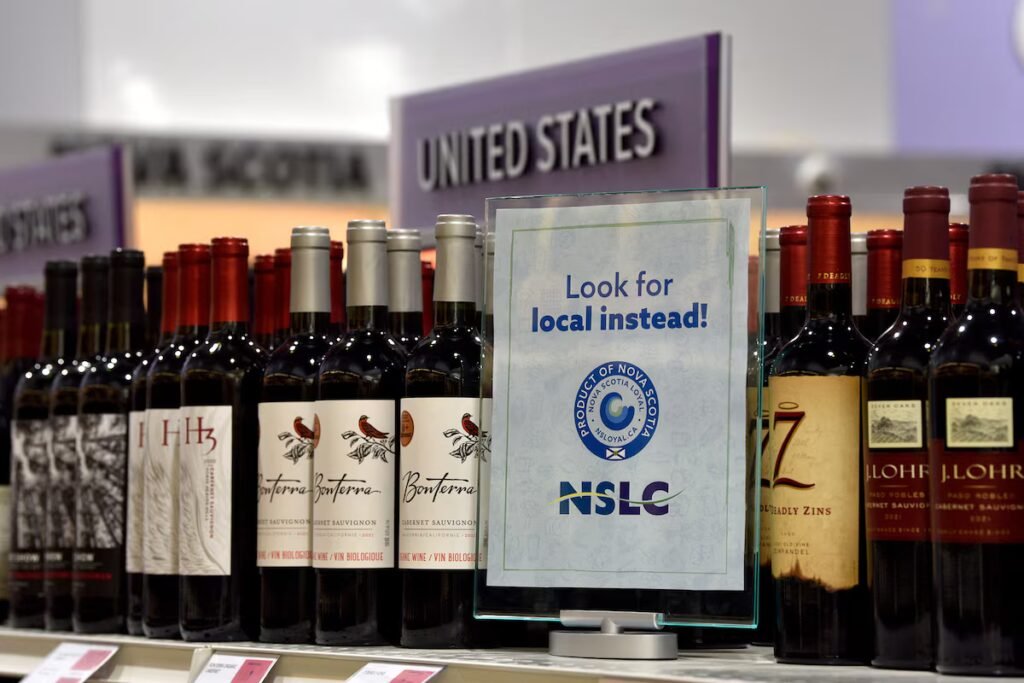

A sign encourages shoppers at a Halifax liquor store to avoid the American wine aisle in February, 2025.Ingrid Bulmer/Reuters
California cabernets, Tennessee whiskey and Kentucky bourbon may soon be back on store shelves across Canada. But that doesn’t mean consumers will rush to take a sip.
Prime Minister Mark Carney asked provincial leaders on Wednesday to end a partial ban on the retail sale of American alcoholic beverages as Canada continued negotiating with the United States over a broader trade deal that would potentially lower tariffs on Canadian exporters.
All provinces except for two have retained the bans imposed on American booze in March, 2025, in response to U.S. President Donald Trump pummelling Canadian industry with multiple rounds of tariffs. The Trump administration has since cited the liquor bans as a major trade irritant.
But more than a year since the bans took hold, consumers who have been forced to expand their horizons have often liked what they’ve found, both in terms of taste and value. And lessons from Alberta and Saskatchewan, the two provinces that ended their bans, suggest that bringing back the booze doesn’t mean consumers will buy it.
If the liquor is back on shelves, “we can let it rot there,” said 63-year-old Victoria resident Rob Lunney, who loves bourbon – but only up to a point.
Marsha Lederman: Canada, it may come back to the shelves, but do not buy the U.S. booze
Harris Davidson, managing director at Rogers & Company, a wine import and distribution business in Toronto, said it’s “basically impossible” to source high-level cabernets to replace wines from California’s Napa Valley.
But, he said, “consumers aren’t necessarily replacing anywhere near one to one – it’s forced consumers to experiment.”
And for many, a return to old habits doesn’t seem likely, at least in the short run.
Alberta, for example, lifted its ban of U.S. alcohol more than 12 months ago. But sales of those products are still weaker than before the ban was put in place there.
Mr. Davidson cited internal figures from the Association of Canadian Distillers that show revenue from U.S. wine sales in Alberta is down by roughly 40 per cent. He added, “We expect a similar situation in Ontario.”
According to an analysis by Jennifer Robson, an associate professor of political management at Carleton University, U.S. alcohol sales in Alberta have been down a monthly average of about 17 per cent since the restrictions on U.S. alcohol were scrapped and federal countertariffs removed at the end of that summer.
Data from Statistics Canada show that imports of U.S. alcoholic beverages in both Alberta and Saskatchewan are still 13 per cent below 2024 levels.
“There’s still lots of anger at the Americans,” said Robbie Raskin, who operates Veritas, an east-end Toronto wine bar.
When Ontario’s U.S. booze ban first started early last year, cocktails and spirits were easy to adapt, he said. “Crown Royal was a really easy substitute – we’re happy not to go back to bourbon ever.”
But a small group of customers openly mourned the rich pinot noirs of California’s Sonoma County and buttery chardonnays from Napa Valley, Mr. Raskin said.
He hardly hears any complaints now. “People were forced to break the habit,” he said. “They have been really willing to switch to something Canadian or French with similar taste profiles.”
After easily finding swaps for his go-to wines from Napa Valley, 64-year-old Rick Porayko from Winnipeg doesn’t see himself going back to U.S. booze any time soon: “Lately, I’ve been on a big kick with malbec, which is Argentinian.”
In a July Nanos research poll of 1,104 Canadians, about 74 per cent said they were not likely to buy American alcohol if it returned to store shelves, up from 70 per cent when the same question was asked a year prior. The biggest portion of those unlikely to budge, about 80 per cent, were in British Columbia, and the smallest group, just under 70 per cent, was in the Prairies.
Over all, Canadian imports of U.S. alcoholic beverages fell by more than 80 per cent to US$137-million in the 12 months spanning March, 2025, to February, 2026, compared with the same period the year before, according to the White House.
But turning away from U.S. booze doesn’t always mean turning toward Canadian alternatives. Lingering interprovincial trade barriers remain a hurdle for businesses.
Giles Gherson: Canada’s economy is splintered by a tyranny of small provincial differences
Cabernet sauvignon and chardonnays from British Columbia’s Okanagan region, for example, are some of the best substitutes for popular U.S. wines, Mr. Raskin said. “But we’re lucky if we get more than 300 bottles of British Columbia wine at any point because of the whole logistical nightmare of importing wine from B.C.”
“We’re forced to go through the LCBO and their approved importers – we can’t just ship from B.C. directly.”
And for Canadian importers of U.S. wine, a lot of damage won’t be undone even when sales resume.
Mr. Davidson still hasn’t been able to access around $1-million worth of California and Oregon wines gathering dust in an LCBO storage facility since last year. He’s laid off five people as a result of the industry turmoil.
“When the ban is lifted, we’ll be given access to that stock,” Mr. Davidson said. But, he added, there will be bottles that won’t be possible to sell, since “some of the wine is less appropriate for aging.”
Still, Mr. Davidson said he’s confident that consumers will eventually be drawn back to their go-to U.S. wines. The question, he said, is, “how quickly.”


More Stories
Canadian employment stumbles again with loss of 68,000 jobs in September
France emerges as Europe’s new bond-market basket case, and Marine Le Pen could make it worse
Americans 75 and older are now the nation’s wealthiest, Fed survey finds