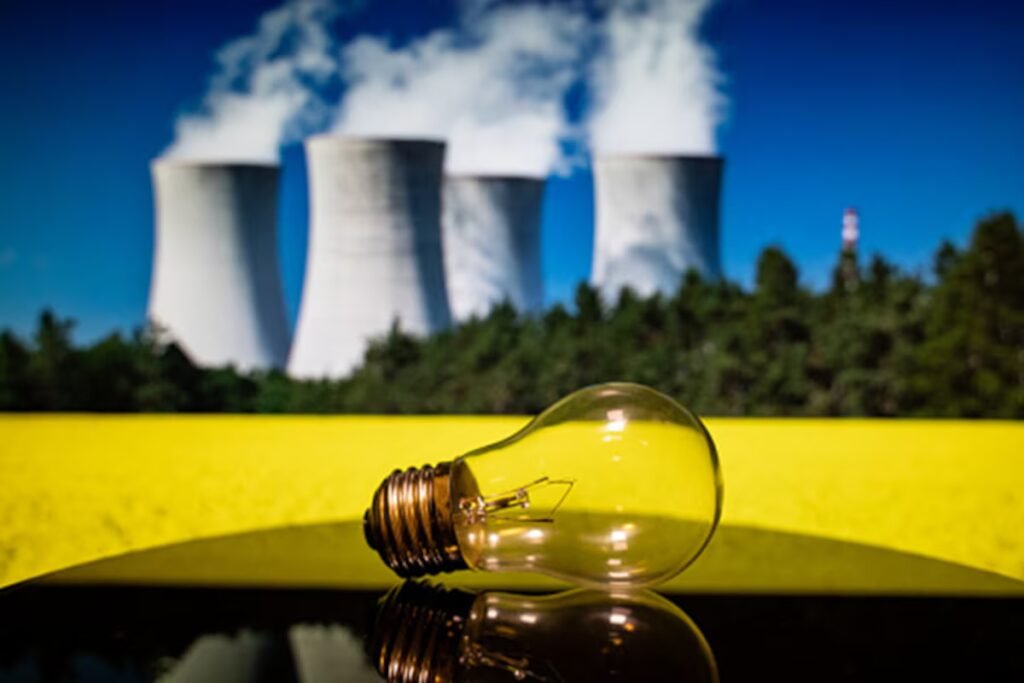

As the demand for reliable, low-carbon power grows, existing nuclear remains a key part of the energy mix.GETTY IMAGES
When Nuclear Promise X (NPX) started in Kincardine, Ont. in 2018, many utilities were facing challenges around cost and execution. The company’s founders believed the industry’s future would depend less on building new nuclear reactors than on finding better ways to design, manage and operate the ones already in service.
“We wanted to make nuclear better, cheaper, faster and more predictable,” says Bharath Nangia, a nuclear engineer and NPX’s chief executive officer and co-founder.
NPX called itself a “nuclear innovation firm”. Their initial assignment, with Bruce Power, was to help identify ways to make its second reactor refurbishment faster and less expensive than the first. As utilities solved one challenge, others emerged, which NPX saw as opportunities.
“The problem statements started to grow,” Mr. Nangia says. “That gave birth to our machine learning team, software engineering team, design engineering team and project management team.”
In March, Bruce Power once again turned to the team at NPX to help manage the early planning stages of Bruce C, a proposed expansion that could add up to 4,800 megawatts of new nuclear generating capacity. The work includes feasibility studies, planning and community engagement as Bruce Power decides whether to move the project forward.
The NPX business model has evolved alongside the changes taking place in Canada’s nuclear sector. A decade ago, the discussions were largely dominated by refurbishment. Today, the conversation has broadened as demand for reliable, low-carbon power continues to explode.
According to one early 2025 estimate from MIT, the energy consumption of the world’s data centres could approach 1,050 TWh by the end of 2026, which would make them the fifth largest energy consumer in the world, between Japan and Russia.
Naveen Joshy, a principal innovation catalyst at NPX, with Spot in a Saskatchewan uranium mine. NPX has deployed Spot, a robot from Boston Dynamics, in nuclear power plants and mines to perform remote inspections and collect data.Supplied
“Canada’s nuclear sector is no longer simply about electricity,” says George Christidis, director of government relations and communications at the Canadian Nuclear Association. “Electricity is now being recognized as a foundational economic innovation, job-creating, climate-achieving and national security asset.”
For NPX, its bet on the digitization of the industry has allowed it to remain competitive and in demand. The company supports digital-first planning for new builds, creates custom digital tools and automation to help modernize operations, and is now employing artificial intelligence in the industry with enterprise strategies and secure AI agents.
“The conversation at every nuclear conference right now is scaling the workforce to meet the demand,” says Margaret McBeath, NPX’s chief people and experience officer and co-founder.
To help build that workforce, NPX invests heavily in students and new graduates, while encouraging employees with different backgrounds to work together through quarterly “hackathons”. During the sessions, teams spend several days exploring customer problems, experimenting with new technologies and developing proof-of-concept solutions. The resulting ideas range from AI applications to robotics.
“We’ve kept some of that flexibility, that agility, that entrepreneurial mindset from the early days,” says Ms. McBeath.
Not everyone agrees on the role nuclear power will play in Canada’s energy future. Refurbishing existing reactors is a logical investment, says Allison Macfarlane, professor and director of the School of Public Policy and Global Affairs at the University of British Columbia. But she’s more skeptical about large-scale new nuclear projects.
As advances in renewable energy and battery storage have changed the economics of electricity generation, new nuclear projects are a less economic option, suggests Ms. Macfarlane, a former chair of the U.S. Nuclear Regulatory Commission.
While governments and utilities continue to weigh different approaches to meeting future energy demands, NPX is positioning itself to support the projects that move forward. “We’re just getting started,” says Mr. Nangia.


More Stories
U.S. business inflation heating up, could lead to even higher prices for American shoppers
Canadian market share of U.S.-made vehicles tumbles 20 per cent in first half
Tires, hearing aids and rental cars: Five ways to turbocharge your Costco membership