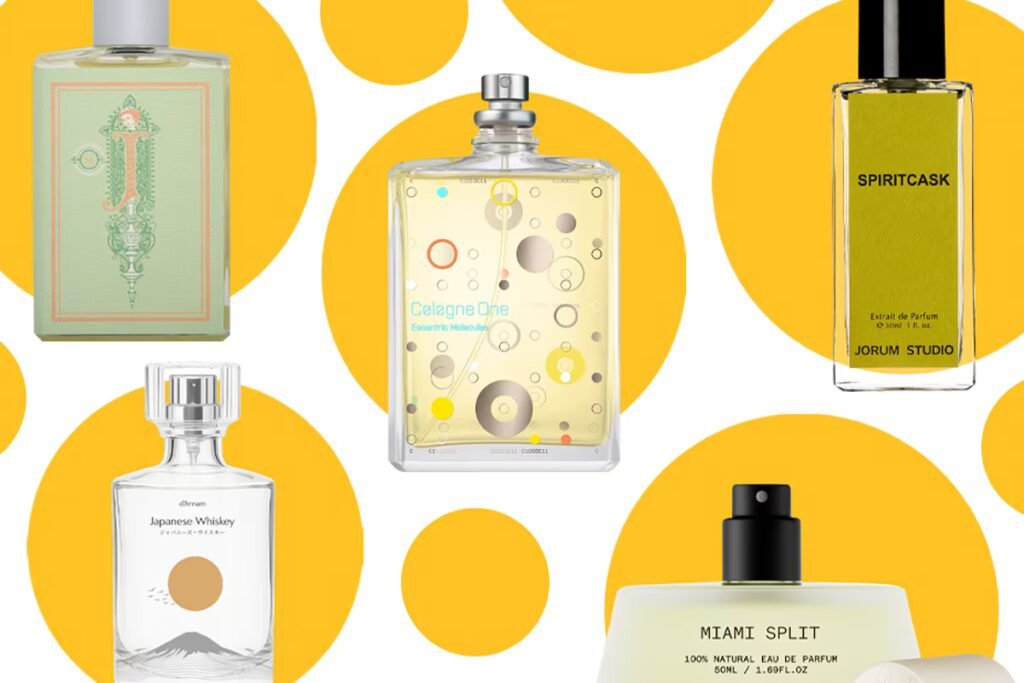

Minimalist fragrance brand Escentric Molecules recently released its first cologne, Cologne One.
For the London house’s zesty spritz, perfumer Geza Schoen takes inspiration from summer’s favourite invigorating drink: Gin and tonic. The initial bitter lemon, lime and bergamot notes are followed by a burst of juniper berries, the predominant flavour in gin, and the effect is just as refreshing.
The worlds of perfumery and libation increasingly intersect in niche fragrance. Cologne One isn’t Schoen’s first go at spirits-as-perfume. In 2003, he composed Infusion by Bombay Sapphire – the liquor brand’s brief promotional foray into fine fragrance – designed to highlight the gin’s 10 signature botanicals. Recently, to mark its classic 1965 cologne’s 60th anniversary, Guerlain collaborated with Hennessy on a special edition called Habit Rouge Spirit. The scent was aged in oak barrels, much like fine cognac.
Similarly, Spiritcask by Scottish brand Jorum Studio looks to the blonde wood finish of oakwood (and chamomile and pear) for its bestselling fragrance. Malin and Goetz’s Dark Rum is a descendant of the bay rum aftershaves of the West Indies. And luxury brand Kilian’s Liquors collection boasts boozy scents like Angels’ Share, which founder Kilian Hennessy comes by honestly (the clue is in his surname).
Vanilla soft serve and candy corn: the best new summer-inspired fragrances
Comfort and familiarity are behind the emerging olfactory trend, according to fragrance evaluator Clayton Ilolahia. At Milan’s Esxence trade fair in June, he said that while premium scent marketing has often relied on evoking memories and/or travel storytelling, he’s seeing a shift toward creating an emotional connection to everyday sensations: “Tactile, sensorial and immediate flavours and tastes – things that you do in your everyday life.”
It helps that spirits and fine fragrance are both about creating a sensory experience. They also share techniques such as maceration (the process of soaking solid organic material in liquid to extract flavour compounds) and distillation, used in perfumery to extract essential oils from raw materials.
The overlap between the disciplines is so rich that French spirits group Rémy Cointreau created a new luxury fragrance brand, Maison Psyché, that underscores its olfactory nuances. Master perfumer Sophie Labbé and Rémy Martin cellar master Baptiste Loiseau collaborate on devising, cellaring and cask-aging raw materials that make up the scents, which are then decanted into Baccarat crystal flacons costing thousands of euros. (Troubled Spirits from Edmonton’s Paraphrase and D.S. & Durga’s Cognac Reign both deliver similarly boozy scents without the VSOP prices).
Vietnamese brand d’Annam’s Japanese Whiskey cologne highlights the subtle woody facets of Mizunara oak notes in much the same way award-winning Japanese and Taiwanese whiskies do. Housed in an oversized bottle evocative of a decanter, it’s become a cult favourite of connoisseurs.
Amsterdam’s BLNDRGRPHY leans into cocktail culture more literally with riffs such as Amber Negroni and Jasmin Martini, as do Abel’s Miami Split and Imaginary Authors’ bourbon-and-mint quencher Saint Julep.
From artistic pursuit to functional fragrance, there’s more to perfume than meets the nose
The principles and science of mixology and perfumery could be making even more connections, according to an expert in both, Kevin Peterson, author of Cocktail Theory: A Sensory Approach to Transcendent Drinks. The Detroit nose and bartender has a line of fragrances, Sfumato, and just launched a fragrant spirits range. Castalia Spirits are botanical liqueurs crafted for aroma as much as flavour.
“I think the cocktail world is at this sort of crossroads where everyone’s trying to push into new territory, the next newest thing, but without the massive expense of prep time,” he said. He found his answer by looking to the fragrance world, macerating ingredients that are atypical in spirits, such as vetiver and rose.
“It’s interesting to me how little the two worlds talk to each other, for treading a lot of the same ground,” said Peterson. “On the Venn diagram there’s a huge overlap, but then when you look at some of the botanicals, they don’t overlap. Why isn’t there vetiver in cocktails? Where is a rose liqueur? Where is tuberose or jasmine, a lot of these lovely flowers utilized heavily in perfumery?”
For those craving the refreshment of a real gin and tonic, pair a spritz of your favourite scent with a few ounces of Comte de Grasse. This gin, made by spirit company 44ºN, housed in the former Roure-Bertrand perfumery in Grasse, France, not only nods to perfumery craft with its bottle design, but is inspired by sustainable fragrance production methods. It’s the ultimate cinq à sept.


More Stories
Stopover in Sydney: Three creative leaders share how to enjoy the city like a local
Your daily horoscope: October 15, 2026
Dessert Club is an ode to artist Diane Borsato’s favourite global sweets