
Business owners on both sides of the Canada-U.S. border are tired.
For those whose goods have been affected by the tariffs fired back and forth between the two countries over roughly the last year and a half, this latest and possibly most punitive round of levies announced by U.S. President Donald Trump only adds to the uncertainty – and fatigue.
It’s a long list and a steep number. Cosmetics, toiletries, packaging, electrical components, chemicals, clothing and flowers are among the bevy of Canadian products now subject to a 50-per-cent U.S. tariff as of Aug. 22.
“Those facing these higher tariffs are going to be affected a lot. They’re punishingly high, and some of the companies have very few options as to where they can sell their products. It’s not like they can easily substitute into the Canadian market or overseas. That takes time,” said Mark Parsons, vice-president and chief economist at ATB Financial.
Trade talks between Canada and the U.S. broke down last week after Mr. Trump delayed the implementation of his 50-per-cent tariffs on $28-billion worth of Canadian goods by three days from the initial deadline of Aug. 19. Lead negotiators on either side reported reaching a tentative deal on Aug. 18, stalling the tariffs while the finer details of the agreement were worked out.
Canada won’t return to negotiating table until U.S. changes its attitude, Carney says
But Prime Minister Mark Carney pulled out of the deal at the eleventh hour, saying later that “it was a bad deal.” He’s left it in Washington’s court to resume talks.
“An attitude at the negotiation table that Canada is a subsidiary of the United States … that’s not something we’re going to accept,” Mr. Carney said on Monday at a press conference in Quebec.
On Sept. 8, Canada’s retaliatory tariffs on $27.6-billion worth of products imported from the U.S. will come into effect. These will compound with the Trump administration’s recent 50-per-cent tariffs and pre-existing U.S. tariffs on a swath of Canadian steel and aluminum products, among other things.
The impact of these levies can be modelled endlessly, parsing out which industries and provinces, territories or states are going to be hit the hardest and what those blows will look like in broad economic terms. But what’s difficult to relay in these charts and statistics, Mr. Parsons said, “is the uncertainty of what’s next, and to what extent businesses are waiting this out before making hiring and investment decisions.”
After all, behind all of those charts are the people who make those industries work. The Globe and Mail spoke to five business leaders in Canada and the U.S. to hear how they’re feeling, how business has changed and ultimately, how they plan to carry on.
Orchid Greens, St. Catharines and Niagara-on-the-Lake, Ont.
Orchids at Bevo Farms in Leduc, Alta.AMBER BRACKEN/The Canadian Press
Number of employees: 60 to 70
Year founded: 2009
Percentage of business done with the U.S.: 40 per cent
Orchid Greens grows plants at its greenhouses in St. Catharines and Niagara-on-the-lake, totalling 350,000 square feet of space during its peak season. Many of its orchids go to Canadian buyers, including grocery chains such as Loblaw Cos. Ltd. and Metro Inc., but nearly half are destined for the U.S.
Mr. Trump’s new 50-per-cent tariffs impact roughly $210-million worth of Canadian flower exports to the U.S., according to Flowers Canada Growers, the Canadian floral industry’s national trade association.
The new tariffs have forced Guann Chen, the owner of Orchid Greens, to sell some of his plants practically at a loss. Mr. Chen doesn’t feel that he has a choice. Orchids are perishable goods and his company needs the revenue to pay his employees.
Orchid starts at Bevo Farms in Leduc, Alta.AMBER BRACKEN/The Canadian Press
The company has hiked prices for its American clients, but it’s absorbing about half of the cost of the new tariffs itself. A few customers have already cancelled their orders.
“For us to be able to survive this, with a 50-per-cent tariff, is unlikely if it’s long term.
“These are plants. These are not dry goods. They’re perishable goods. The plants will never stop growing, so we have to keep the cycle going. Which is why, even if selling at a loss is not in anyone’s favour, we have to do it. Otherwise, it just all goes to the garbage.
“I don’t know why orchids would be part of [the trade war]. Flowers in general. It’s such a small industry that is just bringing pleasure to people, bringing happiness to people’s homes.”
Ottawa suggests trade détente, but Trump escalates tensions with order to rename Lake Ontario
Lee’s Electronic Components Ltd., Vancouver, B.C.
Electronic components at The Royal Mint in Llantrisant, Wales.DARREN STAPLES/AFP/Getty Images
Number of employees: 15
Year founded: 1993
Percentage of business done with the U.S.: 10 to 15 per cent (before trade war)
Lee’s distributes electronic components to manufacturers, schools, governments and other businesses across Canada. They used to have clients across Canada and the U.S., but business in the U.S. has declined rapidly during the trade war, owner Raymond Wong said.
He used to ship small electronic components to customers in the U.S. freely. Now, some of the products Mr. Wong sells are subject to the 50-per-cent U.S. tariff that took effect in mid-August. The recent tariffs have reinforced something Mr. Wong has been seeing for a while now – that business with the U.S. is rarely worth it these days.
Ottawa lays out strategy to hit back at $27.6-billion in U.S. products
“We haven’t figured out new ways to reopen that market. And then a lot of customers complain, ‘Hey, I’m buying a $5 product or $10 product, and I’m paying $15 in brokerage and $20 in shipping.’ So, then they’re going to try to find it somewhere else or find the same product in the U.S.
“We’re looking into opening up more partners in overseas rather than the U.S.
“To my benefit, there are more customers that are local saying, ‘Hey, I’d rather buy from you than order from the U.S.’ So that’s a good thing.”
Andrew Coyne: How Canada can best respond to threats from the United States
Jasper Hill Farm, Greensboro, Vt.
Spruce bark-wrapped cheeses from Jasper Hill Farm.Courtesy of manufacturer
Number of employees: 75
Year founded: 2003
Percentage of business done with Canada: 0 per cent (Before the trade war, they were making inroads toward $250,000 worth of business here)
Jasper Hill Farm is known for its spruce bark-wrapped cheeses, particularly one made during the winter months when cows’ milk is richest in butterfat. This spoonable, award-winning cheese is marketing director Zoe Brickley’s favourite, and she would love to be able to sell it in the farm’s closest major metropolitan area – Montreal.
Unfortunately, owing to rising costs across the board, including an incoming 25-per-cent tariff on U.S. cheese imports to Canada, and the growing anti-American sentiment from Canadian consumers, the market north of the border has become inaccessible.
Alberta, Saskatchewan push back on calls for oil, potash export levies in retaliation for U.S. tariffs
“I think there’s some narrative out there that would say if we’re taxing imports, then American cheeses would be more competitive in our market. And the reality is that all of our suppliers have their businesses disrupted, costs are going up, they’re raising prices across the board to help absorb different tariffs.
“All of our equipment is European, and all of our cardboard, the raw materials, come from Canadian forestry. So, we’re seeing all of our inputs going up.
“We don’t have any hope in being able to build sales until there’s a whole new set of policies in place. Basically, we’re not going to invest any time or money in the Canadian market for the foreseeable future.”
U.S. businesses fear prolonged trade war with Canada could permanently strain cross-border ties
Cavalier Tool and Manufacturing Ltd., Windsor, Ont.
Workers on the assembly hall at Cavalier Tool and Manufacturing Ltd.Dax Melmer/The Globe and Mail
Number of employees: ~200
Year founded: 1975
Percentage of business done with the U.S.: 85 to 90 per cent
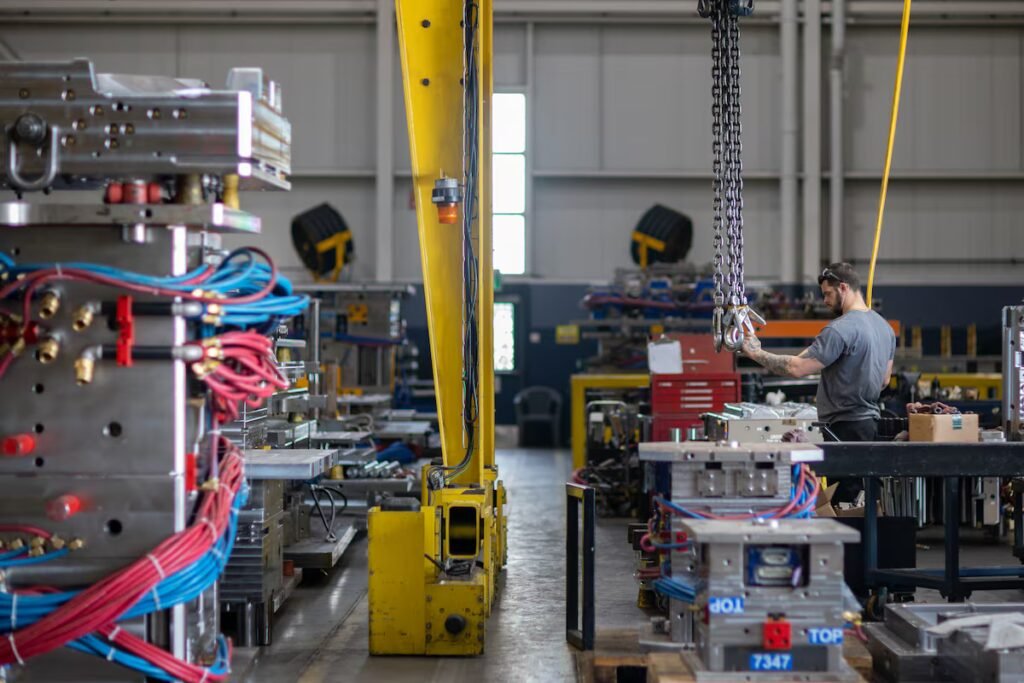
Cavalier is a plastic injection mould company, with three plants across Windsor, serving a variety of markets including automotive, agriculture and commercial goods.
Chris Vander Park, international business manager at Cavalier Tool and Manufacturing Ltd.Dax Melmer/The Globe and Mail
It’s a business that’s heavily intertwined with the U.S., said Chris Vander Park, international business development manager at Cavalier. The trade war has been battering the company since it first kicked off in early 2025. And while Cavalier has been more impacted by targeted steel tariffs than Mr. Trump’s most recent list, the uncertainty surrounding the levies has made it difficult for Mr. Vander Park to communicate with his customers about the impact tariffs may have on the final price of their orders and how this may have changed since they placed them.
“When you don’t know the rules and you don’t know what you’re up against, and I can’t give my customer a specific answer as to what his final price looks like, because when we ship it, it’s going to be on him. We can’t pay the tariffs. We do over $100-million in business. That’s $15-million off our bottom line. I can’t give away $15-million. We don’t have it.
“Some of [our customers] are right now saying, ‘Listen, we’re not placing work in Canada because we don’t know what the final price is going to be.’ That’s a conversation our sales guys go through every day.
“We try to reinvent ourselves every day. We’re still looking at new equipment. We have to. We’re looking at new software. We have to. We’re looking at new automations. We have to. We’re not planning on going out of business. Absolutely not.”
Tony Keller: Americans don’t understand Trump’s trade war against Canada. Here’s how to explain it to them
Montloup Textiles, Montreal, Que.
Montloup Textiles in Montreal, Que.Morgane Clément-Gagnon/Courtesy of manufacturer
Number of employees: 1
Year founded: 2018
Percentage of business done with the U.S.: 0 per cent (down from 15 per cent before January, 2025)
Quebec’s textile industry boomed in the late 19th century, helping to transform rural settlements into bustling mills. But the historic sector has faced challenges in recent decades, especially as fabric production has increasingly moved overseas.
This is the environment in which Lila Rousselet founded Mountloup, a textile provider specializing in eco-friendly, Canadian-made knit fabrics, in 2018, to help provide a domestic alternative for local fashion lines. She stopped selling directly to U.S. clients last year because of the trade war. But she estimates 15 per cent of the clothing that her customers make elsewhere is still sold to the U.S. – garments that will be hit by the latest round of tariffs.
While she’s expecting a drop in orders because of the downstream effects, she’s hopeful about finding new Canadian customers.
Adriana Castillo/Courtesy of manufacturer
“My clients are going to lose sales, and if they lose sales, they will produce less and buy less. I don’t think these businesses are going to be able to accommodate the tariffs. There’s not really anything I can do. I can keep my prices at the same point, but I also don’t make wide margins – I can’t help them.
“I’m going to try to reach out to Canadian companies to make up for this. My way of doing business is through pre-sales, with a minimum of one roll – 50 metres of fabric. I hope I’m going to get more business, but in the meantime, it’s hard for everyone.
“It’s already hard to produce in Quebec or Ontario, there aren’t many players here. Since I started in the industry, three major players have shut down. Most of the time, it’s because it’s hard to compete with low prices from overseas, or older people with nobody to inherit the business. I’m afraid this is another hurdle on top of that. It’s a historic industry and this is putting that at risk.”


More Stories
Toronto robotics startup hopes to expand options for surgical procedures
Canadian investors concerned about future of Thames Water as Britain mulls nationalization
Hitters are winning more ABS challenges in the postseason, and teams are challenging more overall