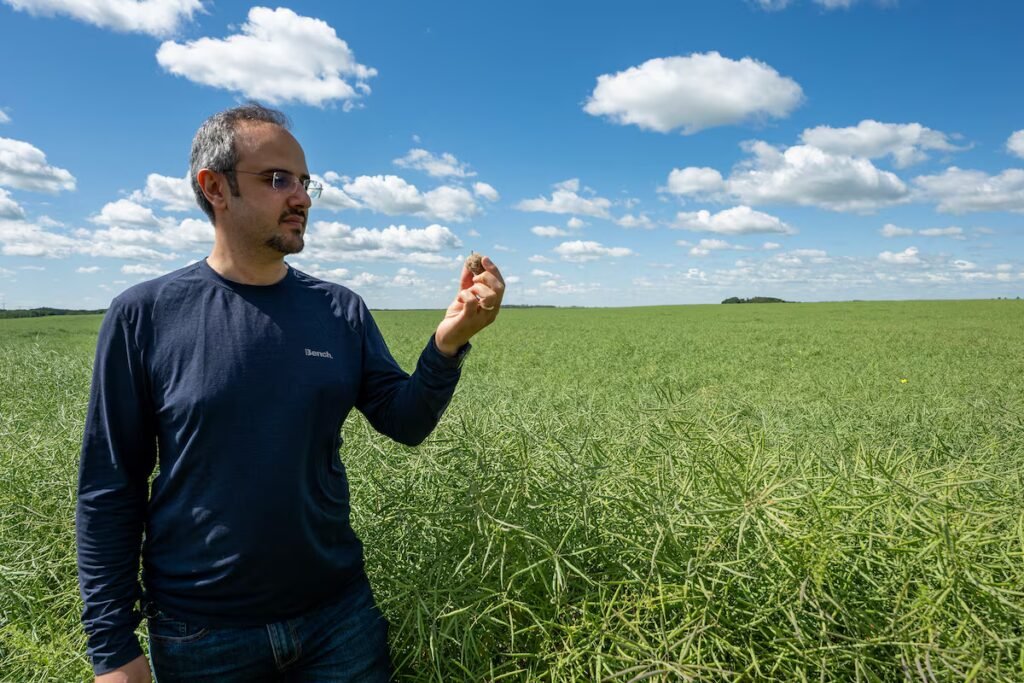

Amin Babaeighazvini, chief science officer at CellCore, holds oilseed flax straw. The nitrocellulose derived from it is used in weapons production.Liam Richards/The Globe and Mail
David Brough wants to use Canadian flax to make nitrocellulose – the chemical compound that makes things go boom.
Traditionally, the energetic material is made using cellulose from cotton, hence its alternate name “guncotton.”
But as Mr. Brough plans construction of the necessary facilities, the chief executive officer of CellCore Technologies Inc. is going the extra mile to make sure not only his company but also his supply chain is Canadian, in response to Ottawa’s call to build at home.
That’s why he’s investing in research and development to turn a byproduct of the domestic flax industry into Canadian intellectual property in the form of nitrocellulose.
After all, few countries have the abundance of raw resources – and the geographic advantage – needed to make nitrocellulose or other energetic materials such as explosives, propellants and pyrotechnics that Canada does. From wood pulp and flax byproducts to a well-established petrochemical industry and production lines distant from conflict zones, the country appears to be prime real estate for this type of production.
“There is no need to go outside of Canada,” Mr. Brough said.
David Brough, CEO of CellCore, says he is confident that the company will start nitrocellulose production by 2028.Aaron Hemens/The Globe and Mail
Currently, Canada doesn’t produce any nitrocellulose, and much of the global supply chain for it relies upon cotton sourced from a handful of the world’s major producers: China, India, the United States and Brazil.
But as the wars in Ukraine and Iran put pressure on munitions supplies worldwide, Canada is also one of several North Atlantic Treaty Organization members working on either starting or increasing production as existing factories producing the military-grade chemical compound are increasingly unable to accept new orders.
Estimates put the number of 155-millimetre artillery shells used each day in Ukraine in the thousands, if not tens of thousands. Each of those shells contains a charge bag system that requires roughly 12 kilograms of propellant and, thus, a significant amount of nitrocellulose, according to a U.S. Department of War report. However, decades of industrial consolidation and atrophy have left many countries’ industries in disrepair, and now they are scrambling to build capacity in support of Ukraine, and to become more self-reliant in an increasingly tense geopolitical environment.
“It’s all about security of supply,” Mr. Brough said.
“Everybody takes that for granted. God forbid a larger conflict kicks off. All those chains of supply, most likely, the countries that actually hold on to those will start to draw them back.”
Estimates put the number of 155-millimetre artillery shells used each day in Ukraine in the thousands, if not tens of thousands. Each of those shells contains a charge bag system that requires roughly 12 kilograms of propellant and, thus, a significant amount of nitrocellulose, according to a U.S. Department of War report.Stringer/Reuters
In February, Ottawa singled out nitrocellulose in its Defence Industrial Strategy as one of the materials it wants to produce at home, without relying on other countries’ supplies. Then, in March, it gave General Dynamics Ordnance and Tactical Systems – Canada, a subsidiary of the U.S. defence company, $355.7-million out of its $6.6-billion strategy fund to build a nitrocellulose facility by 2029.
Mr. Brough sat on the sidelines watching as Ottawa placed its initial bet to solve a sovereign supply issue on a U.S. subsidiary whose supply chain is intertwined with facilities south of the border. But he wasn’t deterred.
“There is certainly room for probably three or four of these facilities in order to be able to supply the globe and continue that global supply chain,” he said.
CellCore aims to be one of them.
Its flax-based nitrocellulose approach uses a byproduct called flax straw that Prairie farmers will typically either try to work back into the soil or rake into piles and burn, according to a guide by the Flax Council of Canada. Depending on rainfall and seeding totals, the council says, the Prairies can produce 500,000 to 1,000,000 tonnes of salvageable oilseed flax straw annually.
From wood pulp and flax byproducts, seen here, to a well-established petrochemical industry and production lines distant from conflict zones, Canada appears to be primed to make nitrocellulose.Liam Richards/The Globe and Mail
Amin Babaeighazvini, chief science officer at CellCore, is sourcing that straw from producers to supply the company’s R&D and, eventually, help fulfill its production goal of 6,000 tonnes of nitrocellulose every year. “Manitoba, Saskatchewan and Alberta; these are three provinces that produce lots of flax, and they are all underutilized.”
Mr. Brough said CellCore will also use dissolvable wood pulp from a Canadian producer, together with the flax, to make its nitrocellulose. The company plans to put shovels in the ground for its facility sometime in September, and Mr. Brough is confident in its ability to start production by 2028.
With contracts already in place, he’s also banking on the world seeing Canada as an attractive source for energetics.
“Canada has the opportunity to really solve a significant portion of that supply problem for the allied network, if it chooses to do so,” said Robert Dimitrieff, CEO of Patriot Forge Corp., an open-die forging company that makes components used in artillery.
Part of that Canadian solution could come in Wetaskiwin County, Alta., almost an hour’s drive outside of Edmonton. It’s a wide county that takes about an hour and a half to drive across from end to end, has a population of roughly 12,000 and has long been dependent on the oil and gas industry.
But those resources won’t last forever, said Josh Bishop, the county’s reeve. “If you’re not growing, you are dying,” he said.
Canadian defence-procurement agency expected to reduce $100-million contract minimum
That’s why he supports Sterling Energetics Inc.’s proposal to anchor a defence industrial park within the county, where the company aims to make a variety of energetics including nitrocellulose.
JR Cox, Sterling’s CEO, said being based in Alberta, where the government is used to dealing with the petrochemical industry, has been helpful in the effort to establish a similarly complex chemical manufacturing process.
Now he’s just waiting for Canadian investors to get on board. Mr. Cox said he’s received interest from American investors but has so far resisted their offers. He doesn’t want to become yet another U.S.-owned subsidiary operating in Canada: “We’d lose sovereignty.”
However, Canadian entrepreneurs aren’t the only ones keeping an eye on the country’s moves in the energetics market. Mr. Brough said CellCore is currently in talks with a European company about a potential partnership. Supply Energetics, a U.S.-based nitrocellulose producer co-founded by Canadian defence-tech entrepreneur Eliot Pence, is also considering setting up shop in Canada, if the conditions are right.
But for now, Michael Brown, another co-founder of Supply Energetics, said the company will wait to see whether the federal government’s support for the sector extends beyond the General Dynamics facility.
“There’s not been much guidance given to allow us to even have a point of view on Canada quite yet.”
Editor’s note: In a previous version of this article, the lead photo was incorrectly captioned. Amin Babaeighazvini is standing in a canola field, and holding oilseed flax straw. The caption has been updated.


More Stories
Canada Rocket Co. to invest $30-million in Ontario engine-testing facility
Ottawa designates West Coast pipeline a project of national interest
Cybersecurity vendor Field Effect growing fast with new tool targeting ‘shadow AI’ at companies