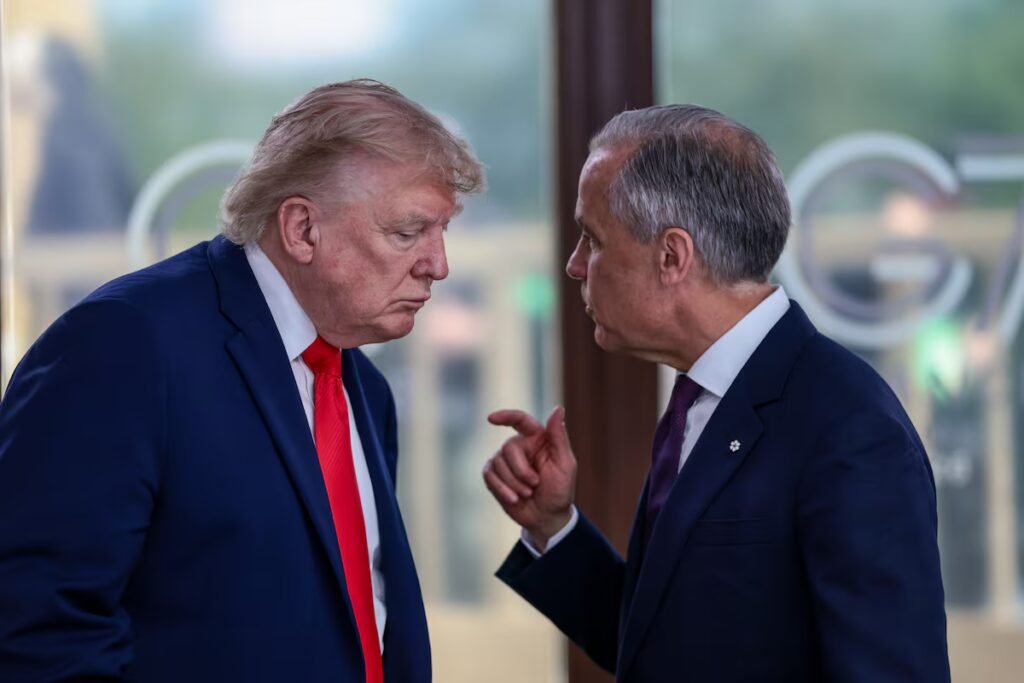

U.S. President Donald Trump speaks with Prime Minister Mark Carney, at a working lunch with leaders of G7 and the Middle East in Evian-les-Bains, France, on June 16.Evelyn Hockstein/The Associated Press
John Rapley is a contributing columnist for The Globe and Mail. He is an author and academic whose books include Why Empires Fall and Twilight of the Money Gods.
When it comes to negotiating deals with U.S. President Donald Trump, the saying in Washington is that reaching an agreement with him doesn’t buy you peace, it only buys you time. Any pact will be subject to his future whims. If in the negotiations he spots what he sees as a weakness, such as agreeableness or a desire to please, he will return later to exploit it.
So, in assessing the deal that Canadian and U.S. negotiators have worked toward, the ultimate question will be, how much time did Mark Carney buy Canada? Will the accord enable the country to continue on the path his government has laid out of developing new industries and finding new markets, or will it lock us back into the dominant embrace of our southern neighbour?
Proposed U.S.-Canada trade deal would introduce steel quota with lower 25% tariff, sources say
During the 1988 federal election campaign, as voters considered whether to proceed with the free-trade agreement Prime Minister Brian Mulroney had negotiated with the U.S., then Liberal opposition leader John Turner challenged his counterpart in a television debate.
“We built a country east and west and north,” he said. “We built it on an infrastructure that deliberately resisted the continental pressure of the United States. For 120 years we’ve done it. With one signature of a pen you’ve reversed that, thrown us into the north-south influence of the United States and will reduce us, I’m sure, to a colony of the United States because when the economic levers go, the political independence is sure to follow.”
Nearly 40 years on, some consider those words to have been prophetic. While on the face of things, free trade with the U.S. delivered three decades of rising prosperity, we’ll never know how Canada might have performed had it chosen a different route.
Auto tariffs of 15% would erase profitability and spur industry’s decline, experts say
What we do know is that our dependence on trade with the United States, already considerable, reached the point that Canada effectively operated as a part of the U.S. economy. It still wasn’t a colony, but Mr. Trump considered it ripe for picking as the 51st state. That’s probably why, fed up with the federal government’s strategy of slow-walking trade talks, he forced it back to the table with the threat of 50-per-cent tariffs.
But Canada may not be as vulnerable as it appears. Consider this: Prior to the advent of the FTA in 1988, Canada already did 68 per cent of its foreign trade with the U.S. Over the next three decades, that rose to 76 per cent. While that might seem to reveal an extreme asymmetry, once Mr. Trump launched his trade war on “Liberation Day” last year and cut imports from Canada, the total share of Canadian trade destined to the U.S. fell back to 68 per cent. Canada replaced its lost U.S. export revenues by shifting to other markets, and the economy weathered the storm.
In other words, challenges bring opportunities, and Canadian businesses seized them. It turned out that Canada had not become a mere economic colony of the U.S. and that it was able to survive a trade war with its southern neighbour.
Meanwhile, Mr. Carney still enjoys a substantial political edge over his American counterpart. Unlike Mr. Trump, who is deeply unpopular, faces brutal legislative elections in November and has no mandate for this sort of trade war on Canada, the Prime Minister is popular, politically strong and enjoys a broad consensus among both the Canadian public and most provincial premiers to stand up to the President.
Tech experts worry that Canada could concede on digital sovereignty in trade talks
Canada can’t just walk away from U.S. trade; economic gravity makes that impossible, for both sides. But it’s in a stronger position than Mr. Trump imagines. If the government is negotiating with its eyes wide open, it will know that this deal won’t buy the country peace. But if the agreement buys it time to continue with its economic strategy of diversification and modernization, that will be a win.
The answer will lie in the fine print. Is talk of reviving the Keystone XL pipeline one of those baubles foreign governments throw at Mr. Trump to distract but which ultimately lack much substance, or will the government be required to reallocate resources to its completion?
Will defence procurement requirements strip Canada of the autonomy to choose its technology? Will the U.S. get right of first refusal for critical minerals or energy that Canada could more profitably ship elsewhere? Will the country be denied the freedom to negotiate new partnerships with China and other emerging powers in, for instance, the electric-vehicle market?
The more negative answers such questions yield, the more freedom Canada will have maintained to chart its own course. If the deal leaves Canada with the ability to manoeuvre its way into new markets and new industries, the government’s strategy can remain on track. Ignore the talk and look at the substance, because that’s all that ultimately matters.


More Stories
U.S. Fed Governor says more rate hikes needed, but leaves door open to October pause
Americans face steep increase in Canadian drug costs if U.S. customs rule takes effect
Gen Z is obsessed with dividends. But at what cost?